“She’s Done Being Quiet”: Joan Baez Ignites a Firestorm With Explosive Statement After $350,000 Payment Leak — “That’s Not Sympathy. That’s Guilt.”
Washington hasn’t felt this kind of thunder in years.
It started as a whisper—then a leak—and by nightfall, it had turned into a political earthquake.
Folk legend Joan Baez, long known for her haunting voice and moral fire, just lit a match under Capitol Hill.
And the nation is still watching it burn.
This week, financial documents surfaced revealing a $350,000 transfer to Erica Kirk, the widow of conservative activist Charlie Kirk, who passed away under mysterious circumstances earlier this year. The payment came from a Delaware-based company that dissolved just days after the transaction cleared.
Then came the moment that turned whispers into headlines.
Baez, 84 and as fierce as ever, took the stage—not with a guitar, but with fury. “When ordinary people lose loved ones, they get grief,” she said. “Not secret payments. That’s not sympathy. That’s guilt.”
The words ricocheted across the country like a cymbal crash. Within hours, hashtags like #FollowTheMoney and #JoanSpeaks trended nationwide.
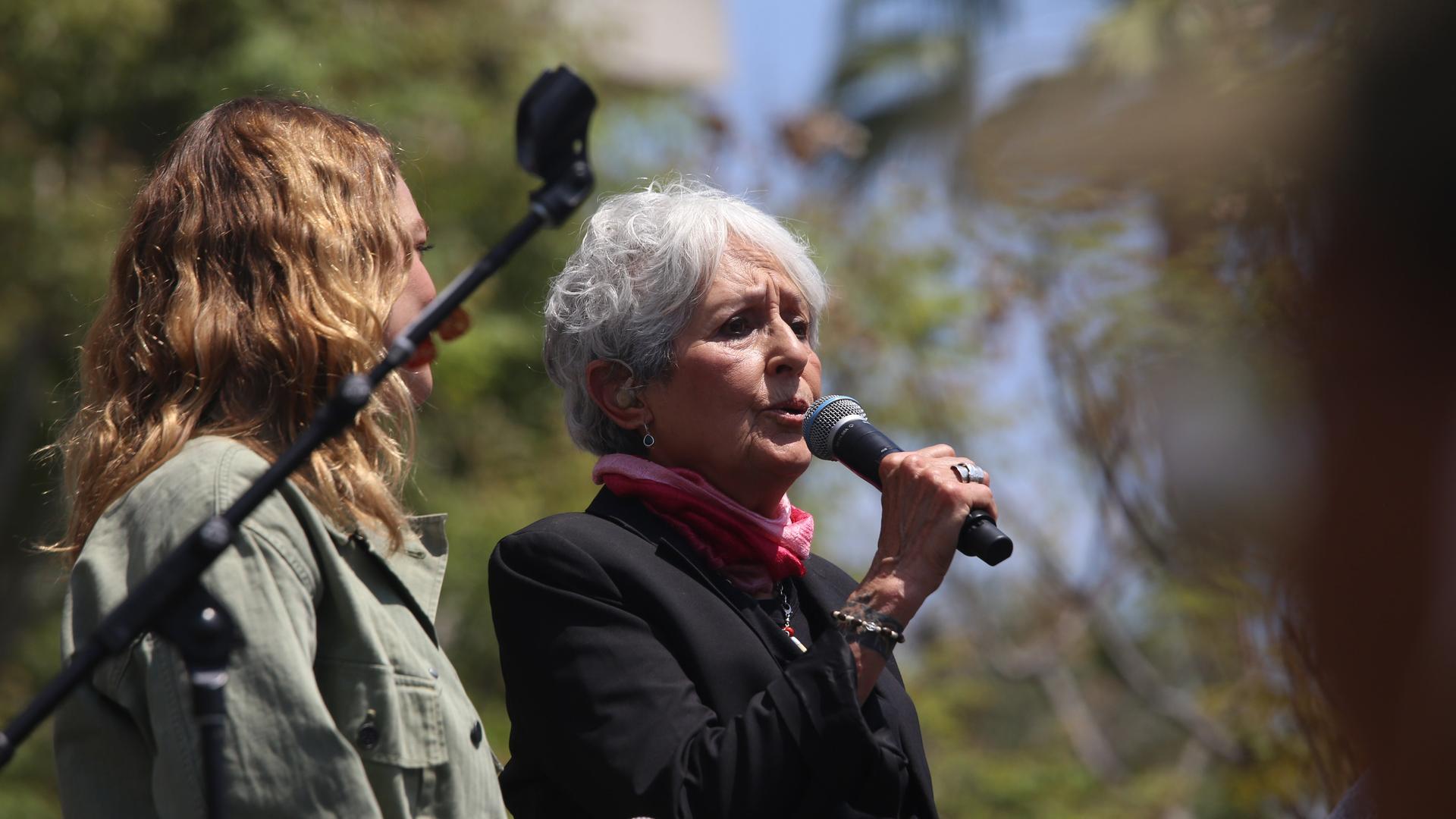
A Legend Steps Into the Fire
For many, Baez’s intervention was a shock. She’s no stranger to controversy—her career has been defined by protest songs and political courage—but few expected her to wade into a modern Washington storm.
Yet, as she stood before the cameras, there was no hesitation in her voice.
“This isn’t about politics,” she said. “This is about truth. If money moves through shadows, someone’s hiding something. And I won’t let that truth stay buried.”
It wasn’t a performance. It was a declaration.
In a follow-up interview, Baez expanded on her call for transparency. “For decades, I’ve watched power use silence as a shield. But paper trails don’t lie. Follow the money—every dollar tells a story.”
She’s not alone in demanding answers. Several members of Congress, reportedly from both sides of the aisle, have begun pushing for a federal review into the Delaware shell company behind the payment.
The Leak That Shook the Room
The documents—shared by an anonymous whistleblower—paint a bizarre picture: a large, unexplained transfer from a company that vanished from state records less than a week later.
No one has publicly confirmed who created the LLC or why it was dissolved so quickly. But financial analysts are calling the pattern “a classic red flag.”
“Payments that size, under that kind of timeline, are rarely innocent,” said economic investigator Marcus Hale. “It could point to money laundering, hush funds, or a cover for political operations. Either way, transparency is non-negotiable.”
Inside Washington, aides are scrambling. The Department of Justice hasn’t confirmed whether an investigation is underway, but insiders describe “a palpable sense of panic” rippling through political circles.

“The Conscience of a Generation” — Back in the Arena
To those who know Baez, her decision to speak out feels less like a comeback and more like destiny.
This is the same woman who marched with Dr. King, stood against the Vietnam War, and sang truth to power when it was dangerous to do so. She has faced fire before—and she’s never blinked.
“Joan Baez doesn’t chase controversy,” said journalist Ellen Hart. “She summons it when silence becomes unbearable.”
That sentiment echoes through her latest crusade.
According to sources close to her, Baez has been quietly working with a small network of investigative reporters to track the origins of the Delaware payment. “Joan’s not chasing conspiracy,” said one insider. “She’s chasing clarity. She believes the American people deserve to know who’s pulling the strings.”
Shockwaves Through the Capitol
The response in Washington was immediate—and divided.
Supporters hailed her as a moral compass in an era of noise and spin. Critics accused her of fanning flames without proof. But no one denied that her words had power.
“When Joan Baez speaks, people stop scrolling,” said political analyst Dana Whitmore. “She’s not just a musician—she’s a conscience. And when conscience collides with corruption, the shockwaves reach the top.”
Within hours, several oversight committee members hinted at possible hearings to determine whether the $350,000 payment violated federal disclosure or ethics laws. “It’s early,” one senator said, “but something about this doesn’t add up.”

“Silence Is the Language of the Guilty”
Even as the political storm rages, Baez has framed her crusade not as a partisan issue—but as a test of moral courage.
“Silence is the language of the guilty,” she said in a viral video viewed more than ten million times in twenty-four hours. “And I’ve heard enough silence to last a lifetime.”
Her words hit a cultural nerve. Americans are exhausted by secrecy—by the sense that the powerful play by a different set of rules. Baez, with her weathered grace and unwavering gaze, speaks directly to that exhaustion.
Her message is simple: if there’s nothing to hide, show the truth.
In an age of algorithmic cynicism, her authenticity is almost radical.
A Country Listening Again
It’s been decades since Joan Baez topped a chart or filled an arena. But this week, her voice has carried further than any song could.
College students are posting her speeches. Veterans of the ‘60s are calling her fearless. Even some who disagree with her politics admit they admire her audacity.
“She’s 84 and still fighting,” wrote one commenter. “That’s the America I want to believe in.”
Indeed, Baez seems to have reignited something deeper than outrage—a hunger for moral clarity.
When asked if she feared backlash, she smiled softly. “I’ve lived long enough to know that truth outlives noise. The question isn’t whether people will attack you for speaking. The question is: can you live with yourself if you don’t?”
The Unanswered Question
As Washington’s rumor mill spins, one question hangs over the capital like fog: Who really sent the money—and why?
Theories swirl. Was it a political donor? A corporate front? A payoff to protect a secret that someone thought might never see daylight?
Baez refuses to speculate—but she refuses to retreat, too. “The truth doesn’t fear light,” she said. “But those who fear the truth will do everything to hide it.”
If that sounds like a lyric, maybe it is. After all, Baez has always blurred the line between poetry and protest.
A Voice That Refuses to Fade
At an age when most legends are content to let the past speak for them, Joan Baez is still writing new verses. This time, the melody is outrage, and the rhythm is justice.
She could have stayed retired, painting in her California home, untouched by the chaos of modern politics. Instead, she’s thrust herself into the storm, armed with nothing but conviction.
Her critics say she’s chasing ghosts. Her supporters say she’s chasing truth.
Either way, she’s moving the nation again.
And maybe that’s the point.
Because in Joan Baez’s world, silence is never golden. It’s a cage.
Epilogue: The Sound of Truth
The Washington night is quiet now. But across America, a different kind of noise is building—a restless buzz of questions, outrage, and awakening.
Baez’s words still echo: “Follow the money. Every dollar tells a story.”
Somewhere, someone knows the ending to that story.
Until then, Joan Baez will keep singing her own version of truth—one that doesn’t need a melody to be heard.
And for the first time in a long time, America seems ready to listen.