Red and blue lights flashed in the desert darkness. Two men in fake badges stepped out, confident they’d found easy prey. But when the convoy of leatherclad riders slowly dismounted, something shifted in the air. Sometimes the hunters become the hunted and justice wears unexpected faces.
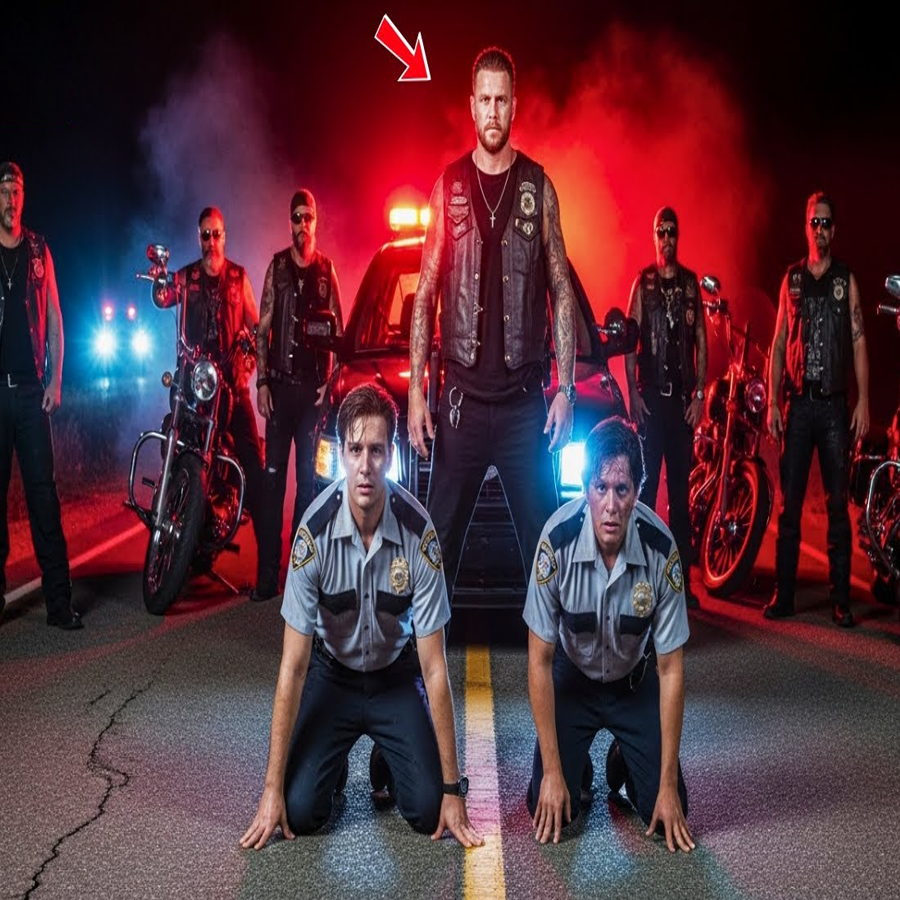
The Nevada Highway stretched endlessly under a canopy of stars, broken only by the rumble of 23 motorcycles cutting through the silence. Albert Steel Rodriguez gripped his handlebars, leading the Hell’s Angels convoy home from their annual charity ride.
Behind him, brothers who’d become family over decades of shared roads and shared pain. The windshield of his Harley reflected the faint glow of distant city lights. Tonight felt different, peaceful in a way that reminded him of his daughter Sophia’s laugh. She’d be 8 next month, and for the first time in years, he’d be there for her birthday.
The custody battle was finally over. In his rearview mirror, Albert caught sight of Tommy Wrench Sullivan, his vice president, riding with his usual steady presence. Tommy had lost his son to addiction last year, and these charity rides had become his way of honoring the boy’s memory. Each mile they rode raised money for recovery programs.
The brotherhood wasn’t what outsiders imagined. They were mechanics, veterans, fathers, sons who’d found purpose in protecting each other and their community. Behind them, James Kowolski adjusted his fake police badge one more time, hands trembling with nervous energy. His partner, Derek Nash, gripped the steering wheel of their modified Crown Victoria, complete with illegal red and blue strobing lights they’d bought online. “20 bikes, man.
That’s got to be at least 50 grand in cash between all of them,” James whispered, his voice carrying the desperation of a man drowning in debt. His daughter needed surgery. Her leukemia treatments had drained their savings and pushed them into bankruptcy. Derek’s jaw tightened. 6 months ago, he’d been a respected construction foreman.
Then the company folded, taking his pension with it. His wife didn’t know about the foreclosure notice hidden in his truck’s glove compartment. She didn’t know they had 30 days to pack their lives into boxes. Just keep it simple, Derek muttered, checking his prop badge. Traffic violation, searching for drugs, take their cash, and disappear. They won’t report fake cops.
Guys like that don’t trust real police anyway. Neither man considered what they were about to face. Albert raised his hand, signaling the convoy to slow as red and blue lights appeared in his mirrors. The desert highway offered no escape routes, just endless sand and sage brush stretching toward distant mountains.
His radio crackled with Tommy’s voice. “You seeing this, Steel? Copy that. Something’s off,” Albert replied. His instincts sharpened by 20 years of military service and another decade navigating the complexities of motorcycle club politics. Real cops didn’t run traffic stops alone on deserted highways at midnight. Real cops had backup procedure accountability.
The convoy pulled over in perfect formation. Engines falling silent one by one. In the sudden quiet, the desert wind carried the sound of footsteps on gravel. Confident strides that didn’t match the nervous energy Albert sensed in the approaching figures. His phone buzzed with a text from Sophia. Daddy, I can’t sleep.
Will you be home tomorrow? His heart clenched. He’d promised her things would be different now, that the dangerous parts of his life were behind them. Tommy dismounted and walked toward Albert, his weathered face calm but alert. “Brothers, stay together,” he said quietly. James approached the lead bike, his fake badge catching the overhead street light.
The leatherclad rider was older than expected, maybe 50, with graying temples and careful eyes that seemed to see everything. Not the young hotthehead James had hoped to intimidate. “License and registration,” James demanded, his voice artificially stern. Behind him, Derek was positioning himself near the other bikers, hand resting on his prop weapon, a paintball gun modified to look authentic in dim light.
Albert slowly reached for his wallet. Movements deliberate and unthreatening. Mind if I ask what this is about, officer? His tone carried the respectful courtesy of someone who dealt with legitimate law enforcement countless times. Routine traffic stop. Reports of suspicious activity in the area. James’ script sounded rehearsed, hollow.
He practiced it in his bathroom mirror for weeks, but facing actual people made the words feel like sand in his mouth. As Albert handed over his license, their eyes met. The biker’s gaze was steady, questioning, not defiant, but not convinced either. James felt sweat beating on his forehead despite the cool desert air. “Nice night for a ride,” Albert said conversationally.
Derek moved among the other bikers, noting their patches, their bikes, their quiet dignity. These weren’t the criminals he’d imagined. They were older, seasoned men who carry themselves with the bearing of veterans and fathers. One rider’s jacket bore a purple heart pin. Another had a support our troops patch stitched beside his club colors.
Everyone off the bikes, Derek announced, trying to project authority he didn’t feel. We’re conducting a search for contraband. Tommy stepped forward, hands visible and non-threatening. Sir, do you have a warrant for that search? His question was polite but pointed, delivered with the confidence of someone who understood his rights. Dot.
Dererick’s pulse quickened. His research had focused on robbery techniques, not constitutional law. We don’t need a warrant for a vehicle search during a lawful traffic stop, he replied, hoping his half-remembered internet legal advice would hold up. “Actually, you do,” said a quiet voice from the back. The speaker was a thin man with intelligent eyes.
Albert recognized him as David Books Martinez, a club member who’d been a parallegal before joining their brotherhood. Unless you have probable cause of criminal activity. The fake cops exchanged glances. This wasn’t going according to plan. James felt the situation slipping from his control like water through his fingers.
These men weren’t intimidated. They were evaluating, calculating, waiting. His daughter’s medical bills flashed through his mind. $47,000 for the last round of chemotherapy alone. Insurance had denied coverage, claiming her condition was pre-existing. Look, we can do this easy or hard,” James said, his voice cracking slightly.
“Just empty your pockets and we’ll be done here.” Albert tilted his head, studying the young man’s face. Fear, desperation, pain. He’d seen that look in the mirror during his own darkest moments after his divorce, after losing his job, after the judge initially ruled against him in the custody case. “Son,” Albert said gently, “what’s really going on here.
” The simple question delivered without judgment or threat, hit James like a physical blow. For a moment, the facade crumbled, and he was just a terrified father watching his daughter waste away while bureaucrats decided whether her life was worth saving. Derek grabbed James’s arm. “Stay focused,” he hissed. But doubt was creeping into his own voice. “These men weren’t victims.
They were somebody’s fathers, somebody’s brothers, somebody’s heroes.” Tommy watched the exchange with growing understanding. 30 years of sobriety had taught him to recognize the signs of desperation. The hollowedeyed look of someone who’d run out of options. He’d worn that expression himself once before the brotherhood showed him another way.
“How much do you need?” Tommy asked quietly, his question directed at James. The fake cop blinked in confusion. “What? How much money do you need for whatever’s got you out here pretending to be police?” Tommy’s tone held no judgment, only the weary compassion of a man who’d made his own share of mistakes. James’ throat constricted.
The number was impossible. Astronomical. $200,000 for his daughter’s treatment protocol, plus living expenses while she couldn’t attend school, plus the legal fees from fighting the insurance company. “It doesn’t matter,” he whispered. “It matters to us,” Albert said, dismounting his bike. The movement was slow, non-threatening, but it shifted the dynamic completely.
Now, the supposed authority figure was looking up at the man he’ tried to rob. Dererick’s hand moved toward his fake weapon, but several bikers had positioned themselves strategically around him. Not threateningly, they simply existed in his space, a reminder that he was outnumbered 23-2. The desert wind carried the distant sound of actual sirens. Faint but growing closer.
Someone had called in the suspicious traffic stop and real law enforcement was on route to investigate. Dererick’s blood turned to ice water in his veins. We need to go, he urged James, but his partner seemed frozen, staring at Albert as if seeing him clearly for the first time.
What’s your daughter’s name? Albert asked gently. Emma, James whispered before he could stop himself. She’s six. She has leukemia. The insurance company says her treatments are experimental, but they’re her only chance. The words tumbled out like a confession. Years of fear and helplessness pouring into the desert night. Albert nodded slowly.
“My Sophia is eight. She’s been through her own battles, different ones, but battles just the same.” He reached into his jacket and Derek tensed, but Albert only pulled out his phone. “Show me.” With shaking hands, James showed him a picture. “A tiny girl with a bright smile and a bald head, giving a thumbs up from a hospital bed covered in stuffed animals.
“She’s beautiful,” Albert said, and meant it. “She’s got fighter’s eyes.” The sirens were getting closer. Tommy stepped closer to Derek, who was calculating distances to his vehicle, escape routes, possibilities that were rapidly shrinking to zero. The fake lights on their Crown Victoria had been spotted by a passing trucker who’d radioed ahead to actual authorities.
“Brother,” Tommy said to Derek, using the word deliberately, “you’ve got about 3 minutes before real cops show up. Then this becomes a whole different kind of problem.” Dererick’s construction worker hands were calloused from years of honest labor, but they trembled now as he considered his options.
Running would make things worse. Fighting was impossible. Surrendering meant prison, and his family would lose their home anyway. I wasn’t always a biker, Tommy continued conversationally. Used to be a lot of things I’m not proud of. The bottle, bad choices, hurting people who loved me. His voice carried the weight of lived experience.
Lost my boy because I wasn’t there when he needed me most. The other bikers had formed a loose circle, but it felt protective rather than threatening, like a campfire gathering rather than a confrontation. Even in the darkness, Derek could see the humanity in their faces. But I learned something. Tommy said, “Family takes care of family.
and desperate people, good people who’ve run out of options, their family, too.” Albert pulled out his wallet, not to comply with the fake traffic stop, but to show James something more important than money. Inside was a worn photograph, himself in military dress uniform, standing beside a woman and a much younger Sophia.
“This was taken right before my third deployment,” Albert explained. I missed two years of her life chasing my own version of doing what I thought was right. His voice carried old pain, carefully examined and slowly healed. When I came back, everything was different. Divorce papers, custody battles, lawyers who charged more per hour than I made in a week.
James stared at the photograph, seeing not a criminal or a threat, but a father who’d fought his own battles for his child. The system failed me too, Albert continued. Judges who didn’t understand PTSD, social workers who saw the motorcycle club and made assumptions. For 2 years, I got to see my daughter every other weekend. Supervised visits in sterile rooms while bureaucrats decided if I was worthy of being her father.
The sirens were close now, maybe 2 minutes out. The real police would want answers, and neither James nor Derek had any good ones prepared. But you know what saved me? Albert asked. Brothers, Albert said simply, gesturing toward the 22 men who stood in the desert darkness. Not the kind you’re born with, the kind you choose.
Men who showed up when the world decided I didn’t matter. David books. Martinez stepped forward, his legal knowledge shifting from defensive to protective. The way I see it, he said to James and Derek. You’ve got two choices. Face real cops alone or let us help you find a better way. The headlights of approaching patrol cars appeared on the horizon. Distant but inevitable.
Derek looked at his partner, seeing his own desperation reflected in James’ eyes. They’d started this evening as predators and somehow become something else entirely. How? Derek asked the single word carrying the weight of surrendered pride. Tommy smiled not mockingly, but with the hard-earned wisdom of a man who’d climbed out of his own hole.
Same way any family handles a crisis. Together, Albert was already making phone calls. I know people, he explained to James. Charity organizers, veterans groups, people who specialize in fighting insurance companies. Emma’s fight doesn’t end tonight. It starts tonight, but with an army behind her. The red and blue lights in the distance weren’t fake strobing LEDs bought online.
They were real, belonging to officers who would want explanations for fake badges, modified vehicles, and attempted robbery. Here’s what’s going to happen,” Albert said, his voice carrying the authority of a natural leader. “You’re going to take off those fake badges and put them in my saddle bag. Derek, you’re going to disable those lights on your car.
When the real police get here, you’re going to tell them the truth, that you made a mistake, that you’re sorry, and that you’re ready to face the consequences.” James’s hand shook as he unpinned the cheap badge from his shirt. They’ll arrest us. My wife doesn’t even know I’m here. She thinks I’m working overtime.
Yes, they probably will arrest you. Tommy agreed. But here’s the difference. You won’t face it alone. We’ll make sure Emma has the best lawyers, the best doctors, the best chance. Your family won’t lose their home while you’re getting back on your feet. Dererick stared at the approaching lights, then at the bikers who surrounded him.
Not as captives, but as unexpected allies. Why would you help us? We tried to rob you. Because that’s what families do, Albert said simply. Because your daughters deserve better than fathers who feel like they have to choose between crime and watching their children suffer. Because sometimes the system fails good people.
And when it does, we step up. The police cars were close enough now that individual headlights were distinguishable. Three vehicles, maybe four. Books Martinez was already crafting the legal strategy in his head. Attempted impersonation of a police officer, possibly attempted robbery, but no actual theft occurred, no violence, and full cooperation with authorities.
First offense for both of you, clear mitigating circumstances, genuine remorse. He turned to James. You’ll need to prepare your wife. Tonight’s going to be hard, but it’s the first step towards something better. We have contacts at St. Jude’s, lawyers who specialize in insurance disputes, fundraising networks that have moved mountains for families like yours.
Derek was methodically disconnecting the fake police lights from his car’s electrical system, his construction experience, making quick work of the wiring. I don’t understand why you’re doing this, he said. Because we’ve been where you are, Tommy replied. Maybe not exactly, but close enough.
Desperate enough to make choices that scared us. The difference is we had brothers who pulled us back from the edge. Albert checked his phone. A text from Sophia. Daddy, I had a bad dream. When are you coming home? His heart clenched, but for the first time in hours, he felt hopeful about his answer. The first police car was slowing, spotting the unusual gathering on the highway’s shoulder.
Sergeant Patricia of the Nevada Highway Patrol stepped out of her cruiser, hand resting casually on her weapon as she assessed the scene. 23 motorcycles, two dozen leatherclad bikers, and a modified Crown Victoria with disabled police equipment scattered on the ground. Gentlemen, she said, her voice carrying the authority of 15 years in law enforcement.
Someone want to explain what’s happening here? Albert stepped forward, his movement slow and deliberate. Sergeant, these two men made a serious mistake tonight. They’re prepared to surrender themselves and cooperate fully with your investigation. James and Derek stood side by side, no longer trying to project false authority.
They looked exactly like what they were. Two desperate fathers who’d reached the end of their rope and made a terrible choice. “We impersonated police officers,” James said, his voice steady despite the fear in his eyes. “We attempted to rob these men. We’re sorry and we’re ready to accept responsibility for our actions.
Sergeant raised an eyebrow. In 15 years, she’d never had suspects voluntarily confessed to crimes she hadn’t even identified yet. And you gentlemen, she asked the bikers. “We’re witnesses,” Tommy said simply. “And we’re going to help these families through what comes next.” As James and Derek were processed and read their rights, Albert made a series of phone calls that would change two families lives forever.
First to Sarah Chun, a lawyer who specialized in medical insurance disputes and had never lost a case involving childhood cancer coverage. Sarah, it’s Albert Rodriguez. I need you to take on a pro bono case. 6-year-old girl, leukemia, insurance company denying experimental treatment coverage. He listened for a moment. Yes, I know it’s midnight.
Yes, it’s that important. Next to Dr. Michael Torres at Children’s Hospital, a pediatric oncologist who donated his time to charity cases for years. Then to Maria Santos, who ran a nonprofit that helped families navigate medical crisis. By the time the real police had finished their preliminary interviews, Emma’s treatment team was already being assembled.
Dererick’s family would have housing assistance, job placement services, and legal representation for the foreclosure proceedings. Tommy watched the two men being placed in separate patrol cars. Their fake badges and prop weapons bagged as evidence. “This isn’t how they’ll be remembered,” he said to Albert. “No,” Albert agreed.
“This is just where their real story starts.” 3 hours later, Albert finally made it home to his small apartment where Sophia was sleeping in her bed, clutching a stuffed motorcycle he’d given her for her birthday. He sat on the edge of her bed, studying her peaceful face in the dim light from the hallway.
His phone buzzed with updates. Sarah Chun had already reviewed Emma’s case and was filing an emergency injunction against the insurance company. Dr. Torres had contacted Emma’s current oncologist to discuss treatment options. The machinery of compassion was already in motion. “Daddy,” Sophia stirred, opening sleepy eyes. “You’re home.
I’m home, baby girl.” He smoothed her hair, marveling at how different this conversation felt from the one he’d imagined having hours earlier. “I had an interesting night. Met some people who needed help. Did you help them? She asked. The simple question carrying the moral clarity that only children possess. We try to. Sometimes helping people means showing them they’re not alone, even when they think they are.
Sophia nodded solemnly as if this made perfect sense. Like how Uncle Tommy helped you when mommy moved away. Exactly like that. 6 months later, Albert received a video call from an unexpected source. James Kowolski appeared on his phone screen, but he looked different, healthier, more grounded. Behind him was a hospital room where a little girl with growing back hair was sitting up in bed, coloring in a book.
Emma’s in remission, James said, his voice thick with emotion. The treatment worked. Sarah Chun got the insurance company to cover everything, plus damages for the delay in treatment. Emma waved at the camera. Are you my daddy’s motorcycle friend? She asked with the directness of childhood. I guess I am, Albert replied, smiling. How are you feeling, sweetheart? Good.
Daddy says you and your friends are like superheroes, but with motorcycles instead of capes. James laughed. The sound of a man who’d found his way back from the edge. Dererick’s doing well, too. He’s working construction again, and his family kept their house. We both did community service instead of jail time thanks to books and his legal magic. And the charges? Albert asked.
Expuned after completion of community service and restitution. Clean slate. James paused. Albert I don’t know how to thank you. What you and your brothers did. You don’t need to thank us. Just pass it forward when you get the chance. The annual charity ride had grown from 23 bikes to over a hundred with James and Derek now among the regular participants.
They rode their own motorcycles now nothing fancy but honest machines bought with honest work. The route had been extended to include a stop at children’s hospital where Emma and other young patients would wave from windows as the convoy passed. What had started as a simple fundraising ride had become something larger.
A rolling symbol of hope for families facing impossible odds. Albert led the formation as always. But now Sophia rode with him on weekends when the weather was good. At 8 years old, she understood that the motorcycle club wasn’t about leather jackets and loud engines. It was about showing up when people needed you most. Tommy had started a new tradition.
Every rider carried a photo of someone they were writing for. His wallet still held his son’s picture, but now it was joined by Emma’s hospital portrait and dozens of others. Children, veterans, families who’d been helped by the brotherhood’s expanding network of support. “You know what? I’ve learned,” Tommy told Albert as they prepared for departure. “Heroes don’t wear capes.
They wear whatever they need to wear to get the job done.” As the sun set over the Nevada desert, the expanded convoy prepared to return home. The same highway where desperation had nearly destroyed two families now witnessed something different. A celebration of what was possible when people chose compassion over judgment.
Derek rode beside James. Both men transformed by the experience of being seen as human beings worth saving rather than criminals worthy only of punishment. Their wives rode behind them. Patricia Kowalsski and Linda Nash had become close friends, bonded by the shared experience of nearly losing everything and discovering they weren’t alone.
Emma’s latest test results were taped to James’ fuel tank. No evidence of disease for words that represented hundreds of phone calls, thousands of dollars raised, and dozens of people who’ chosen to care about a little girl they’d never met. Albert received a text from Sophia who was spending the weekend with her mother. Daddy, I’m proud of you.
See you Sunday for pancakes. The message made him smile. Sunday pancakes had become their tradition. Father and daughter time, simple and precious and unhurried. In his rear view mirror, he could see the lights of Las Vegas growing closer, and beyond that, home. The convoy reached the city limits as the last light faded from the western sky.
One by one, riders peeled off toward their own neighborhoods, their own families, their own quiet victories. The brotherhood would gather again next week for their regular meeting, but tonight was for individual homecomings. Albert parked his Harley in the garage and sat for a moment in the silence, thinking about the journey that had brought him here.
From desperate father fighting for custody to leader of men who chose to see possibility where others saw only problems. His phone showed dozens of messages from people asking for help. A veteran facing eviction. A single mother whose child needed surgery. A family devastated by medical bills. Each message represented someone who’d heard about Emma’s story and wondered if hope might be possible for them, too.
The answer Albert knew was always the same. Yes, but not alone. Never alone. He thought about James and Derek, about the choice they’d made to surrender their weapons and accept help instead of continuing down a path that would have destroyed them. He thought about Emma’s smile and Sophia’s laugh and Tommy’s quiet wisdom.