I never imagined that something as innocent as a school parade would become the beginning of a nightmare. I still remember the sound of Lily’s screams, sharp, terrified, echoing down the street as her wheelchair smashed into the curb and flipped. But before that day, before everything unraveled, our lives were good, quiet, safe. At least I believe they were.
My name’s Daniel and I’m a single father. My daughter Lily is 9 years old and she’s the strongest person I know. When she was six, a drunk driver ran a red light and hit our car headon. I made it out with a fractured rib and a few cuts. Lily wasn’t so lucky. The crash shattered part of her spine and left her paralyzed from the waist down.
Since then, it’s been just the two of us fighting, healing, surviving. I left my job as a civil engineer to care for her full-time. We moved into this neighborhood a year ago, a gated HOA managed community in a small town in Oregon. It looked peaceful. Middle-class homes with trimmed hedges, kids riding bikes, neighbors waving politely. The HOA was strict, but I figured what could go wrong with a few lawn rules. I was wrong.
At first, life here felt like a fresh start. Lily quickly made friends at her new school. She loved to draw, read books about animals, and tell me everything about her day over hot chocolate each night. She had this old sketch pad that she carried everywhere, doodling everything from birds to castles to alien robots.
Her laughter returned little by little. It meant everything to me. The neighbors were okay. Most kept their distance, though a few were kind enough to bring over muffins or wave when we passed. We didn’t make waves. We paid our dues, trimmed our bushes, and tried to blend in. Then came the spring parade.
Lily had been talking about it for months. For the first time, her elementary school was inviting all students, including those with disabilities, to join in. Each kid could decorate a bike, a wagon, or in Lily’s case, her wheelchair. She called it her float and spent every weekend crafting paper flowers, ribbons, and painting wooden butterflies to attach to the wheels. She wanted to look like a forest princess.
She said, “I stayed up with her each night helping glue decorations, testing batterypowered lights, and making sure everything was secure. She was proud of it, and I was proud of her.” Two nights before the parade, we rolled her decorated wheelchair into the driveway to test it.
The sun was setting and Lily was giggling as the wheels sparkled in the golden light. “Do you think they’ll clap for me, Daddy?” she asked. “They won’t just clap, sweetheart,” I told her, kneeling beside her. “They’ll cheer.” And then something strange. That night, while I was locking up the garage, I saw someone across the street watching us. A woman.
She stood under the glow of a lampost, arms crossed, clipboard tucked under one arm. I recognized her vaguely tall, stiff posture, hair in a tight bun under a wide-brimmed sun hat. She didn’t wave, just stared. I brushed it off. Maybe a curious neighbor, maybe someone from the HOA. I didn’t think much of it until the next morning when a bright yellow envelope appeared on our porch.
A violation notice. It claimed we had displayed excessive and unapproved decorations on personal mobility equipment visible from the public sidewalk. I laughed at first, thinking it had to be a mistake, but it wasn’t. It was signed by Marjorie Collins, president of the HOA, the same woman who’d been watching us.
I figured it was just petty bureaucracy. I emailed her explaining this was for a school event, that Lily was just a child. I assumed any reasonable person would understand. She never replied. Instead, another notice came the next day and another after that, but I’ll get to that later. For now, all you need to know is this.
On the morning of the parade, Lily was up before sunrise, dressed in a purple gown, hair curled into ringlets, eyes full of hope. We rolled her down the driveway, her float shining like a dream. I never could have guessed what had been done to it while we slept. Let us know where you’re watching from today.
And if you’re new here, don’t forget to like this video and subscribe to join our growing community. If I could go back to that morning and do things differently, I would have never taken my eyes off Lily’s chair. But we were both too caught up in the moment, in the pride, the excitement.
We were just two people trying to enjoy a good day, and someone was already working to ruin it. The parade was set to start at 10:00 a.m. We arrived at the school around 9:15, just early enough to find parking and get Lily settled. She was grinning ear to ear, waving at her friends, showing off her glittery butterflies and the glowing fairy lights I’d looped around her wheels. The other kids loved it.
Some even asked if she’d help them decorate next year. I stepped back to take a photo. Lily lifted her chin and smiled, one hand holding her sketch pad like a trophy. I snapped the picture, never realizing it would be the last one I’d take before everything changed.
That’s when I saw her across the schoolyard, arms folded tightly, lips pinched into a thin line. Marjorie Collins, the HOA president. Her wide sun hat shielded her face from the sun, but not from my view. She was standing near the edge of the parking lot next to a white sedan that practically screamed, “Retired control freak.” She wasn’t smiling. She wasn’t clapping.
She wasn’t even watching the other kids. She was watching Lily and her eyes. There was something in them. Not anger, not even judgment, something colder, like contempt. I walked over, tried to be polite. Morning. Didn’t expect to see HOA folks at a school event. She didn’t look at me. Her voice was flat. I live on this street. I have a right to be here.
Of course, I said, keeping my tone even. Well, enjoy the parade. She didn’t reply. Instead, she turned toward the crowd of parents and walked off. I stared after her, confused. What was her problem? The day before, she’d sent us a third notice. This time, it wasn’t just about Lily’s wheelchair decorations.
It claimed our front flower bed violated color harmony guidelines and that our recycling bin had been visible from the street for longer than regulation allows. I laughed bitterly when I read it. Our flower bed was lavender and white the exact same colors as half the neighborhood and the recycling bin.
It had been out for less than an hour. I started to realize this wasn’t about rules. This was about us, more specifically about Lily. It wasn’t long after we’d moved in that Marjorie had first made herself known. She knocked on my door one Saturday morning holding a ruler. Yes, a literal ruler.
And told me the American flag I’d hung beside our front porch exceeded the approved dimensions. Then she told Lily, who was drawing chalk flowers on the sidewalk, that HOA rules prohibited unauthorized markings on communal concrete. Lily had looked up at her, confused. But it’s my house,” she said. Marjorie didn’t even acknowledge her. I remember biting my tongue hard.
From that day on, it was always something. If Lily’s wheelchair left a track in the grass, we got a notice. If her friends visited after 6:00 p.m., we got a warning about child noise violations. Once she even accused Lily of scaring her dog by laughing too loudly. I thought it would pass. I thought maybe she was just a bitter old woman trying to control something in her life.
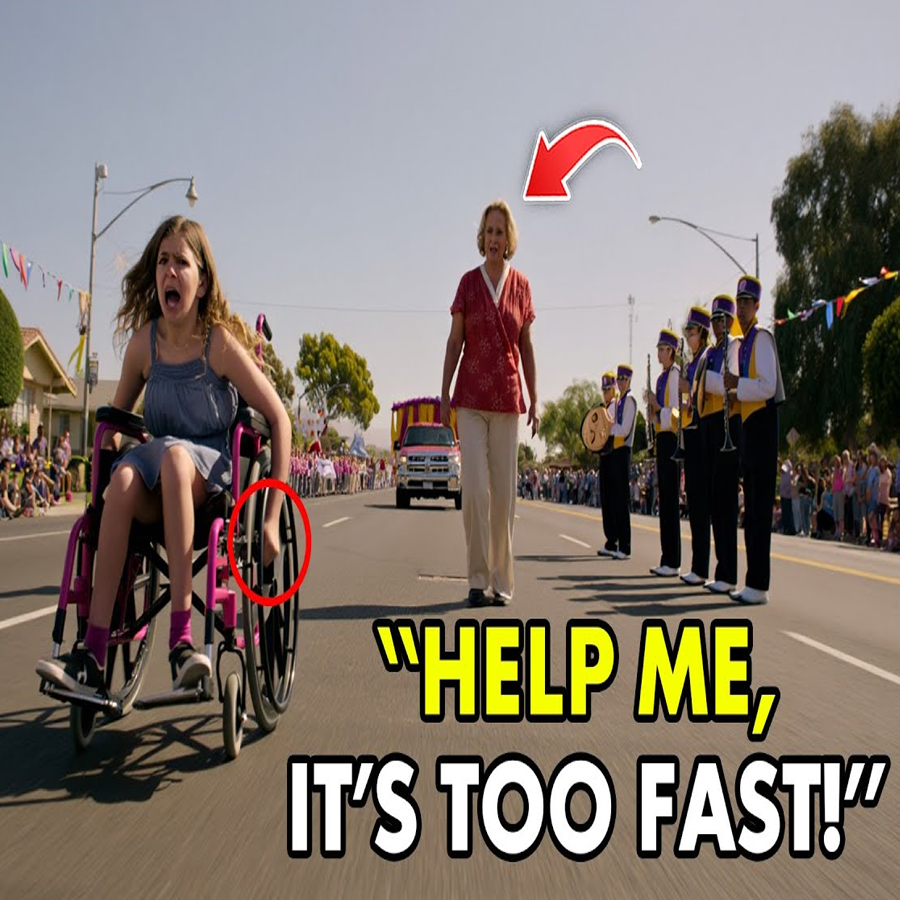
But now, as I stood at the edge of the school field and watched her disappear behind a cluster of parked cars, a chill ran down my spine because the way she’d looked at my daughter just now wasn’t petty. It was personal. The parade began with music and cheers. Children in costumes rolled by with paper dragons, balloons, flags waving in the wind.
When it was Lily’s turn, she rolled forward with such joy, I thought my heart might burst. Her float glowed in the sunlight. The other kids cheered. Even some of the teachers wiped tears from their eyes. And Marjorie, she was nowhere to be seen. Lily completed her circle, beaming as she rolled back toward me.
Did you see them, Daddy? They loved it. I told you they would. I helped her off to the side for a quick water break. Everything seemed fine until we went to roll her back to the car. That’s when I noticed the brake felt loose. I crouched down. One of the cords looked off, frayed. “Did someone mess with this?” I muttered. Lily tilted her head.
“What do you mean I didn’t want to scare her?” I told her it was probably wear and tear and that I’d take a closer look when we got home. But I knew better. Something wasn’t right. And I couldn’t shake that image of Marjorie watching us. By the next morning, I couldn’t deny it anymore. The brake cable on Lily’s wheelchair hadn’t worn down.
It had been cut. Clean, precise, deliberate. I’d taken it into my garage to inspect it, half hoping I was wrong. But after 15 years as a structural engineer, I knew what a mechanical failure looked like and what sabotage looked like.
Someone had sliced into the housing just enough to make the brake function one last time and then fail. I stood in the garage holding the shredded cable and something inside me cracked. This wasn’t just passive aggressive notices or HOA warnings anymore. This was an attack. An attack on my daughter. And deep down, I already knew who had done it. Still, I didn’t want to jump to conclusions. I needed something concrete proof.
I didn’t want to accuse someone without evidence, no matter how much I loathed her. So, I kept quiet. That week, I focused on Lily. Thankfully, the break hadn’t failed during the parade, but the idea that it almost had made me sick to my stomach. I told her we were upgrading her chair, adding stronger cables, thicker tires, and a GPS tracker just in case.
She didn’t ask many questions. She trusted me. But Marjorie, she didn’t stay quiet. 2 days later, I received a certified letter from the HOA. The envelope was thicker than usual. Inside were not one but five citations. One for a non-approved vehicle, my pickup truck, parked temporarily on the street while I cleared space in the garage. One for visible non-native plants, Lily’s little succulent pots by the window.
One for non-conforming exterior paint shade the exact same beige that had been on the house when we moved in. One for child’s toy left in front yard, a plastic drawing easel that Lily had left for 10 minutes while I was inside grabbing lemonade.
And the last improper display of mobility equipment in shared public view. That one hit different. It was clearly aimed at Lily. Her wheelchair. My hands trembled as I read that last line again. The coldness of it. The complete lack of empathy. This woman didn’t just dislike us. She wanted us out. And it wasn’t just the paperwork. Later that week, I was out back watering the tomatoes when I heard Lily scream.
Not loud, but sharp. Frightened, I dropped the hose and ran around the side of the house. She was sitting in her wheelchair on the sidewalk, tears welling in her eyes. I I didn’t mean to, she stammered, pointing toward our mailbox. The front panel had been pried open. The latch snapped clean off. pieces of her sketchpad, her birds. Her drawings were torn and scattered across the driveway.
I looked up and saw Marjorie standing across the street with her little dog watching us. She didn’t speak. She just stood there. And then she smiled, a slow, tight-lipped grin that sent a chill down my spine. “Did you see who did this?” I asked Lily gently. She shook her head, still rattled. It was like that when I rolled out.
The mailman confirmed later that he dropped off our mail an hour earlier. Everything was intact. Someone had come by after someone who knew exactly what they were doing. I called the HOA to report vandalism. They never returned my call. Instead, I received another letter the next day.
This one accusing me of aggressive behavior toward board members and threatening suspension of privileges if I continued to violate community standards. What privileges? We didn’t use the pool. We didn’t attend board meetings. We didn’t socialize at their wine nights. All we did was exist. And that apparently was the problem. The I started to feel the isolation creep in.
Neighbors who used to wave now avoided eye contact. Parents stopped inviting Lily to birthday parties. One even crossed the street when she saw us rolling past. Fear does that. Fear of being targeted next. Of ending up on Marjgery’s list. Lily noticed she was too smart not to. One evening, she looked up at me while we were working on a puzzle and asked, “Daddy, did I do something wrong? I froze.
” “Why would you ask that, sweetheart?” She shrugged. “People don’t talk to me anymore.” “And Miz Karen?” She looked at me like I was bad. I took her hand and looked her in the eye. You did nothing wrong. You’re the kindest, brightest person I know. Some people just can’t handle seeing someone strong.
She nodded, but I could tell part of her believed it was her fault. And that was the moment I realized something deeper than anger had taken root in me. It wasn’t just about what Marjorie had done. It was what she was making Lily believe about herself. I’d lived my whole life by the rules, believed in order, in systems, in due process. But this this was no longer about HOA violations or neighborhood politics. This was war.
And I had to find a way to fight back. There’s a difference between someone being cruel and someone being dangerous. I used to think Marjorie Collins was just the first, a bitter old woman clinging to her clipboard like a sword, swinging petty rules to feel powerful. I was wrong. She was far worse. It happened on a Thursday. I’d gone to the grocery store early that morning. Just a quick trip bread, eggs, a few apples.
Lily had wanted to stay behind to finish a drawing she was working on for her art class. I wasn’t thrilled about leaving her alone, but she was responsible and had her cell phone. I’d be gone 20 minutes at most. At the store, I got delayed. The register froze and the line moved slow.
I tried not to stress, but something gnawed at me the entire time. A sense of unease I couldn’t shake. I rushed home. When I pulled into the driveway, something felt off. The front door was closed, but Lily’s wheelchair ramp had leaves scattered all over it like it hadn’t been used. I opened the door and called out, “Lily?” No answer. Panic started to rise in my throat.
I searched the living room, the kitchen, her bedroom empty. I ran out back. Nothing. Then I heard it. A faint muffled sound. Crying from the garage. I threw the door open and found her there curled in the corner behind the toolbench. Hands shaking, face stre with tears. Her wheelchair was missing. Lily, I dropped to my knees.
What happened? She couldn’t speak at first, just wrapped her arms around me like she was drowning. I held her for what felt like forever, whispering, “You’re safe now. I’m here.” When she finally calmed enough to talk, her words came out broken. She came inside, said she needed to check the backyard fence for HOA compliance. I didn’t open the door, but then she was just in the house. I felt a chill rush through me.
How did she get in? I think the back gate, it wasn’t locked. She told me I had to come outside with her, that kids weren’t allowed to be alone in the house by HOA rules. What? She grabbed my chair, pulled me down the ramp. I tried to yell, but she told me to shut up. Said I was being disruptive. My fist clenched so tight I thought I might draw blood. She took me to her backyard. Lily whispered. I asked her to let me go.
She said I was faking my disability. That she had a cousin who used a wheelchair and they didn’t need special treatment. Oh god. Then she pushed me onto the grass. Said I needed to learn how to crawl if I wanted to act like a burden. I couldn’t breathe. I dragged myself to the side gate. Lily said, tears running down again.
I got out, crawled across the yard into the garage. I couldn’t get back in the house. Her elbows were scraped raw, her palms bruised, grass stains streaked her dress. I called 911 immediately. The officers who arrived were kind to Lily, but to me, they were cautious.
I could see it in their eyes when they heard it was a dispute with the HOA. One of them asked if I had video evidence. I didn’t. We’d never installed cameras. We lived in a safe community. That was the point, wasn’t it? They took our statements and said they’d speak with the neighbor, but they didn’t arrest her. Didn’t even detain her. Instead, Marjorie stood on her porch with her arms crossed, staring me down while the officers left. And then she did the unthinkable.
She smiled and blew Lily a kiss. That night, I held my daughter as she cried herself to sleep. I sat beside her all night, listening to the sound of her breathing, watching the bruises on her arms swell darker with every passing hour. I filed a police report. I called CPS. I contacted the school, but nothing moved fast. Everything needed process, investigation, due diligence.
Meanwhile, Lily was afraid to leave her room. She didn’t want to go back to school, didn’t want to draw anymore. She barely spoke. She was slipping away from me, and no one seemed to care. Not the HOA, not the police, not the neighbors. One of them even had the audacity to tell me. I’m sure Marjorie didn’t mean it like that. Maybe your daughter misunderstood.
No, my daughter didn’t misunderstand. She was abused by a woman hiding behind community rules, protected by the silence of people too afraid to speak up. And that’s when I made a promise. I would not rest. I would not wait. I would not beg for justice. I would build it with my own two hands because no one, not Marjorie, not the HOA, not anyone, gets to hurt my daughter and walk away smiling.
I used to think the lowest point in my life was the night I held my wife’s hand as she slipped away in the ICU. But that was before I watched my daughter stop speaking, before I watched her turn her face away from the window each morning because she was afraid of what might be waiting outside. Before she started wetting the bed again.
It had been 5 days since Marjorie dragged Lily out of our home, left her crawling through the grass like an injured animal. And still not a single thing had changed. No arrests, no charges, no updates. I called the police station every day. They told me the case was being reviewed. I submitted a full written report with photos of Lily’s injuries and a notorized statement. I called our lawyer, but the civil route would take months, maybe years.
I even reached out to local news outlets. None of them responded. Maybe it was the neighborhood. Maybe they were afraid of defamation lawsuits. Or maybe they just didn’t believe it. Marjorie had that kind of face, the kind people trust without question. Her pearls, her perfect lawn, her clean HOA jacket and garden club pins. The face of a woman who baked cookies for fundraisers and shared charity brunches.
And me, I was just a tired single dad with a truck, an overgrown garden, and a daughter who couldn’t sleep through the night. I wasn’t the storybook victim. One night around 200 a.m., I found Lily sitting in the hallway in her pajamas, clutching her sketch pad like a shield.
She’d drawn something, only it wasn’t like her usual pictures of birds and trees. It was a woman, tall, wide hat, big angry eyes. Her hands were holding a pair of scissors, and next to her was a broken wheelchair. I didn’t say a word, just sat down beside Lily and put my arm around her. She leaned against me and whispered, “She’s still watching.
” And that’s when I realized this wasn’t just about what Marjorie had done. It was what she was still doing without even needing to set foot inside our home. She’d infected Lily’s mind. Turned her joy into fear, her art into warnings. I wanted to scream, to break something, to knock on Marjgery’s door and drag her out by that smug little grin.
But I couldn’t because I knew exactly how that would go. She would play the victim. The HOA would call it aggression. The police would see a man with a record of disputes against a sweet old HOA president. So I did nothing, at least on the outside. On the inside, I was a volcano. Each day I dressed Lily, helped her brush her hair, sat beside her during online school lessons.
Even though she didn’t pay attention anymore, she mostly stared out the window, flinching whenever a car slowed near the house. Each night, I sat by her bed until she fell asleep. Then I stayed up watching the security feed because now I had cameras. I installed four after the garage incident. Highresolution, infrared, hidden.
It was too late to stop what had already happened, but I’d be damned if I let her get away with anything else. Still, the silence from the outside world was suffocating. The HOA sent another letter, this time, citing me for unauthorized exterior surveillance equipment visible from the street. I wanted to laugh. Visible. I’d buried the wires, hidden the cameras in birdhouses and porch lanterns. This wasn’t a citation. It was a warning. She knew.
She knew I was watching her now and she didn’t like it. Good. Let her feel it. Let her wonder what I was planning because something was coming. But I wasn’t ready. Not yet. I needed time and I needed someone, anyone who would believe me. The next day, while walking Lily to the mailbox, I noticed something strange.
A curtain in the house across the street moved slightly, a shadow behind it. Then it disappeared. Later that night, we got a knock at the door. It wasn’t police. Wasn’t HOA. It was Ruth, a soft-spoken woman in her 70s who lived alone next to Marjorie. She looked nervous. Her hands were trembling slightly as she clutched a small USB flash drive. I’ve been watching, she said.
I don’t agree with her, but I was afraid. We all are. She handed me the drive. I saw what she did to your daughter. She whispered. I have cameras, too. I didn’t say a word, just nodded. My hands were shaking as I took it from her. She looked at me. Tears in her eyes. Make her pay. And just like that, a crack of light broke through the darkness. I had evidence. I had a witness. And now I had hope.
I sat at my desk that night with shaking hands and plugged Ruth’s flash drive into my laptop. I didn’t know what I expected. Maybe some blurry footage. Maybe some shadows, but what I saw, it stopped my heart. Ruth’s security camera faced Marjory’s sideyard, her fence, her gate, and the strip of grass where she liked to prune her roses.
The video was dated 2 weeks ago, the morning of the school parade. At 5:47, Jum Marjgerie Collins appeared on screen. She wasn’t in her usual HOA blazer or sun hat. She wore a dark windbreaker, gloves, and sunglasses like someone trying not to be recognized.
She walked briskly across her driveway, crossed the street, and disappeared from view for several minutes. When she returned, she had something clutched in her hands. It was Lily’s brake cable. She bent down behind her trash bins, pulled out pruning shears, and started cutting into it, snipping it like a dead branch. She wasn’t just trying to intimidate us. She was building a weapon.
I watched the footage over and over again. Every frame burned itself into my memory. The way she moved, calm, focused, no hesitation. This wasn’t a mistake. This wasn’t a misunderstanding. This was intent to harm a child. The next morning, I called my old friend Mitch. He and I had served together in the Army Corps of Engineers years ago.
After active duty, he went on to become a private investigator specializing in legal disputes and community fraud. When he answered the phone, I didn’t waste time. I need your help. By sunset, Mitch was at my house. I showed him the footage. He watched it once, then again. He didn’t say much, just leaned back in his chair and folded his arms. “You’ve got her,” he said simply.
“But we need more.” I raised an eyebrow. “More? That’s not enough. It’s enough for pressure, not a conviction. Not yet. We don’t just want to shake her. We want to bury her. That night, Mitch set up a command post in my garage, installed backup cameras, encrypted backups, and set up discrete motion alerts across the front and backyards.
He even checked the electrical boxes to ensure no tampering. He moved like a soldier again, efficient, controlled, focused. He also started asking around. Turns out Ruth wasn’t the only one with doubts. Two more neighbors, Paul and Jen, had received anonymous HOA violations the week after they let their kids play with Lily in the front yard.
Paul said his HOA fine claimed he left unsanctioned playground equipment on community lawn. It was a chalk hopscotch board. Jen got a citation for excessive noise after dusk. Her toddler had giggled too loud during hideand-sek. Both of them had said nothing, scared of being harassed.
But when they heard what happened to Lily and saw the footage, they were ready to talk. Mitch compiled everything into a neat little file. Screenshots, statements, video stills, a timeline. He handed it to me one night and said, “She doesn’t just hate you. She hates joy. Control is her drug, and this neighborhood is her kingdom.” He was right.
Every single piece of evidence pointed to a woman who had grown so addicted to power. She no longer saw children as innocent. She saw them as threats. We mailed a copy of the full report anonymously to the sheriff’s office, to the district attorney, to the state attorney general’s consumer protection division, and to the local newspaper.
But we weren’t done because justice in the system takes time, and Marjorie needed to know she wasn’t untouchable anymore. It started small. Mitch changed the locks on my side gate and set up a silent tripwire alarm, one that sent alerts to both our phones. Then we placed a sign in our yard under surveillance. Trespassers will be prosecuted, and we waited.
Three nights later, the alarm went off at 2:3 a.m. Mitch and I bolted out of bed, grabbed flashlights, and sprinted to the backyard. And there she was, Marjorie Collins, caught red-handed. She froze under the spotlight. Her hands hovered near the motion sensor light Mitch had camouflaged in the planter.
“What are you doing on my property?” I said, voice trembling with fury. She stammered. “I I was just checking the fence.” “Choy, you don’t work for the HOA at 2:00 in the morning.” Mitch barked. She tried to regain control, straightened her shoulders. I have the right to inspect number Marjgery. I interrupted. You have the right to remain silent. and if I were you, I’d start using it.
” She stood there, stunned, realizing for the first time in a long time she wasn’t the one in control. We didn’t need to call the cops that night, we already had everything we needed. She just didn’t know it yet. But she would soon, the night Marjorie got caught in my backyard changed everything. She didn’t get arrested. She wasn’t handcuffed.
But the look on her face, the flicker of panic when the spotlight hit her was enough for me to know she wasn’t as untouchable as she thought. And now she knew we were watching. The next morning, the neighborhood was buzzing. Someone, probably Mitch, had slipped anonymous flyers into every mailbox.
They included stills from Ruth’s video footage and a simple question in bold, “Would you trust this woman with your child’s safety?” By noon, the HOA board called an emergency meeting. Marjorie, of course, called it herself. Claimed a coordinated attack had been launched against her, that certain residents were trying to discredit her leadership.
She used words like slander, safety risk, and fabricated footage. But it didn’t matter because people had seen the truth. I didn’t attend the meeting in person, but Mitch did. He recorded everything. Marjorie stood at the podium, flanked by her clipboard like it was a badge of honor, but her voice wasn’t as steady as usual. She fumbled papers. Sweat dotted her hairline.
For the first time, she looked small. And then came the twist. Mitch had asked Ruth to come. She did quietly, bravely. And when the floor opened for comments, Ruth stood up, hands trembling, and said, “I have more videos.” gasps. She held up another flash drive. I’ve lived here 21 years. I’ve never spoken out before.
But what Marjorie did to that little girl to Lily, it wasn’t just wrong. It was evil. Someone in the crowd clapped. Then another. Marjorie tried to interrupt, but Mitch cut in. Ma’am, you’re the subject of this hearing. You’ll have a chance to respond. The room turned on her like a switch flipped. Neighbors who’d kept their heads down started speaking up.
Jen stood up and recounted how her toddler got an HOA fine for child disturbance. Paul described how his son’s lemonade stand was shut down after Marjgery called it an illegal vendor operation. Someone else said their elderly mother was cited for unauthorized garden furniture because she had a wheelchair ramp on her porch. The pattern was clear. Marjorie wasn’t just targeting my daughter.
She was targeting anyone vulnerable, anyone who didn’t fit her mold. By the end of the meeting, two board members had called for an official vote to suspend Marjorie as HOA president, pending an external investigation. That was a crack in the dam. But I wasn’t stopping at suspension because justice doesn’t knock gently. It breaks the door down.
Mitch and I took everything we had, videos, statements, HOA abuse patterns, and compiled them into one master file. Then we submitted it to three places at once, the district attorney’s office, under charges of felony child endangerment and harassment. The local news station, who had previously ignored me until they saw the footage, and most importantly to a civil rights attorney named Dana Malone, known for going after HOAs that abused their authority. Dana was a force of nature.
When she saw the video of Marjorie cutting Lily’s brake cable, her voice went cold. You let me handle this, I’ll burn her house down legally. She filed a civil suit on Lily’s behalf within 48 hours. Charges intentional infliction of emotional distress, property sabotage, unlawful entry, assault, and discrimination against a disabled child. Within days, the press picked it up.
The headline read, “Hoa president allegedly sabotages wheelchair of disabled girl family seeks justice.” It spread like wildfire. Suddenly, Marjgerie Collins wasn’t just the tyrant of our neighborhood. She was on the evening news. Her picture taken outside her home in that ridiculous sun hat was plastered across screens with words like endangerment and sabotage underneath.
She tried to respond, held a press conference on her lawn, but she cracked. She shouted at reporters, claimed we forged everything, that the videos were deep fakes, that our daughter was probably exaggerating for sympathy. That was her final mistake because Lily, she watched that press conference, then quietly turned to me and said, “Can I speak too?” 2 days later, Dana arranged it. A video statement from Lily filmed at our kitchen table.
Her voice was soft but steady. Her words simple but powerful. She said, “I didn’t matter, but I do. I’m not broken and she can’t hurt me anymore.” By the time it aired, the entire town was watching and so was the district attorney. The day the sheriff knocked on Marjgery’s door, I stood across the street holding Lily’s hand. It was 9:13 a.m.
Two patrol cars pulled into the HOA loop drive. One plain clothed investigator, one uniform deputy. Marjorie opened the door in her usual cream blouse and beige slacks, her mouth already forming one of those fake HOA smile greetings until she saw the badge.
I couldn’t hear what was said, but I saw the change, the frozen smile, the way her shoulders locked, the flicker of fear in her eyes. They handed her a warrant. I watched as she sputtered, waved her arms, and tried to protest. Then the deputy stepped forward and gently guided her inside while the investigator began snapping photos of her garage inside gate. I couldn’t help it. I smiled.
For the first time in weeks, I smiled without guilt because it was happening. Justice wasn’t coming. It had arrived. That afternoon, Marjorie was formally charged with multiple counts criminal trespassing, vandalism, child endangerment, and tampering with medical equipment. The judge denied her request to be released without bail, citing her clear disregard for legal boundaries and escalating pattern of hostile behavior. The HOA board scrambled to distance themselves.
Within 24 hours, they held an emergency vote to remove Marjorie permanently as HOA president. Her name was taken off all correspondents, her key access revoked, her email shut down, and then the twist came. The one no one saw coming. The news station ran a follow-up story the next morning. They’d done some digging thanks to a little help from Mitch, who fed them everything they needed.
And there it was. Father of disabled girl is former federal compliance investigator now suing HOA for systemic abuse. Yep, that’s me. Daniel M. Caldwell, former Department of Justice compliance specialist. Before Lily’s accident, I spent 12 years auditing public housing, school districts, and local governments for federal ADA violations and civil rights abuse.
I knew every line of the law Marjorie had crossed, but I kept my mouth shut because if I’d played that card too early, she’d have gone underground, hidden her behavior behind layers of legal fog. So, I waited, I watched, I gathered, and when the time was right, I acted. The phone calls started flooding in. Reporters, civil rights groups, disability advocates, attorneys. One local station called it the single most appalling abuse of HOA power in state history.
And Marjorie Well, she finally did what bullies always do when the tables turn. She cracked. Her lawyer issued a statement blaming undue stress, concern for community integrity, and even claimed she had undiagnosed anxiety that caused her behavior. I didn’t buy it. Neither did the DA. Neither did the judge.
During the preliminary hearing, Marjorie sat pale-faced and rigid, her hands clenched in her lap while the prosecutor played the video, the one Ruth captured on a giant screen for the courtroom. When the footage reached the moment Marjorie cut through the brake line and tucked the cable in her coat, you could hear the gasp in the room, then silence. Then Lily’s video played.
The room changed. Even the baiff wiped his eyes. And then I stood on the stand under oath. I told the story not just of what Marjorie did, but what she tried to do. She tried to humiliate a child who already carried more pain than most people live with in a lifetime. She tried to break a father who had already lost more than she could imagine. But in the end, all she did was expose herself.
The judge ordered a full trial, civil and criminal. Dana, our attorney, filed an injunction that froze Marjgery’s assets, her accounts, her properties pending investigation into further HOA misuse of funds, and abuse of power. The floodgates opened. More neighbors came forward.
More stories, more citations, a long list of intimidation tactics, fake violations, and fear-driven silence. She had ruled this neighborhood like a private thieft. But now her rain was over and the neighborhood it started to breathe again. Kids played outside without fear. Flags flew on porches again. And Lily Lily started smiling. She even began sketching again. One afternoon she brought me a new drawing.
It showed our house and her in her wheelchair. Wings sprouting from the wheels, glittering in the sunlight. Flying again. she said. I didn’t cry, but my voice cracked when I said, “You always were.” The courthouse was packed the morning of the sentencing. News vans lined the block. Parents clutched their children’s hands. Neighbors who once whispered behind curtains now stood tall and unafraid.
And there, in the front row of the gallery, sat lily pink cardigan, fresh braids, and that quiet strength in her eyes. Marjorie entered in handcuffs. No pearls, no sun hat, just a gray jumpsuit and the unmistakable slump of a person who finally understood what she had lost. The trial itself hadn’t been short.
Over 3 weeks, the jury had heard from Ruth, Paul, Jen, and over a dozen other neighbors. The prosecution laid out Marjgery’s history of abuse, patterned citations against families with disabled members, threats of fines if children made too much noise, accusations against elderly residents for yard non-compliance, and then of course there was the footage, the break cable, the trespassing, the dragging of a disabled child through the yard, the injuries. When the verdict came in, it was unanimous guilty on all counts.
The judge didn’t hold back. He called Marjgery’s actions a calculated campaign of cruelty and her behavior an insult to every parent who ever trusted a neighborhood to be a safe place. She was sentenced to 9 years in state prison with no eligibility for early release due to the nature of the victim and the premeditation. But that wasn’t all.
Dana, our attorney, had filed a parallel civil suit that moved like wildfire through the courts because the case had become national news by now. The HOA’s insurance collapsed under pressure. Sponsors pulled out, vendors cut ties, the board dissolved, the neighborhood was ordered into full compliance, restructuring under new leadership, and Marjgery, her assets were seized, her savings drained to cover legal costs and damages.
Her house, the one with the picture perfect roses and pristine gutters, was auctioned off in a public foreclosure. I didn’t attend the auction, but Ruth did, and she texted me afterward. A young couple bought it. The wife uses a wheelchair. You’d like them for the civil suit. The jury awarded Lily and me a settlement of $4.
2 $2 million enough to cover lifelong medical needs, trauma therapy, and ensure she never again had to worry about access, dignity, or safety. We didn’t do it for the money. We did it because she deserved to be seen. And now she was. The local school board created a new rule in Lily’s honor, ensuring all children with mobility challenges have equal participation rights in every school event, from parades to field trips to PE. They named it Lily’s Law.
The governor sent a letter. So did the Secretary of Education, but the most powerful moment came quietly. It was 2 weeks after sentencing. A small ceremony was held at the town park, reopening a space that had long been dominated by HOA restrictions. This time it was rededicated as a fully accessible, inclusive playground. They let Lily cut the ribbon. She gripped the scissors with her little hands, smiling wide.
As the crowd applauded, she turned to me and whispered, “Does this mean we won?” I bent down and kissed her forehead. “No, sweetheart. This means we showed them you mattered.” And that was always the real win. Later that night, after Lily went to bed, I sat on the porch alone for a long time.
I watched the stars and I thought about Marjorie, about power, about how easily cruelty can hide behind rules, titles, and neighborhood committees. But not anymore. Because she didn’t just lose her title. She lost everything she used to keep others down. And as for me, I didn’t get revenge. I got something better. I got peace.
Looking back, I still wonder how something so small decorating a wheelchair for a school parade led us down a road filled with fear, rage, and ultimately justice. I used to think monsters wore masks or crept in shadows. Now I know better. Sometimes they wear cardigans and carry clipboards. Sometimes they live next door and call themselves president.
But I also learned something else, something more important. That courage doesn’t always roar. Sometimes it comes in the shape of a 9-year-old girl smiling through pain, holding her sketch pad like a shield. Sometimes it’s a neighbor quietly leaving a flash drive. A friend showing up at midnight. A tired father choosing not to break. We didn’t just survive Marjorie Collins. We exposed her.
We took everything she used to hurt others and we turned it into fuel. Lily sleeps through the night now. She laughs again. She paints. Her new chair rolls smoother than ever. And when she goes to school, the teachers don’t just wave. They salute her. And me, I still sit on the porch some nights watching the wind move through the trees.
And I remind myself justice doesn’t always come fast, but when it comes, it stays. So, if you’re watching this and you feel powerless, if you’ve been silenced by someone who hides behind rules or reputation, remember this. You are not alone. And no bully, no matter how many meetings they run, can stand forever against the truth. Because the truth doesn’t knock.