What would you do if someone deliberately defaced your disabled child’s prosthetic leg just because it didn’t conform to their idea of aesthetic standards? Would you quietly comply with their demands or fight back with everything you have? I still remember the exact moment I found my 12-year-old daughter Sophia collapsed on our front steps, her body shaking with sobs.
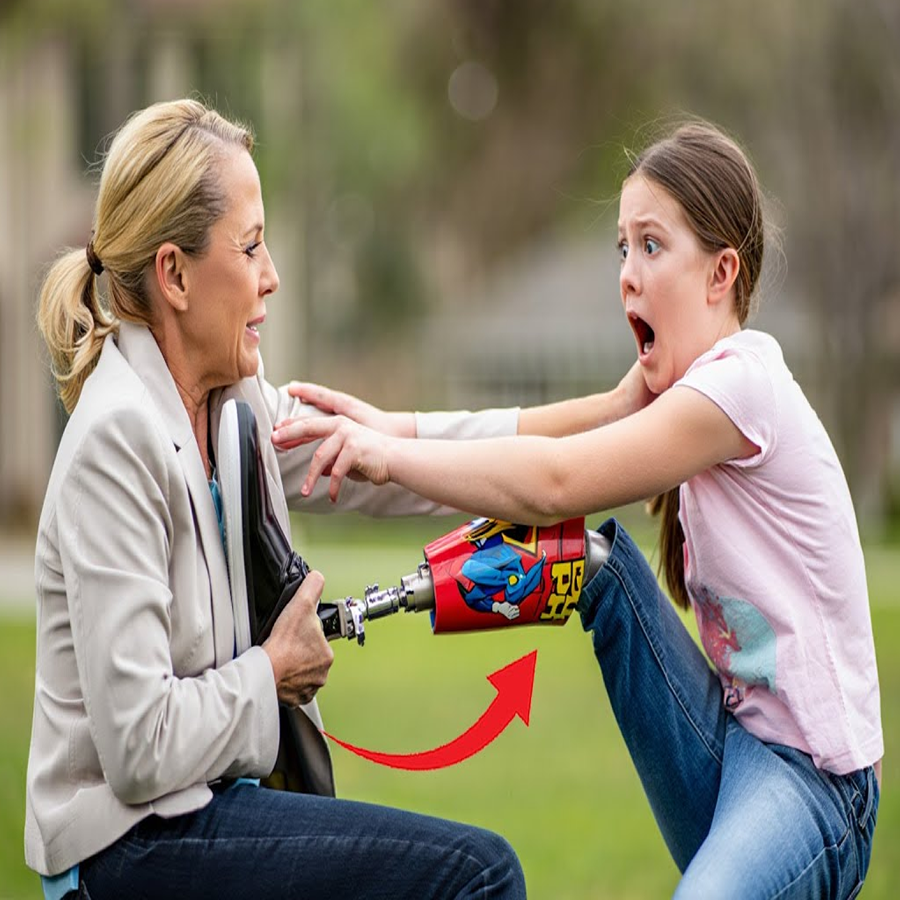
The beautiful customized prosthetic leg that had finally restored her confidence after a devastating accident was now covered in black permanent marker. The words follow rules were scrolled across the colorful design she had chosen so carefully. The artwork stripped away in places by what looked like paint thinner. The superheroes she loved.
The stars that reminded her to reach for her dreams, all defaced by someone who decided their idea of community standards, was more important than my child’s dignity. In that moment, as I held my sobbing daughter, something inside me broke and something else, something fierce and protective took its place. I recognized that feeling.
It was the same fire that had fueled me in courtrooms years ago before I traded my legal career for the stability my daughter needed. I hadn’t felt it in years, but it came rushing back with an intensity that nearly took my breath away. But I’m getting ahead of myself. Let me start from the beginning. My name is Michael Anderson.
Two years ago, our lives changed forever when a drunk driver plowed through a red light and struck our car. I walked away with minor injuries, but Sophia lost her left leg below the knee. I still hear her screams sometimes in my nightmares. Still feel the helplessness that overtook me as I fought to reach her in the crumpled passenger seat.
The physical recovery was excruciating. Three surgeries, weeks in the hospital, months of physical therapy, the phantom pain that would wake her screaming in the night, reaching for a limb that was no longer there. But the emotional toll was even worse. Before the accident, Sophia had been vivacious and outgoing. The kind of child who would spontaneously dance around the kitchen while I made dinner, who organized neighborhood talent shows who never met a stranger.
She couldn’t turn into a friend within minutes. After the amputation, that bright, confident girl disappeared. She became withdrawn, refusing to leave the house unless absolutely necessary. She hid her prosthetic under long pants, even in the sweltering summer heat. Her friends invited her to the community pool, she declined.
The dance classes she once loved, cancelled birthday parties. Suddenly, she had too much homework. The school counselor called to tell me Sophia was eating lunch alone in the library rather than joining her friends in the cafeteria. “Dad,” she whispered one night as I tucked her in. Do you think people will ever see me as normal again? I didn’t have an answer that didn’t break my heart.
The turning point came 6 months after the accident when we connected with a nonprofit called Kids Steps Forward. Unlike standard medical providers, they create customized prosthetics for children that aren’t just functional but expressive. Their philosophy is that if children are going to live with prosthetics, they should be sources of pride, not shame. Dr.
Amelia Santos, the organization’s founder, spent hours with Sophia, gently drawing her out about her interests, her dreams, what would make her smile when she looked down at her prosthetic. It was the first time I’d seen Sophia engage enthusiastically with anyone since the accident. “Most medical professionals want prosthetics to be invisible,” Dr.
Santos explained to me while Sophia was designing her leg with one of their artists. We believe they should be joyfully visible on the child’s terms. They designed a leg for Sophia adorned with vibrant colors, stars that glowed in the dark, and her favorite superheroes engaged in acts of courage. It cost $25,000 covered entirely by the charity. When Dr.
Santos told me the price, I blanched as a single father who had already faced staggering medical bills. There’s no way I could have afforded it on my own. This isn’t just a medical device, Dr. Santos said, noticing my reaction. It’s an investment in her future, her confidence, her sense of self. We believe that’s worth every penny.
I’ll never forget the moment Sophia first put it on. She stood in front of our hallway mirror, slowly rolling up her pant leg to reveal the colorful prosthetic underneath. For what felt like the first time in months, her eyes lit up. “Dad,” she whispered. “It’s like wearing art. I don’t have to hide it anymore.
” That night, she asked if we could go out for ice cream. The first time she’d voluntarily suggested leaving the house in months. As she proudly walked into the ice cream shop with her prosthetic visible under shorts, a little boy pointed at her leg and exclaimed, “Wa, that’s so cool. You’re like a superhero, Sophia beamed.
The prosthetic wasn’t just a medical device. It was her badge of courage, tangible proof that being different could be beautiful. Over the next year, I watched my daughter gradually reclaim her life. She rejoined her friends at lunch. She started a new hobby, adaptive rock climbing, where her prosthetic became an advantage rather than a limitation. Her grades improved.
The nightmares became less frequent. We had our challenges, of course, but I began to recognize the resilient girl I’d raised. 6 months ago, I accepted a promotion that required us to relocate. I was hesitant to uproot Sophia just as she was finding her footing again. But the opportunity came with a substantial salary increase that would provide greater financial security for us.
More importantly, the new location offered one of the country’s best school districts for inclusive education, a place where Sophia’s different abilities would be supported rather than merely accommodated. We moved into Oakidge Estates, an upscale gated community in suburban Boston. The neighborhood was picture perfect manicured lawns, coordinated mailboxes, and a homeowners association HOA that promised to maintain community standards and property values.
The homes were beautiful, the neighbors seemed friendly, and Sophia was excited about the school’s robotics program. What I failed to research was the reputation of Camila Whitmore, the HOA president who had been ruling over the community with an iron fist for 15 years, a former real estate agent in her 50s with an immaculate blonde bob and perpetually pursed lips.
She treated the HOA rule book like sacred text, and herself as its sole interpreter. Other residents later told me they referred to her as the common dant behind her back. Our first encounter happened at the mandatory new resident orientation. Camila’s eyes narrowed slightly when Sophia walked in with her colorful prosthetic visible beneath her shorts.
I noticed the slight tightening around her mouth, the almost imperceptible shake of her head. But surely I thought even the strictest HOA wouldn’t take issue with a child’s medical device. I dismissed my concerns as paranoia. “Mr. Anderson,” she said later, pulling me aside while Sophia was chatting with another new resident.
“While we’re so delighted to have you join our community, I should mention that we do have certain aesthetic standards. Medical devices should be discreet.” “I’m sorry,” I responded, certain I’d misheard her. “Your daughter’s”? She paused, waving her manicured hand vaguely toward Sophia. leg. It’s rather attention-grabbing, isn’t it? Some residents might find it distracting.
The temperature in the room seemed to drop 10°. I looked at her perfectly composed face, searching for some sign that this was an ill-conceived joke. My daughter’s prosthetic leg isn’t violating any rules, I said evenly. Well, not explicitly, but we do have guidelines about visual harmony in common areas. Her smile never reached her cold eyes.
Perhaps a more neutral colored option would be better suited for community appearances. And perhaps, I replied, struggling to keep my voice level. Some residents might need to mind their own business. Her smile tightened. We’ll see. And see we did. A week later, the first violation notice arrived in our mailbox. Something about improper lawn edging.
Then came warnings about our mailbox height. apparently two inches too tall, the shade of our window blinds, cream instead of white, and a bird feeder that was described as excessive ornamentation. None of these alleged violations had anything to do with Sophia’s prosthetic, but the message was clear. Conform be harassed.
Each notice was signed with Camila’s flowing signature, each one a little dig, a reminder that we were under scrutiny. If you’re watching from anywhere in the country where you’ve dealt with unreasonable HOAs, drop a comment below and let us know. And if you’re new here, don’t forget to like this video and subscribe to join our growing community of people standing up to injustice.
The situation escalated at the monthly HOA meeting. Sophia had asked to come along because she wanted to propose a community fundraiser for Kids Steps Forward, the charity that had provided her prosthetic. She’d spent hours preparing her little presentation, practicing in front of the mirror, nervous but determined to give back to the organization that had helped her so much.
“Are you sure you want to do this?” I asked as we walked to the community center. “We can find another way to raise money for them,” Sophia squared her shoulders. “I need to do this, Dad. If I can help even one kid feel like I did when I got my special leg, it’s worth it.” When we arrived, Camila was seated at the center of a long table at the front of the room, flanked by the other board members.
Her gaze locked onto Sophia’s leg for a moment before she looked away with a slight grimace. Beside her sat Patricia Sheffield, a thin woman with wire- rimmed glasses who served as HOA secretary. Patricia leaned over to whisper something to Camila, who nodded with a tight smile. Throughout the tedious first hour of the meeting, I noticed several residents glancing at Sophia’s prosthetic with curiosity.
Most smiled warmly when she caught their eye. A few children were openly fascinated, one even giving her a thumbs up when his mother wasn’t looking. Contrary to Camila’s concerns, no one seemed distracted in a negative way. When it came time for new business, Sophia raised her hand. I squeezed her shoulder in encouragement.
I’d like to propose a community car wash to raise money for kids steps forward, she said, her voice clear, despite her nervousness. They help children like me get custom prosthetics that make us feel good about ourselves again. I’ve prepared a short presentation about their work. Patricia cleared her throat. While that sounds nice, we already have our charity calendar filled for the year, but Sophia started.
Camila cut her off. And frankly, we’ve had complaints about your prosthetic, young lady. The room fell silent. I felt my blood pressure spike. “Excuse me,” I said, my voice dangerously calm. “Several residents have mentioned that the colorful thing is an eyes sore,” Camila continued as if discussing an improperly placed garden gnome.
We have standards in Oakidge, she gestured to Patricia, who began distributing printed copies of a previously unknown medical aesthetics addendum to the HOA guidelines. I scanned the document, which specified that all visible medical devices must be skin- toned or neutral in color with no personalization or embellishments that could disrupt community aesthetic consistency.
This was never provided to us during the buying process. I said it was ratified last year, Patricia replied smoothly. Doctor Marcus Freeman, our neighbor and the pediatrician who’d been helping Sophia with her physical therapy stood up. I don’t remember voting on this. And as a medical professional, I find this deeply problematic.
You must have missed that meeting, Dr. Freeman, Camila replied dismissively. The point is, the Anderson family has two weeks to comply or face daily fines of $100. I looked at Sophia, whose eyes had welled up with tears. The light that had finally returned to them was dimming again. “We won’t be complying,” I said firmly. “That prosthetic is medically necessary equipment, and my daughter has the right to express herself.
” “Then prepare for fines, Mr. Anderson,” Camila said with a cold smile. “Rules are rules.” As we left the meeting, several neighbors approached us to express their support quietly. Don’t let her get to you,” one older woman whispered. “She does this to everyone who doesn’t fit her idea of perfect.” The next two weeks were a barrage of certified letters, each threatening increasingly steep penalties.
I contacted a friend who specialized in housing law, and she confirmed what I suspected. The HOA was on shaky legal ground. The medical aesthetics addendum almost certainly violated the Americans with Disabilities Act. Still fighting would be expensive and exhausting, especially after all we’d been through with Sophia’s medical bills.
I was considering our options when the situation suddenly escalated beyond anything I could have imagined. It was a Tuesday afternoon. I was working from home when Sophia’s school bus dropped her off instead of her usual call of, “Dad, I’m home.” I heard sobbing. I rushed to the door to find her collapsed on our front steps, tears streaming down her face.
Sophia, what happened? I knelt beside her, checking for injuries. She couldn’t speak through her sobs. Instead, she pointed to her prosthetic leg. The beautiful custom-designed prosthetic that had restored her confidence had been defaced. Black permanent marker covered the artwork with the words, “Follow rules,” scrolled across it.
There were scratches in the finish and some of the paint had been stripped away with what looked like paint thinner. In that moment, I felt a combination of heartbreak and fury that I can’t adequately describe. I helped her inside and called the school immediately. They were horrified and promised to review security footage, but the locker room had no cameras for privacy reasons.
As I was helping Sophia clean her prosthetic as best we could, our doorbell rang. It was Dr. Freeman. Michael, I saw Sophia coming home. Is she okay? His face was etched with concern. I showed him the vandalized prosthetic and his expression darkened. “I think I know who did this,” he said quietly. “This morning, I saw Camila and Patricia at the school.
They claimed they were dropping off forgotten lunch money for Patricia’s nephew, but they were headed toward the gym area, not the office.” A cold fury settled in my chest. Are you certain? Positive? I was there for a wellness presentation. They seemed surprised to see me. Just then, my phone pinged with a text message from an unknown number.
I have something you need to see. Meet me at the community garden in 20 minutes. Elijah. Elijah Cooper was the groundskeeper for our community. A quiet man in his 60s who kept to himself, but always had a kind word for Sophia. He had once told her that her prosthetic reminded him of the wild flowers he tended to beautiful in their uniqueness.
“Can you stay with her?” I asked Dr. Freeman, who nodded immediately. I found Elijah nervously pacing by the tomato plants. When he saw me, he glanced around to make sure we were alone before pulling out his phone. “I didn’t know who else to show this to,” he said, his voice low. “They don’t know I saw them.
” He handed me his phone. On the screen was a series of photos clearly taken through the garden shed window. They showed Camila and Patricia huddled together in the parking lot of Sophia’s school, examining what was unmistakably my daughter’s prosthetic leg. In one photo, Patricia was holding a Sharpie. In another, Camila was applying something with a cloth. My hands shook with rage.
When did you take these? This morning, I was delivering mulch to the school garden. They never saw me. Elijah’s weathered face was grim. I’ve worked here for 12 years and I’ve seen how they treat people who don’t fit their idea of perfect. Last year, theyounded the Martinez family because their autistic son would sometimes make noises in their backyard.
Before that, it was the elderly Washingtons who couldn’t keep up with the lawn maintenance after Mr. Washington’s stroke. But this this crosses every line. Would you be willing to show these to the police? I asked. Elijah nodded without hesitation. Those two have bullied folks for too long. What they did to your little girl’s leg, it ain’t right.
I thanked him and hurried home, my mind racing. When I got there, Sophia had fallen asleep on the couch, emotionally exhausted. “Dr. Freeman was sitting nearby, his face troubled.” “Michael,” he said quietly. “I hope you’re planning to fight this.” I nodded, a plan already forming. Oh, I’m going to do more than fight.
I’m going to end Camila’s reign of terror. What Camila didn’t know, what I hadn’t shared with anyone in our community, was that before becoming a software engineer. I had been a civil rights attorney specializing in disability discrimination cases. I’d changed careers after Sophia’s mother died from cancer when she was four, wanting more flexibility to be there for my daughter.
But I’d kept my law license active and Camila Whitmore had just made the biggest mistake of her life. That night, after Sophia was asleep, I made three calls. The first was to the police to file a vandalism report. The second was to an old colleague who specialized in Americans with Disabilities Act, ADA violations.
The third was to a friend who produced investigative news segments for the local NBC affiliate. The next morning, I drove Sophia to school myself and spoke with the principal, who was appropriately horrified and promised full cooperation. Then, I went to the police station to provide Elijah’s photos and Dr. Freeman’s statement. By noon, I had filed an emergency injunction against the HOA’s medical aesthetics policy and a personal restraining order against Camila and Patricia. But I wasn’t done.
That evening was the HOA’s executive board meeting, a smaller gathering where the real decisions were made. I arrived early and took a seat in the front row. Dr. Freeman and several other neighbors joined me in silent support. Camila faltered slightly when she saw me, but quickly regained her composure. Mr. Anderson, this meeting is for board members only.
Actually, according to HOA bylaws, section 43, all homeowners may attend executive sessions as observers. I smiled pleasantly. I’ve brought copies of the relevant section for everyone. Patricia shuffled uncomfortably as I distributed the papers. Fine, Camila snapped. But observers do not have speaking privileges. I’m not here as an observer, I replied calmly.
I’m here as legal counsel. The room went silent. I don’t understand, one board member finally said. I stood up no longer the accommodating new neighbor. My name is Michael Anderson sit. I’ve filed a lawsuit against this homeowners association and specifically against Camila Whitmore and Patricia Sheffield for violations of the Americans with Disabilities Act, destruction of medical equipment, harassment, emotional distress, and conspiracy.
Patricia’s face drained of color. Camila’s reened. That’s absurd. Camila sputtered. We’ve done nothing wrong. I placed a folder on the table. Inside you’ll find copies of the police report I filed this morning, photographic evidence of you and Miss Sheffield vandalizing my daughter’s prosthetic leg witness statements and documentation of the systematic harassment you’ve directed at my family since we moved in.
I paused to let that sink in. Also included is a copy of the emergency injunction a judge granted this afternoon prohibiting any attempt to enforce your discriminatory medical aesthetics policy or to issue any fines against my family. You can’t prove anything. Patricia whispered, but her voice lacked conviction. Actually, I can.
I nodded to Dr. Freeman, who opened the meeting room door. In walked a police officer, followed by a reporter and cameraman from the local NBC affiliate. Officer Davis is here to serve you both with legal papers. The news crew is here because the story of an HOA president vandalizing a disabled child’s medical equipment makes for compelling viewing.
Don’t you think? Camila stood up so quickly her chair toppled backward. This is a private meeting. You can’t bring cameras in here. Actually, I countered. The HOA bylaws you’re so fond of citing specifically state that all meetings must be open to the community press if requested.
I have the request form right here properly submitted last week. It was a bluff. I’d only called the news station yesterday, but Camila was too flustered to check. You’re making a grave mistake. She hissed. “No, you made the grave mistake when you targeted my daughter.” My voice was deadly quiet. The prosthetic you vandalized was worth $25,000.
It was specially fitted to her body and designed to help her participate in normal childhood activities. Because of your actions, she’ll need a replacement, which means additional medical appointments, missed school, and psychological trauma. I turn to address the entire board. The lawsuit seeks $150,000 in damages, $25,000 for the prosthetic replacement, $25,000 for medical and therapy costs, and $100,000 in punitive damages.
However, I’m prepared to negotiate under certain conditions. The board members looked at me with a mixture of horror and fascination. First, Ms. Whitmore and Ms. Sheffield must immediately resign from the board and agree never to serve on any HOA board again. Second, this HOA must adopt a comprehensive non-discrimination policy specifically protecting residents with disabilities.
Third, the HOA must make a $50,000 donation to Kids Steps Forward. The organization that provided my daughter’s prosthetic. That’s extortion, Camila cried. No, I replied calmly. It’s justice and it’s considerably less expensive than what you’ll pay if this goes to court. Not to mention the public relations nightmare when this airs on the evening news.
I nodded to the camera crew who had been filming the entire exchange. What followed was chaos. Board members began arguing amongst themselves. Patricia burst into tears and Camila stormed out, nearly knocking over the camera operator in her haste to escape. Within 48 hours, both Camila and Patricia had resigned from the board. The remaining members unanimously approved my proposed non-discrimination policy and agreed to the donation to Kids Steps Forward.
They also issued a public apology to Sophia and arranged for a communitywide fundraiser to support the organization. The consequences extended beyond the HOA. Patricia, who worked as an elementary school administrator in a neighboring town, was placed on administrative leave pending an investigation. Camila’s real estate business suffered as clients canceled listings.
The police decided to pursue criminal mischief charges against both women. But the most beautiful outcome wasn’t about punishment. It was about Sophia. 3 weeks after the incident, kids steps forward, surprised her with a new prosthetic leg, even more beautiful than the one that had been vandalized. This one featured a space theme with stars, planets, and a tiny astronaut that looked suspiciously like her.
When she put it on for the first time, her smile lit up the room. “Dad,” she said, twirling to see how the stars caught the light. “I think I want to be a lawyer when I grow up. I laughed and hugged her tightly.” “Whatever you want to be, sweetheart. No one’s going to stand in your way.” In the months since our community has transformed, the new HOA board consults with a diversity committee on all policy decisions.
Five other HOAs in our region have reached out to adopt similar non-discrimination policies. And Sophia has started a peer support group for kids with prosthetics and other medical devices. As for me, I’ve taken on a few disability rights cases. Again, I’d forgotten how satisfying it feels to fight for justice. Last week, Sophia came home from school with a drawing a classmate had made of her.
In it, she was wearing her space- themed prosthetic and a superhero cape. Above the drawing in careful letters, the child had written, “Sophia is brave.” That night, as I tucked her in, she said, “Dad, I’m glad they did it.” “Did what, sweetheart?” “Vandalized my leg.” She looked up at me with those wise eyes that had seen too much pain for someone so young.
If they hadn’t, we wouldn’t have been able to help change things. Sometimes bad things have to happen so good things can come after. I kissed her forehead, humbled by her wisdom. You’re braver than any superhero I know. She smiled sleepily. It’s because I have the best dad. If there’s one thing I’ve learned from this ordeal, it’s that bullies thrive when good people stay silent.