An elderly nurse with nothing left to give, offered her skilled hands to a wounded biker, never expecting that by dawn her quiet street would be lined with hundreds of leatherclad guardian angels. What happens when society’s most feared outsiders discover one of its most overlooked heroes? And how did a single act of kindness transform both their worlds forever? The first hint of sunrise painted the eastern sky in soft pinks and golds, casting long shadows across Oakidge Lane. The small houses, once bright with fresh paint decades ago, now showed their age with peeling boards and sagging porches.
Number 42 stood in the middle of the block, its faded blue exterior barely visible behind an overgrown garden that Ruth Jenkins no longer had the strength to tame. Inside the old wall clock ticked steadily as Margaret pinned her silver hair into a tight bun.
Her fingers, though marked with age spots and slight trembling, moved with the sure touch that had comforted thousands of patients over her 50 years as a nurse. The small gold pin in her hand, shaped like the medical staff with two snakes, caught the morning light streaming through thin curtains. Almost forgot you,” she whispered to the pin, her voice warm but tired.
She fastened it to her collar and stood back to check her reflection in the bathroom mirror. The uniform she wore was clean but faded from countless washings, the white now a soft gray that matched her hair. Deep lines framed her kind eyes and mouth. a map of years spent smiling through exhaustion, of holding hands through pain and loss.
Margaret sighed and reached for the framed photo on her dresser. Robert’s face smiled back at her, frozen in time 20 years ago before cancer took him. “Another day, another dollar,” she told him, their morning ritual unchanged by his absence. Not that Milfield General pays much for old nurses like me. The kitchen was small but spotless with mismatched cups hanging from hooks and a kettle that had seen better days.
Margaret’s breakfast was simple. Toast and tea eaten standing up as she checked her ancient flip phone for messages. Her pension barely covered the bills, and the extra shifts at the hospital made all the difference between keeping and losing the house where she’d lived her entire married life.
Outside, the neighborhood was waking up. Mrs. Peterson across the street shuffled to get her newspaper. The Martinez kids next door shouted as they raced to catch the school bus. Margaret watched them through the window, remembering when this street was filled with young families and block parties. Now most homes held either the elderly who couldn’t afford to leave, or renters who wouldn’t stay long.
The clock struck six, and Margaret gathered her purse and lunch, a peanut butter sandwich and an apple packed in the same plastic container she’d used for years. Her car, a 20-year-old sedan with fading paint, waited in the small driveway. It groaned in protest when she turned the key, but finally rumbled to life.
“Just hold on another year,” she patted the dashboard. “We’re both retiring next May, I promise.” The drive to Milfield General Hospital took 15 minutes. Each turn and stoplight so familiar she could navigate them half asleep, which after night shifts she sometimes did. The morning air held a chill that her car’s heater couldn’t quite chase away.
Margaret turned the radio to the oldies station, humming along to a song from her youth. As she pulled into the staff parking lot, the farthest from the building, of course, her phone buzzed. The text message made her heart sink. need you to cover for Linda tonight. Emergency staffing. No question. No, please. Just another demand on her time.
Margaret looked at the hospital building rising against the morning sky. Its new wing gleamed with glass and steel, while the older section where she worked showed its age like she did, functional, but overlooked. With a deep breath that caught slightly in her chest, she turned off the engine and gathered her things.
“One shift at a time,” she reminded herself, stepping out into the cool morning air. The weight of her nursing pin pressed against her collarbone, a small comfort as she walked toward the automatic doors, ready to care for others when there was no one left to care for her. The double shift left Margaret’s feet throbbing as she drove home under a sky dark as spilled ink.
12 hours of rushing between rooms, changing sheets soaked with sweat, and worse, lifting patients twice her weight with only a hurried thank you from the young doctor who couldn’t remember her name. Her back achd in that deep, familiar way that no amount of heat patches could truly fix. home beckoned like a promise. Just 15 more minutes and she could sink into her old armchair with a cup of tea and silence.
The rumble came first, a deep sound that shook the air before she could place it. Margaret slowed her car as she turned onto Oakidge Lane, headlights catching something strange in their beam. A massive shape lay sprawled half on the sidewalk in front of her house. A motorcycle tipped on its side, one wheel still spinning slowly.
The rider hadn’t moved. “Lord in heaven,” Margaret whispered, pulling over and grabbing her phone. Her fingers hovered over 911, then stopped as she squinted through the windshield. Dark liquid pulled beneath the still form, blood catching the glow of the street light. 20 years of emergency room work kicked in like a switch flipping.
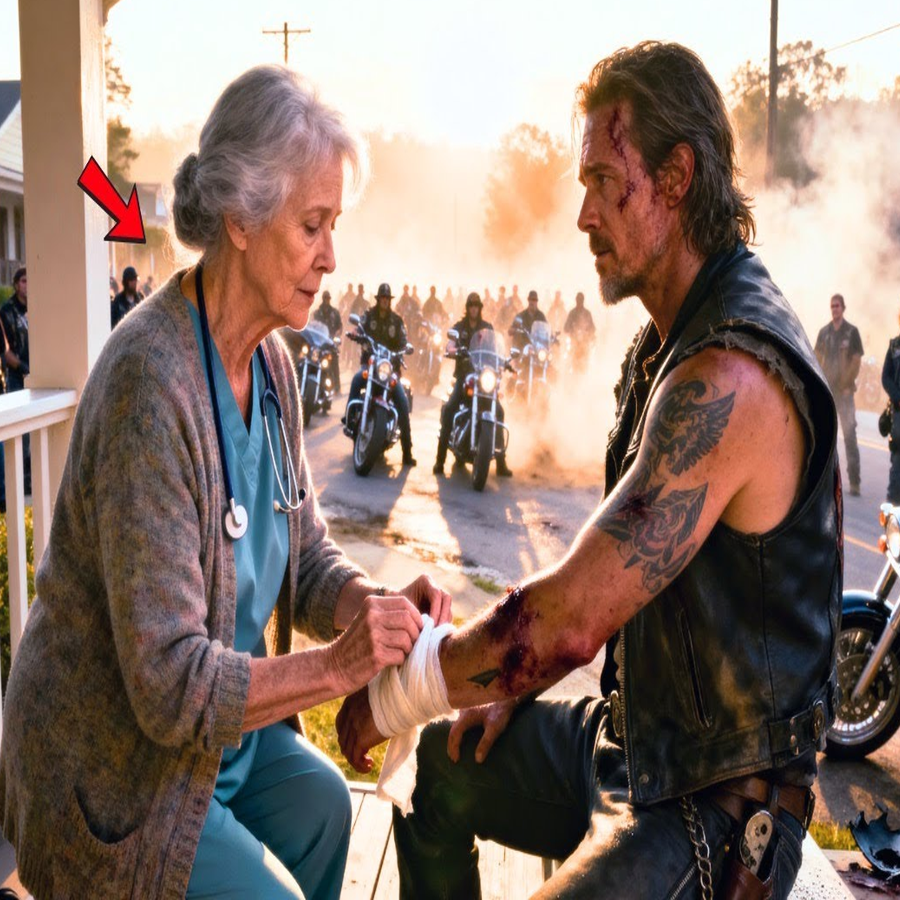
She couldn’t wait for an ambulance that might take 30 minutes to reach this forgotten corner of town. Margaret grabbed her nursing bag from the back seat and rushed toward the fallen rider. Up close, he was huge. All leather and muscle and tattoos peeking from torn sleeves. His helmet had cracked on impact with the ground, and blood matted his beard.
One leg bent at an angle. Legs shouldn’t bend. Can you hear me? Margaret knelt beside him, feeling for a pulse in his thick wrist. Strong but racing. Good. The man’s eyes fluttered open, unfocused at first, then sharp with pain and weariness. “No hospital,” he growled, trying to sit up and falling back with a groan that rattled deep in his chest.
You’ve got a broken leg. Probably ribs, too. And that cut needs stitches, Margaret said, opening her bag. I’m a nurse. I can help with the bleeding, but no. Hospital. Each word pushed through clenched teeth. They ask questions, check records. Can’t do that. His hand shot out, grabbing her wrist with surprising gentleness despite its size.
Please. Margaret looked into his eyes, young behind the hard lines life had carved around them. She thought of her house sitting empty, her first aid supplies, the pain medication left over from Robert’s final days. She thought of hospital forms and insurance questions and police reports.
“What’s your name?” she asked, already tearing open a gauze packet. “Jax.” He watched her hands work with the focus of someone used to assessing threats. You didn’t call 911. Not yet. Margaret pressed the gauze against his forehead, guiding his hand to hold it there. Can you move if I help you? My house is right there.
I’ve got supplies. It took 20 minutes of struggle and sweat to get Jax onto her couch. His massive frame dwarfing the faded floral pattern. The grandfather clock in the hall struck midnight as Margaret cut away his leather pants leg, revealing a compound fracture that made her lips thin with concern. “This needs setting,” she said.
“It’s going to hurt something awful.” Jax’s laugh was a harsh, short bark. Had worse. His eyes roamed the living room, taking in the doilies on the armrests, the collection of teacups on the shelf, the wedding photo of Margaret and Robert from 1975. Why are you helping me? Lady like you should be calling the cops on a guy like me.
Margaret didn’t look up as she prepared a syringe with steady hands. I’ve been a nurse for 50 years. Never turned away someone hurting. She worked through the night, setting the bone with a skill born from years in understaffed rural clinics, stitching the gash on his head with tiny, precise stitches that would leave minimal scarring, wrapping his ribs with firm bandages.
Neither spoke much, but in the stillness of her small house, something settled between them. An understanding made of shared pain and the simple dignity of one human helping another without questions. Morning light streamed through the living room curtains, painting gold stripes across Jax’s sleeping form. Margaret moved quietly around the kitchen, bones creaking as she prepared coffee.
She’d called the hospital with her first sick day in 3 years, her voice steady as she spoke the lie about a stomach bug. Guilt pinched at her conscience, but one glance at the massive man on her couch, breathing easier now, but still far from well, settled her resolve. The phone in Jax’s jacket buzzed for the fifth time. Margaret hesitated, then slipped it from the pocket.
15 missed calls and dozens of messages flashed on the screen. As she set it on the coffee table, Jax’s eyes opened, alert despite the pain medication. “They’re looking for me,” he said, voice rough with sleep. “My club. Should I answer? Tell them you’re safe.” Margaret placed a mug of coffee within his reach.
Jack struggled to sit up, wincing as his ribs protested. No, better they don’t know where I am. Safer for you. But by midday, a single motorcycle rumbled down Oakidge Lane, moving slowly as the rider searched house numbers. Margaret peaked through the curtains as the bike stopped in front of her house. The rider, a woman with a leather vest over her plain white t-shirt, removed her helmet and stared directly at Margaret’s window.
She found me, Jack said from behind her, leaning heavily on a makeshift crutch Margaret had fashioned from an old broom handle. That’s Raina, our scout. Before Margaret could respond, three more motorcycles appeared at the end of the street, then five more behind them. Within minutes, the quiet lane filled with the thunder of engines and the gleam of chrome.
Neighbors peeked through windows as 30 leatherclad men and women parked their bikes in a line that stretched the entire block. Jacks. Margaret’s voice shook slightly. What is this? He hobbled to the door. My family. Hell’s Angels. Michigan chapter. His face softened at her expression. They won’t hurt you. I promise. Rea reached the porch first, her eyes taking in Jax’s spinted leg, the bandage on his head, the way he leaned against the door frame.
Been looking everywhere for you, “Brother?” Her gaze shifted to Margaret, standing small but straight behind him. “This who patched you up?” Jax nodded. “Margaret? She’s a nurse. Found me crashed in front of her house. Could have called the cops. didn’t. A tall man with a gray beard and arms covered in faded tattoos stepped forward.
A patch on his vest read, “President beneath the Hell’s Angels logo.” The crowd of bikers parted for him like water around a stone. “You fixed him up?” The man’s voice was surprisingly gentle. “Without questions,” Margaret lifted her chin. “He needed help. That’s what I do.” The man studied her face, then the small house with its peeling paint and sagging gutters.
His eyes caught on the faded scrubs hanging to dry on the porch line patched at the knees. “I’m Bear,” he said, extending a hand that dwarfed hers when she shook it. “We take care of our own, ma’am, and anyone who helps our own.” As the afternoon waned, Margaret’s quiet street transformed.
Bikers moved between their motorcycles and her house, carrying bags of groceries, cases of beer, envelopes that they pressed into her hands despite her protests. Two members with construction backgrounds examined her roof and gutters, making notes and measurements. Three women from the club took over her kitchen, cooking enough food to feed an army. Mrs.
Peterson across the street finally gathered her courage and brought over a plate of cookies. Her eyes wide as a leatherclad giant with tattooed knuckles thanked her politely and offered her a beer in return. The Martinez kids darted between motorcycles, squealing with delight when Bear lifted them onto a parked bike for photos.
As twilight fell, more bikes arrived. Margaret stood on her porch, counting in disbelief as the number climbed past 100, then 200. By nightfall, 580 Hell’s Angels had transformed Oakidge Lane into something between a block party and a rally. Music played from portable speakers, grills appeared from truck beds, and laughter. So much laughter filled the air that had been so quiet for so many years.
“I don’t understand,” Margaret said, turning to Jax, who watched the scene with a small smile. “All this for you? Not for me?” He nodded toward the street where Bear was leading a group of serious-faced writers toward the porch. “For you?” Bear stood on Margaret’s porch steps, his massive frame backlit by the string lights someone had hung along the railing.
The rumble of conversations died as he raised his hand, and 580 faces turned toward him. Margaret felt small beside him, her nurse’s uniform exchanged for a simple dress that hadn’t left her closet in years. Most of you don’t know this lady. Bear’s voice carried without shouting. Her name is Ruth Jenkins. For 50 years, she’s been a nurse, helping people who needed it and asking nothing back.
He turned to face her, his weathered face solemn. Three nights ago, she found our brother Jax bleeding on her sidewalk. She could have called the cops, could have turned him away. Instead, she brought him into her home and fixed him with her own two hands. A murmur passed through the crowd.
Margaret felt her cheeks warm as hundreds of eyes studied her. “The angels have a code,” Bear continued. “We protect our own, and anyone who helps our own becomes family.” He reached into his vest and pulled out an envelope thick with cash. We took up a collection. Every chapter in three states sent what they could. Margaret shook her head, trying to push the envelope away. I can’t accept that.
I was just doing my job. No, ma’am. Bear’s voice gentled. Your job would have been calling an ambulance. This was kindness, pure and simple. He pressed the envelope into her hands. There’s enough here to fix your roof. Replace that furnace, Jack says. Make scary noises and put new tires on your car. Tears pricricked at Margaret’s eyes as she looked down at the envelope.
More money than she’d ever held at once. That’s not all. Rea stepped forward, holding a leather vest like her own, but smaller. This is for you. On the back below the Hell’s Angels patch were the words Angel of Mercy in red stitching. You’re the first honorary member who isn’t a writer. Family for life. The crowd erupted in cheers and applause as Raina helped Margaret slip the vest over her dress.
The leather was soft and warm against her arms. Strange, but somehow right. Dawn was breaking when the last motorcycles finally left Oakidge Lane, leaving behind spotless yards, repaired mailboxes, and promises to return. Margaret sat on her porch swing, the vest still around her shoulders as she watched the sun paint the sky, the same pink and gold as three mornings ago, when everything was different.
Jax hobbled out to join her. Moving better with the proper crutches the club had brought. “They’re sending someone next week to finish your roof,” he said, lowering himself carefully beside her. “And Bear wants you to know there’s a standing invitation to the clubhouse for Sunday dinners.” “Margaret smiled, running her fingers over the Angel of Mercy patch.
In all my years of nursing, no one’s ever done anything like this for me. The hospital gave me a pin for my 40th year. Plastic, not even real gold. They sat in comfortable silence, watching as Mrs. Peterson waved from across the street, no fear in her face now. The Martinez children rode bikes decorated with streamers that Raina had helped them attach.
Bear also said to tell you something else. Jax looked down at his spinted leg. “He wants you to teach me and a few others some basic medical stuff,” said a club our size should have people who know what you know. He glanced at her sideways if you wanted to. I mean, Margaret thought of the hospital, of forms and time clocks, and being called the old nurse behind her back.
She thought of her empty house and lonely evenings. She thought of skilled hands going unused after retirement next year. “I’d like that,” she said softly. “Very much.” As morning fully arrived, Ruth Jenkins rose from her porch swing. She pinned her nurse’s kaducius to her new leather vest, the small gold pin catching the sunlight.
Then she helped Jax to his feet, supporting him as they walked inside to where coffee brewed, and her phone buzzed with messages from new friends. Through the window, she could see the street where she’d lived her whole life, the same houses and trees and sidewalks. But somehow overnight, it had become home again. In her living room, Jax pointed to the empty wall beside Robert’s photo.
That’s where it should go, he said. And Margaret knew he meant the framed patch they’d given her, signed by all 580 angels, with words that made her heart full. Angels, watch over you now.