What if a child’s quiet need caught the attention of someone miles away? What if a box labeled could change a life without a single word spoken? This is the story of how a barefoot girl, a mystery biker, and one silent act of kindness transformed an entire town. Before we begin, I hope today brings you comfort, clarity, and something beautiful you weren’t expecting.
Comment below where you’re watching from. Your every comment, gift, and membership helps us bring more heartfelt stories to your life. The bell rang through the town of Ellensworth like it always did. Sharp and expectant, calling students back into the rhythm of a new school year. Backpacks bounced, lunchboxes clinkedked, and laughter echoed through the gates of Maple Hill Elementary.
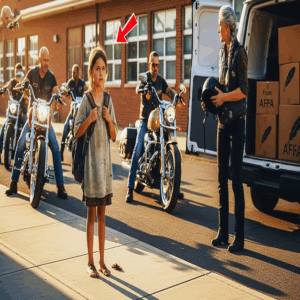
But not for Nora. She stood just outside the playground, clutching the straps of her faded backpack. Her feet pressed against warm pavement. No socks, no shoes. Her classmates didn’t point or laugh. They simply stared, unsure whether to look or look away. Norah had grown used to it. The stairs, the silence, the polite questions that adults asked with eyes instead of mouths.
Her mother had tried calling every thrift store within reach, but nothing in Norah’s size, nothing that fits both feet and dignity. So, she came barefoot, not because she wanted to be brave, but because missing school felt like a worse kind of shame. She didn’t know it yet, but her quiet courage had caught the attention of someone watching, and that someone didn’t just notice. They decided to act.
At home, Norah’s mother, Alina, sat on the edge of the kitchen chair with her hands wrapped around a chipped coffee mug. She didn’t drink from it. She just held it like something to ground her. Bills were piled on the counter, and the fridge buzzed loudly in the silence. Alina had always found a way, even when life twisted tighter around her.
She worked nights at the diner, picked up shifts at the laundromat, and sold homemade soap at the farmers market. But this year had hit harder. Rent went up. Hours were cut. And just before school started, Norah’s shoes split clean through at the toes. There wasn’t enough for the new ones. Not after groceries, not after the electric bill.
Alina cried once in the car where Nora couldn’t see. But that morning, watching her daughter walk barefoot out the door, something inside her cracked. She had failed in a way that felt loud, even though no one said a word. If only someone, anyone could help. But in small towns, pride keeps pain quiet, and help doesn’t usually roll in until it does.
Two days after school began, a hum broke the stillness of Ellensworth’s main street. The kind that starts low and rolls in thick. Not traffic, not thunder. Engines. A line of motorcycles curved around the old post office. Their chrome catching the sun in blinding streaks. People came out onto porches, shielding their eyes.
Riders, leather, patches, helmets. But this wasn’t a rally. No flags, no chaos, just motion, steady, intentional. They weren’t from around here. And at the front, leading them all, was a woman named Frankie Hol, broad-shouldered, gray braid down her back and a leather vest with four stitched letters, FFA. They rode past the gas station, past the grocery store, until they stopped outside the school.
Engines cut. Silence fell. And then the doors of a white van behind them swung open. Inside were boxes, dozens of them. Each one was labeled the same way. From angels forever. Forever angels. From her classroom. Norah heard the engines first. Her teacher paused mid-sentence, glancing toward the windows.
A few children pressed their faces to the glass, whispering guesses. Norah didn’t move. She was used to being invisible in moments like this. Never the one called to the front. Never the one things were about. But her eyes flicked to the parking lot. She saw the bikes, the tall woman stepping down, and then the boxes.
Something about them made her sit up straighter. A small flicker of hope sparked inside her chest, almost too small to feel. In the office, the principal looked confused as Frankie walked in, helmet under her arm, smile calm but firm. We’re here for someone, she said. Someone who needs shoes. The secretary blinked.
Do you have a name? Frankie nodded once. We’ve got several, but we heard about a girl. She placed a box on the desk. If it’s the right size, give her these and tell her. We came because she matters. The call came over the intercom just before lunch. Norah Lane, can you come to the office? Heads turned. Norah froze.
She had never been called out of class before. Not for anything good, anyway. Her palms sweated, her heart raced. She walked the hallway slowly, her bare feet whispering against the tile. When she stepped into the office, she saw the box, small, labeled in thick black marker from AFA. Her name was on a sticky note beside it. No card, no instructions.
The secretary just smiled and said, “They’re yours.” Inside were shoes, not just new, but perfect. Soft Saws, sturdy stitching, and her favorite color. Norah stared at them like they might disappear if she blinked. “Try them on,” the secretary said gently. “She did. They fit. Not just her feet, but something deeper.” That afternoon, Nora ran across the schoolyard with the other kids, her laughter ringing through the trees.
She didn’t know who AFA was, but for the first time in weeks, she felt light. Not because of the shoes, but because someone somewhere had chosen to see her. By the next morning, the news had made its way down every hallway, alley, and kitchen table in Ellensworth. Did you hear about the girl with no shoes? The biker woman boxes marked AFA.
Some believed it was a corporate campaign. Others guessed it was a church group in disguise. Theories filled the space where facts hadn’t yet landed. But one truth everyone agreed on. Someone had come to help and they hadn’t asked for anything in return. At the diner, old men stirred their coffee more slowly, eyes fixed on the window.
At the school gate, mothers whispered while watching their own kids’ shoes. And in the mayor’s office, a letter had arrived. No sender, no logo, just two sentences on a plain sheet of paper. We look where others don’t. AFA. The signature was a drawing. A single feather sketched in quiet detail. The mystery wasn’t frightening. It was humbling.
Someone was seeing them. Not just their buildings or names, but their cracks, their quiet needs. And that kind of attention felt sacred. It wasn’t just Nora. The day after her shoes arrived, a teacher noticed a boy in third grade wearing a jacket two sizes too small. He never complained. He just pulled his sleeves tight when the wind bit.
On Thursday, a new coat appeared on his desk, folded with his name written on a paper tag. In the staff room, teachers found more boxes. Inside socks, backpacks, notebooks, lunchboxes, each labeled from AFA, and always the same feather sketch on the corner. The staff began keeping a quiet list of kids who needed help. but wouldn’t ask.
The boxes kept matching the names. No one saw the riders again. No engines, no vans, just boxes, as if the road itself was delivering them. Nora, now wearing her new shoes with quiet pride, began asking her mom if they could write thank you notes. To whom, sweetheart? Alina asked. to them.
Norah said, even if we don’t know where to send it that night, she drew a picture of her shoes and below it wrote in careful block letters. You made me feel seen miles away in a modest home on the edge of a dusty road. Frankie Holt sat cross-legged with a leatherbound journal spread across her knees. She had done these rides for years. AFA wasn’t just a name.
It stood for all for future angels. A small self-funded circle of writers who travel town to town, delivering what systems often overlooked. No press, no posts, just precision. Frankie flipped through her notes, scribbled conversations, handwritten school supply needs, tiny maps drawn from memory. Ellensworth had been a tip from a former teacher she met at a gas station two months ago.
She’d followed it like a breadcrumb. And she’d been right. The need was small but sharp. Children going unnoticed. Families too proud to ask. Frankie ran her fingers along Norah’s name on the list. She always wrote their names. Not for records, just so she’d never forget who mattered. When people asked why she rode, she never explained.
She didn’t need to. The road knew. And somewhere a girl was running in new shoes. That was all the answer she needed. Back in Ellensworth, something unusual was happening. Inspired by the boxes, locals began doing what they hadn’t in years, paying attention. A high schooler named Jason noticed his neighbor. A veteran named Earl using duct tape to hold his mailbox shut.
The next morning, a brand new box was bolted to the post with no return address. The local groceryer started adding community cart slips to receipts. If someone left even $1, it went to buying milk, diapers, and bread for whoever needed it. A shift had begun, one not driven by pressure, but by example. Norah started a kindness corner at school where kids left notes, shared snacks, or brought gently used items for others.
The principal let her because something had changed. It wasn’t just generosity. It was awareness. The kind that doesn’t wait to be asked. The kind that listens between the silences. In the middle of it all was Nora. Still small, still quiet, but now a spark in the town’s breath. On a gray morning marked by gentle rain, Norah arrived at school to find something strange by her locker.
A small white envelope with no name. Inside a single sketch, a feather drawn in pencil, delicate and simple. Nothing else. She held it like it might break. Her fingers trembled. Later that day, her teacher pulled her aside and said, “There’s a woman who dropped this off. Did she say anything?” Norah asked. The teacher shook her head.
“Just smiled.” Then she rode off. That night, Norah placed the feather sketch in a frame beside her bed. Alina stood in the doorway, watching her daughter’s eyes shimmer with something rare. Not just gratitude, but belief. What does it mean? Alina asked gently. Norah looked up and whispered. “It means someone’s out there and they see us.
Even when we don’t say a word, she lay down quietly. And as she fell asleep, her new shoes tucked neatly by her bedside.” Norah dreamed not of running, but of someday riding too, delivering hope the same way it found her. Frankie didn’t stay in Ellensworth. She never did. Once the mission was complete, once the boxes were delivered and the eyes started to soften, she moved on.
Not because she didn’t care, but because others waited. The AFA writers believed in one thing. Seed the ground, then let it bloom. They never stayed for applause. But as she rode toward the next town, wind tugging at her braid, she carried something new in her journal. Norah’s feather sketch. She tucked it behind the cover right next to a Polaroid of another girl from another ride, another miracle.
Frankie didn’t smile often. But that morning, she did. Not for long, just enough. Because something about Ellensworth felt like more than a success. Felt like a spark. And sometimes when sparks land in the right soil, they catch fire. Principal Harrow had been at Maple Hill Elementary for over 20 years. He had seen fads, funding cuts, and faces come and go, but nothing like this.
The last two weeks had shifted something deep in the students. Bullying dropped. Volunteers surged. Even the teachers moved with a new purpose. One afternoon, Harrow found himself walking toward the same diner where the AFA riders had stopped. He didn’t know what he was looking for. A trace, card, person. Instead, he found a waitress cleaning menus.
Did they say where they were going next? He asked gently. She shrugged. Nope. Just left a napkin that said Ellensworth matters. Look after it. Harrow took the napkin home and pinned it on his corkboard above his desk. That evening, he wrote a proposal to the district. A plan to create an annual day of need awareness. No speeches, just listening, just noticing.
The AFA writers hadn’t stayed, but their impact had. It was Norah who had the idea first. “What if we planted something?” she asked during a school assembly. “To remember them?” The principal hesitated, unsure if it was too symbolic, too fragile. But Norah’s eyes didn’t waver. “It doesn’t have to be big,” she added.
So, they planted a tree, a small cherry blossom sapling near the school’s entrance. The whole school gathered. Every child tied a ribbon to its base, each one holding a handwritten promise. “Be kinder. Help others. Notice the quiet ones.” And at the very top of the treere’s plaque in quiet lettering, it read, “Planted in honor of the ones who give without being seen from AFA.
” No photos were taken. It wasn’t for the internet. It was for them, the town, the children, the invisible helpers who had taught them how to see. Alina found Norah one night sitting cross-legged on the floor writing. The room was quiet, the air still. “What are you working on?” she asked. Norah looked up. Letters, she whispered. To them.
She held up a bundle of envelopes. None with addresses. I don’t know where to send them, but I need to write them anyway. Each letter was short, written in pencil, carefully folded. Thank you for my shoes. You made me brave. I want to be like you when I grow up. How did you know? Alina sat beside her, pulled out a piece of paper, and started her own.
Her words came slowly. You saw my daughter when I couldn’t provide. You helped without making me feel ashamed. That means everything. They never mailed the letters. They placed them in a shoe box under Norah’s bed. Their own secret tribute, a growing archive of gratitude, invisible to the world, but heavy with meaning.
Because sometimes you thank someone not with applause, but with an echo. Frankie always left one note per ride, just one. She slid it into a school’s mailbox or left it taped under a diner table or hidden between books at the library. In Ellensworth, she tucked it into the front door slot of Maple Hill Elementary.
The janitor found it and handed it to the principal. The paper was soft, folded many times. It read, “We don’t need recognition. We just believe no child should feel invisible. When you notice someone really notice them, you become part of AFA. Pass it on.” At the bottom was the feather. From that day forward, the people of Ellensworth began leaving feathers on each other’s doorsteps.
Sometimes with small gifts, sometimes with just a note, “You matter. We see you. You’re not alone.” The feathers spread to lockers, windshields, mailboxes, and so long after the riders disappeared. Their symbol remained, not just drawn, but lived. Months passed. Autumn softened the air, and Ellensworth moved through its seasons.
But something had changed for good. The from AFA boxes no longer arrived, but the actions they inspired never stopped. A neighboring town, Bramble Ridge, began its own silent kindness board. Someone had left a feather there, taped beside a pair of shoes. The school principal from Ellensworth had spoken at a teacher conference and shared Norah’s story.
That same week, three districts launched anonymous donation drives for students in need. No press releases, no logos, just quiet resolve. Frankie never knew how far it spread. She never checked. She was already on the road, already listening for the next whisper. That’s what AFA was.
A chain not held together by metal or brand, but by hearts tuned to the quiet hearts that understood that sometimes the smallest kindness can echo into someone else’s forever. Three years passed. Norah was taller now, her voice stronger, her eyes still soft. She volunteered at the school library and helped with the coat drive every winter.
One afternoon, while unpacking donated clothes, she opened a worn box and froze. Inside, folded neatly on top, was a child’s sweater, and tucked beside it a feather, not drawn, real, pale gray, almost translucent. She held it between her fingers, her breath caught in her chest.
She didn’t say anything to the others. She didn’t need to. That evening, she visited the cherry blossom tree. It had grown taller, its branches stretching proudly over the school’s walkway. Norah sat at its base and whispered, “I remember somewhere far away, a rider crossed a county line, unaware that a single feather had reopened a sacred memory.
That’s how legacies work. quiet, deep, permanent. In the basement of Maple Hill Elementary, the new principal discovered an old shoe box while organizing storage. Inside were dozens of envelopes, letters written in small, careful handwriting. Most were insigned. A few were drawn with stars and hearts. All of them were written to AFA.
The box was taken to the school’s main hallway, turned into a display case with a small plaque that read letters never sent. Words that carried us forward. Children would stop there, press their noses to the glass, and read the notes. Thank you for helping my mom smile again. I want to help people like you helped us.
Some teachers began using the letters in class. Others made them part of the graduation speech. Nora, now 15, visited once a week, not to read the words, but just to remember that once a stranger taught her what it meant to be truly seen. No one expected the bikes to return. Not really, but on a breezy spring morning, as the town prepared for the annual kindness fair, a low hum stirred the air.
It grew louder, familiar. Children dropped their paintbrushes. Shopkeepers stepped outside. The mayor placed her hand over her heart. One by one, motorcycles rolled down Main Street. Not a parade, not a spectacle, just presents. Frankie was there, her braid now streaked with silver. She stopped outside the school, dismounted, and looked at the cherry tree.
Nora was waiting, older now, stronger. Their eyes met. No words, just a nod. Then Frankie pulled a small package from her saddle bag. Inside was a jacket, black denim, child-sized with four stitched letters across the back. FFA. Norah hugged it to her chest, not as a fan, but as the next rider. Years later, people would still talk about that first ride, the shoes, the boxes, the mystery.
But in Ellensworth, the story didn’t end there. Norah grew up and became the youngest member of AFA. She rode with Frankie once, then again, then always, and she understood now what she couldn’t then, that the mission wasn’t to save the world in grand gestures. It was to listen for the softest cries, the ones too proud to speak.
She never chased fame, she just chased need. And wherever the road bent, a lonely porch, a struggling school, a cracked smile, she stopped, delivered, left a box or a feather, sometimes both. And when asked, “Who are you?” she just smile and say, “You’ll know soon enough.” Because kindness, when given with no expectation, never truly disappears.
It rides forward just like they did. If the story moved you, don’t let it end here. Share it. Start your own ripple. Kindness doesn’t always ride in on a motorcycle. Sometimes it starts with noticing. Subscribe for more stories of hope and tell us what’s one silent act of kindness that changed your life.