A 17-year-old kid was walking home from his dishwashing job when he heard a motorcycle breaking down in the pouring rain. So, he stopped to help push it three blocks to the nearest garage, never bothering to look at the patches on the rider’s leather vest. 6 months later, when his family was about to lose everything, that same teenager made a phone call that would change his life forever.
But what happens when you accidentally do a favor for the captain of the most dangerous motorcycle club in the state? And what did those bikers do when the kid who helped their leader needed help in return? The rain hammers Roosevelt Avenue like machine gun fire. Each droplet exploding against cracked asphalt that gleams under the sickly yellow street lights of downtown Chicago’s forgotten edge.
Steam hisses from manholes, creating ghostly pillars that twist upward into the November darkness, while the smell of wet concrete mingles with exhaust fumes and the metallic tang of rust bleeding from fire escapes and chainlink fences. Marcus Chen pulls his thin hoodie tighter around his 17-year-old frame. The fabric already soaked through and clinging to his shoulders like a second skin that offers no warmth, no protection from the storm that appears bent on washing away everything he’s fought to hold together. His sneakers
squaltch with each step, water seeping through holes he’s been meaning to patch with duct tape for weeks now. And in his right pocket, 23 crumpled dollar bills press against his thigh. Three hours of scalding dishwater and endless plates at Romano’s diner. Money that represents beyond just wages, beyond mere time traded for survival.
His fingers still burn from the industrial soap that strips skin raw, leaving his knuckles cracked and bleeding in places where the harsh chemicals have eaten away at flesh that never quite heals between shifts. And his lower backs from hunching over steel sinks that never seem to empty. a constant reminder of the price his body pays for every dollar he earns.
All Marcus can think about is the prescription bottle sitting empty on their kitchen counter. The one with his mother’s name printed in neat pharmacy labels that might as well be written in a foreign language. For all the hope they offer when your bank account holds more prayers than pennies. The diabetes medication costs exceeding what he makes in a week, surpassing their rent, greater than the fragile mathematics of survival allow.
But without it, his mother’s condition will spiral beyond what their threadbear insurance can cover, beyond what love and determination can heal through sheer force of will. “Mama’s going to be okay,” he whispers to himself. The words lost in the storm’s fury. But he needs to hear them. needs to believe that $23 can stretch far enough to cover her insulin until his next shift.
That somehow the math will work out differently this time, even though it never has before. The memory of her face this morning pale and drawn, her hands shaking as she pretended to drink coffee that was mostly hot water because they ran out of grounds 3 days ago. to burns brighter than the neon signs flickering behind rain streaked windows of the pawn shops and liquor stores that line his route home like sentinels of broken dreams.
Three blocks ahead, their apartment building rises like a broken tooth against the skyline, its brick facad stained with decades of weather and neglect. windows dark except for the occasional flicker of television light that suggests life still clings to these walls despite everything working against it.
Somewhere on the fourth floor, behind a door marked 4B in peeling gold numbers, his 10-year-old sister Lily sits at their wobbly kitchen table, probably still struggling with the fractions homework he promised to help her with before his shift started 12 hours ago, waiting for him like she does every night since their father walked out 6 months ago with nothing but a mumbled apology and a suitcase that couldn’t hold all his broken promises.
The thought of her small face pressed against their window, watching for his return through glass that rattles in its frame whenever the wind picks up, pushes Marcus forward through puddles that have become small lakes. Past the bodega, where Mrs. Rodriguez always asks about his mother with eyes full of sympathy he can’t afford to acknowledge.
Past the bus stop where teenagers his own age huddle under the insufficient shelter of plexiglass that’s been tagged so many times. The graffiti has become its own kind of abstract art past the church with its broken cross and boarded windows that stopped offering sanctuary when the congregation could no longer afford to keep the lights on.
Marcus keeps his head down, counting his steps toward home when something breaks through his desperate calculations. A sound that cuts through the storm like a wounded animal crying out in the darkness. A deep mechanical weeze followed by the frustrated growl of an engine that refuses to catch. Then silence that feels heavier than the rain itself.
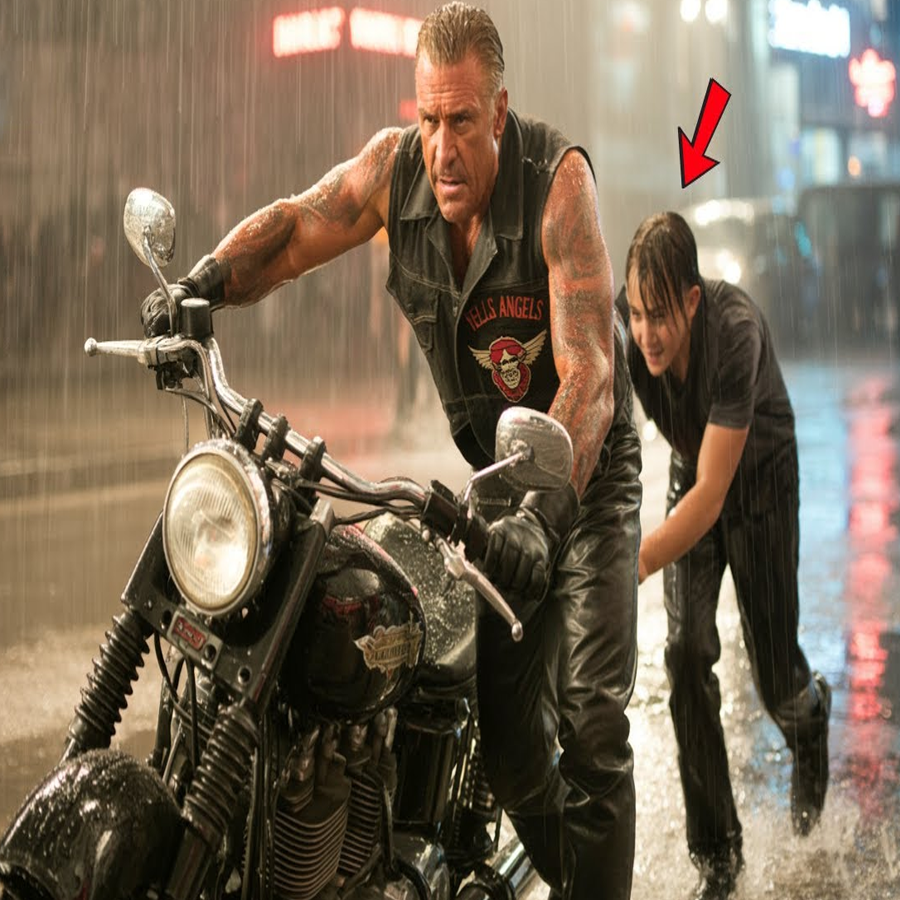
Marcus stops midstride, moisture cascading down his face as he peers through the downpour toward the massive shape hunched against the curb like some prehistoric beast brought low by forces beyond its control. The motorcycle is enormous. All chrome and black steel dulled by the relentless precipitation. Its engine block steaming in the cold night air with the acrid smell of burned oil that makes his eyes water.
Beside the machine stands a mountain of a man whose leather jacket has seen more miles than Marcus can imagine. Decades of road dust and desert sun and stories that would probably terrify most people. But right now, all Marcus sees is someone else caught in the storm’s merciless grip.
The man’s beard drips steadily, and his massive hands rest on the bike’s handlebars with a gentleness that seems at odds with everything about his imposing presence. Hands that shake not from the cold, but from something deeper. A look painfully familiar to the teenager who knows what it means to feel powerless against circumstances that seem designed to crush you.
Damn thing picked a hell of a night to die on me,” the man mutters, his voice like gravel mixed with honey. And there’s a quality reminding Marcus of his own father during those last weeks before he left. That same note of defeat wrapped in false bravado. The leather vest bears patches that Marcus doesn’t recognize. Skulls and wings and Gothic script that speaks of brotherhood and territory and things his suburban upbringing never taught him to decode.
But patches don’t matter when. You’re stranded in a storm that shows no mercy to anyone, regardless of what colors they wear. You need help pushing it? Marcus calls out, his voice barely audible above the rains assault on metal and concrete. And when the man looks up, his eyes are the color of winter storms, weathered and hard, but carrying something that looks almost like surprise, as if kindness from strangers has become rarer than he ever expected it to be.
For a moment, they study each other across the flooded street, the mountain of leather and muscle who belongs to a world Marcus has only glimpsed in movies, and the skinny kid in the soaked hoodie who barely looks old enough to drive. and something passes between them that has nothing to do with age or appearance or the vast differences in their circumstances.
“Kid, you sure about that?” the man asks. And there’s genuine concern in his voice as if he’s trying to protect Marcus from something. But the teenager is already stepping forward, already positioning himself at the bike’s rear wheel, his hands finding purchase on whatever solid piece of metal they can grip.
The machine weighs more than anything Marcus has ever tried to move, its bulk anchoring it to the asphalt like it was born from the street itself. But when he leans his full weight into the effort, the man mirrors his movement, and together they begin the slow, laborious process of coaxing the beast forward through water that runs red with rust from the city’s aging infrastructure.
Names tank,” the man says between labored breaths, offering this piece of himself like a gift. And Marcus tells him his own name in return. Feeling oddly honored by the simple exchange as they navigate around potholes that have become treacherous lakes, their combined effort creating a strange rhythm in the chaos of the storm.
Three city blocks stretch before them like an endless gauntlet of flooded asphalt and flickering neon. Each step a battle against the motorcycles tremendous weight and the storm’s relentless assault on their already exhausted bodies. Marcus’ lungs burn with each labored breath. His thin frame straining against forces that seem determined to break him.
But something about Tank’s quiet determination keeps him moving. keeps him focused on the rhythm of their footsteps splashing through puddles that reflect the city’s lights like shattered mirrors. The older man occasionally glances at him with what might be respect or maybe just curiosity about this skinny kid who stopped to help when everyone else hurried past with averted eyes, their umbrellas bent against the wind like broken wings.
You don’t have to do this, you know, Tank says as they pause at a red light that flickers uncertainly in the downpour, his massive chest heaving with the effort of the last two blocks. And there’s a tone suggesting this simple act of kindness has caught him completely offguard. Marcus wipes rain from his eyes with the back of his free hand, tasting salt and city grime and something else, something that might be the metallic flavor of his own determination.
his refusal to let go when someone needs help, even if that someone is a stranger whose world exists in a completely different orbit from his own. “My dad used to say, you help people when they’re down, no matter who they are,” Marcus replies. The words coming out before he can stop them. And immediately he wishes he hadn’t mentioned his father wishes he hadn’t opened that particular wound.
In front of this man whose own scars probably run deeper than anything a 17-year-old could imagine. But Tank just nods, a slow acknowledgement that suggests he understands something about absent fathers and the lessons they leave behind, both good and bad. and they lean back into the bike’s weight as the light turns green and the city swallows them once again.
The neon sign of Tony’s allight garage appears through the rain like a beacon of hope, its red and blue letters buzzing with electricity that casts strange shadows across the flooded street. And Marcus feels something shift in Tank’s posture. A visible relaxation that speaks of sanctuary. Finally, within reach, the garage bay doors are open, spilling fluorescent light across the wet pavement.
And inside, Marcus can see the silhouettes of other motorcycles. Chrome gleaming under industrial fixtures that turn the space into something almost cathedral-like in its mechanical devotion. Almost there. Tank breathes. But his voice carries more than relief. There’s something approaching reverence in his tone, as if this place represents more than just motorcycle repair, more than just shelter from the storm.
As they guide the massive bike through the garage’s entrance, Marcus notices other men emerging from the shadows. All leather and muscle and faces that have seen more than their share of hard roads. But their expressions soften when they see Tank. When they realize their captain has made it safely through whatever trial the knight has thrown at him.
Who’s the kid? One of them asks. His voice carrying that familiar suspicion Marcus recognizes from his own neighborhood. The weariness that comes from living in a world where trust has to be earned rather than given. And Tank’s response cuts through the tension like a blade through silk. This kid pushed my bike three miles through this storm when he could have walked on by,” Tank says, his hand falling on Marcus’ shoulder with a weight that feels like both protection and benediction.
“And suddenly, the garage falls silent, except for the sound of rain drumming against metal and the distant hum of fluorescent lights that illuminate a moment Marcus will remember for the rest of his life.” When Tank turns to face him fully, rain streaming down his weathered face like tears he’s probably never allowed himself to shed, Marcus sees something in those winter storm eyes that takes his breath away.
Not the hardness he expected, not the danger his mother would have warned him about, but a recognition that runs so deep. An understanding that passes between people who know what it means to carry weight that threatens to crush them. The tough exterior cracks just enough to reveal something unexpectedly tender.
Something that speaks of a man who has spent years building walls around his heart only to have them breached by a 17-year-old kid who stopped to help in the rain. “Kid, you got no idea what you just did for me,” Tank says, his voice thick with emotion that the storm can’t wash away. and he reaches into his leather jacket with movements that are almost ceremonial in their deliberateness, pulling out a business card that’s been worn soft from handling.
Its edges rounded by countless miles and memories. The card is simple, black with white lettering that seems to glow under the garage’s harsh lights. Tank Morrison, Brotherhood Motorcycle Club. When you need family, call. He presses it into Marcus’s palm with hands that completely engulf the teenager’s smaller ones.
And Marcus can feel the warmth of the older man’s skin, can sense the weight of whatever promise this simple piece of cardboard represents. Anything you need, anytime you call that number, Tank continues, his eyes locked on Marcus’ with an intensity that makes the teenager’s heart race. And around them, the other bikers nod their approval.
their faces reflecting something that looks like respect for this skinny kid who helped their captain without asking for anything in return. Marcus stares at the card through the wetness trailing from his hair, not understanding the magnitude of what he holds, not knowing that the patches on Tank’s vest mark him as captain of the most feared motorcycle club in three states, not realizing that his simple act of human kindness has just earned him the protection and loyalty of men who would ride through hell for each other. The moment
stretches between them like a bridge across two different worlds. The successful businessman Tank used to be in another life recognizing something of his younger self in this kid who works dishwasher shifts to keep his family afloat, who helps strangers push broken motorcycles through storms because it’s the right thing to do.
Then Tank disappears into the garage’s fluorescent lit bay with his brothers surrounding him like a protective wall, leaving Marcus standing alone in the rain with $23, a business card, and the strange sensation that his life just shifted in ways he can’t yet comprehend. 6 months would pass before Marcus truly understood the weight of that rain soaked promise.
When the insurance company tried to evict his family after his mother’s accident, when hope seemed as distant as that November night, he would remember Tank’s words with perfect clarity and reach for a worn business card that had been waiting in his wallet like a lifeline he never thought he’d need to News.