Imagine the Appalachian Mountains in the late 19th century. Endless ridges cloaked in dense forests, mist curling around isolated cabins, and small villages where every neighbor knew your name but not your secrets.
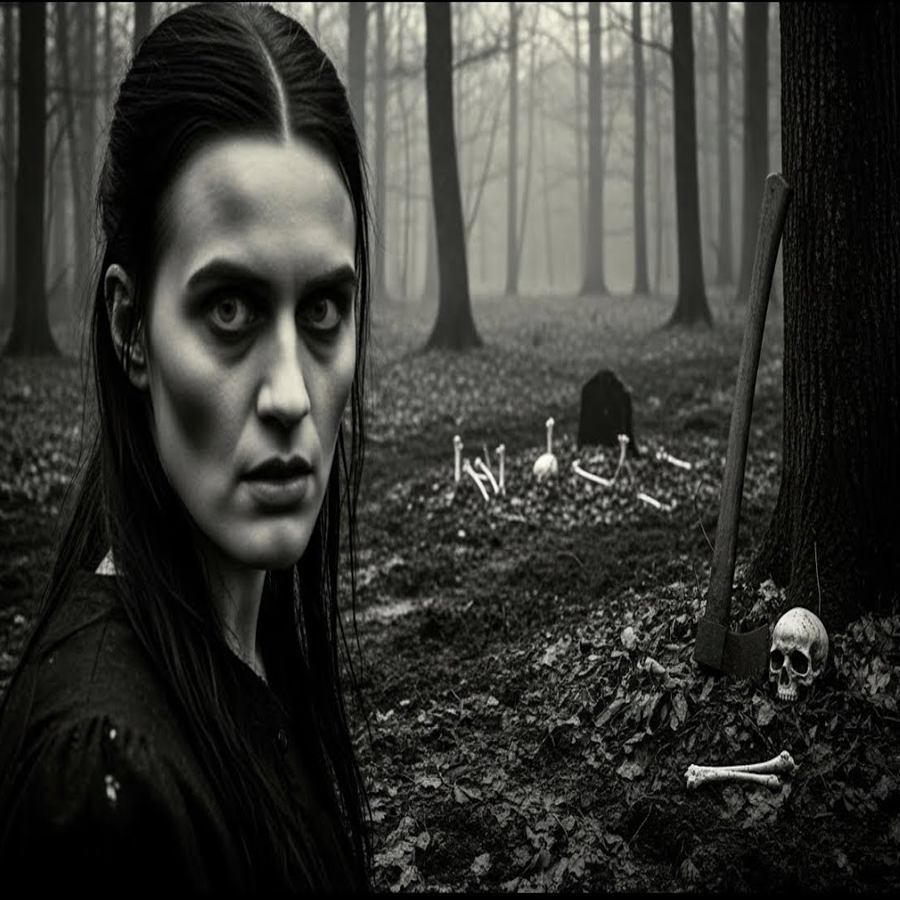
It was here in the remote county of Hawthorne that Eivelyn Caro arrived, barely 22, with a smile that could disarm suspicion and eyes that seemed to study every detail. To outsiders she was polite, charming, and intelligent, a young woman with dreams as vast as the mountains themselves. But beneath that veneer lay a mind trained in observation, patience, and manipulation.
From the moment she settled in Hawthorne, the local men could not help but notice her. Eivelyn had a way of making anyone feel seen, understood, even admired. She would attend church gatherings, local fairs, and Sunday markets with a grace that drew attention. Yet her presence left a strange tension in the air.
It was subtle, but those who encountered her more than once sensed an uncanny precision in her movements, the careful calculation behind every word. And then the disappearances began. Henry Caldwell, a widowed farmer in his 40s, was the first to vanish. His cabin was left untouched, the hearth cold, and his horse wandering free in the meadow.
Neighbors assumed he had gone on a business trip or sought work elsewhere, but days turned into weeks, and he did not return. People began whispering. Evelyn’s calm demeanor, her quiet composure in the wake of Henry’s absence, did not go unnoticed. Instead of panic or despair, there was a subtle satisfaction in the way she managed the household, in the way she navigated towns folk who asked uncomfortable questions.
She became a figure of fascination and fear, a young woman whose charm masked something darker, something dangerous. But this was only the beginning. Eivelyn was patient, observing the weaknesses as of those around her, identifying the men who were vulnerable, isolated, wealthy, or unsuspecting, and waiting for the perfect moment to strike. The mountains themselves seemed to shield her actions.
The dense forests a perfect cover for secrets no one dared to follow. Over the next few years, Hawthorne would witness a series of disappearances, each more chilling than the last, leaving behind a trail that would eventually earn Evil in Carrow a name whispered with fear. The Black Widow of Hawthorne.
Next, we dive into the life of Henry Caldwell, the first man to cross paths with Evil in Caro, and the mysterious circumstances that surrounded his disappearance.
Henry Caldwell was a widowerower in his early 40s, a man known for his honesty and hard work on the small plots of farmland that stretched along the Hawthorne valleys. Widely respected in the community, he lived a quiet life, his days consumed by the rhythm of sewing and harvesting, and his nights by the creaking floors of his modest cabin.
When Evelyn Caro arrived in town, Henry’s attention was immediately drawn to her. She carried herself with a poise uncommon for someone so young. Yet there was warmth in her smile that made Henry feel as though she understood him in ways no one else could. Their acquaintance began with small conversations at church and market stalls, where Eivelyn would ask questions about his land, his family, and the challenges of managing alone.
Henry, like many men in Hawthorne, had longed for companionship, someone to share his solitude with. Evelyn offered that and more, attention, admiration, and a charm that seemed effortless. Within weeks, their relationship progressed quickly. To neighbors, it seemed as though Henry had found a reason to smile again.
Invitations for Evelyn to stay at his cabin grew frequent, and soon whispers of a possible marriage began circulating through the tight-knit community. But Evelyn’s interest was never in companionship alone. Her focus was calculated, methodical, her attention drawn not to Henry as a man, but to his property, his wealth, and the vulnerability that came with his solitary life. Then came the night that would forever change the trajectory of the valley’s history.
According to later accounts from neighbors who heard faint disturbances, Eivelyn had been at the cabin the evening Henry disappeared. Henry’s voice, firm and authoritative, had clashed with Eivelyn’s softer yet unwavering tone. The argument was never fully witnessed, but echoes of conflict floated across the frostcovered hills.
By morning, Nang, Henry Caldwell was gone. The cabin remained in pristine order, no sign of struggle except for a rope hastily hidden beneath the floorboards and the faint trace of blood on a chair. Evelyn claimed later that Henry had been abusive, that she had acted in self-defense, but there were no witnesses to corroborate her story.
The town’s people, cautious and superstitious, hesitated to intervene immediately, assuming Henry might have traveled to nearby counties. Weeks passed, and the reality became undeniable. Henry Caldwell was gone, vanished without a trace. Eivelyn, ever composed, managed the property, attended church, and continued her daily routines as if nothing had occurred.
Yet beneath the calm, she was already laying the groundwork for the next phase of her plans. For Evelyn, Henry Caldwell was only the beginning, a test of her methods, a demonstration of her ability to manipulate charm and control. The mountains, dense and unforgiving, concealed her secret well.
No one could have imagined that a young woman, appearing so delicate and harmless, could orchestrate such a calculated disappearance. As the valley whispered and rumors spread, Evelyn in Carol’s reputation as a figure of intrigue and danger began to take shape. Next, we uncover the investigation that would follow Henry Caldwell’s disappearance, the first signs of suspicion, and the meticulous clues that would eventually start revealing the truth about Evelyn Carrow’s deadly pattern.
The disappearance of Henry Caldwell shook the Hawthorne Valley more than anyone could have anticipated. At first neighbors assumed he had traveled to visit distant relatives or attend to business in the nearby town of Elmwood, but as days turned into weeks, the absence of any word from Henry became impossible to ignore.
Concern turned into suspicion, and the local constable, Amos Ridley, was called in to investigate. Ridley was a meticulous man, methodical in his approach, yet even he had never faced a case of this nature. He began by visiting the Caldwell cabin, noting every detail with careful precision.
The house appeared undisturbed, the hearth still warm, the table set as if Henry had only stepped outside. But subtle irregularities caught Ridley’s eye, a small trace of blood on the chair near the fireplace, a rope tucked under the floorboards, and the faint impression of recently moved soil in the backyard garden. Ridley interviewed neighbors, collecting every scrap of observation.
One elderly woman reported hearing voices arguing late one night, a man’s deep tone clashing with a woman’s softer, commanding voice. Another mentioned seeing evil in carol lingering near the cabin at odd hours, her expression unreadable, her composure unsettling.
Though each account seemed minor in isolation, Ridley began piecing together a pattern. Elyn had arrived in the valley only months prior, yet she appeared to know precisely how to navigate the community, ingratiating herself with towns people while subtly drawing attention to Henry’s vulnerabilities. While Ridley collected these testimonies, he also examined the property records.
He noted that Henry’s holdings, land, livestock, and savings were substantial for a man of his age and background. Ridley suspected that someone might have had a motive beyond personal animosity. With each day, the list of irregularities grew. The rose p the minor traces of blood, the witness accounts, all painted a picture that no casual observer could ignore.
Ridley began to suspect that Henry Caldwell had not simply left voluntarily. Evelyn Carol’s role in his disappearance became central to the investigation. Yet, the young woman remained calm, even serene, in public. She visited neighbors, attended church, and smiled politely at those who inquired about Henry. Her charm masked a meticulous strategy, one that Ridley would slowly uncover over the following weeks.
Meanwhile, the valley’s sense of unease grew. Families whispered behind doors. Children overheard hushed conversations, and the once quiet streets seemed charged with anticipation. Rumors began to swirl about Eivelyn’s past, about other men she had known, and about her unusual interest in property and inheritances. Ridley took careful notes of every detail, aware that the first misstep could allow crucial evidence to slip through his fingers. As Snow began to dust the surrounding hills, he widened the search, exploring
nearby creeks, forests, and abandoned structures where Henry might have been concealed. Each lead seemed to fade into the mountains vast, unyielding expanse, but Ridley persisted, guided by an intuition born of experience. Every observation, no matter how small, brought him closer to understanding that Henry Caldwell’s disappearance was not a simple case of misfortune.
It was a carefully orchestrated event, and the woman who had captured his heart was now at the center of a growing storm. Next, we delve into the shocking discoveries that would unearth the first tangible evidence linking Evelyn Caro to Henry’s fate, setting the stage for a trial that would captivate the region. The search parties had been scouring Hawthorne Valley for weeks when the breakthrough finally came.
Deep in a ravine on the outskirts of Elmwood, a group of local farmers noticed a strange mound beneath a tangle of roots and fallen leaves. Curious, they called in Constable Ridley, who arrived with a small team, each man equipped with shovels and lanterns, the winter sun already dipping behind the mountains.
As they cleared the debris, a chill ran down Ridley’s spine. The soil beneath the undergrowth had been recently disturbed, forming a shallow depression in the earth. When the first shovel full of dirt was lifted, the unmistakable glint of metal appeared. Henry Caldwell’s pocket watch, tarnished by exposure, yet still intact, its chain coiled in the soil.
The team exchanged uneasy glances. Ridley instructed them to proceed carefully. Hours later, the ground revealed more than just personal effects. The soil gave way to fragments of clothing, tattered and muddied, and horrifyingly human remains, an arm partially buried, a skull peeking from beneath the leaves. Ridley’s stomach tightened. This was no accident. The body had been deliberately concealed.
The investigation now entered a critical phase. Forensic examination, rudimentary as it was for the time, confirmed the identity. Henry Caldwell. His demise had been violent, a struggle evident in the contusions on the bones, the marks around the neck suggesting strangulation.
Even from a distance, it was clear someone had attempted to disguise the scene, scattering leaves and roots to mimic a natural occurrence. Ridley’s thoughts immediately turned to evil in Caro. The young woman had been the last person seen with Henry before his disappearance. Witnesses recalled her charm, her subtle probing about his estate, her uncanny ability to vanish at crucial moments.
Now, with the evidence of Henry’s death lying bare in the veil, lay suspicion could no longer be avoided. While Ridley documented the scene, neighbors shared their recollections. One man remembered seeing Eivelyn carrying a burlap sack toward the woods days before Henry vanished.
Another described her lingering near Henry’s property late at night, her gaze fixed on the cabin as though she were measuring every corner, every hidden passage. These accounts, combined with the discovery of the body, painted a chilling picture of meticulous planning. The valley buzzed with rumors. Whispers spoke of a woman capable of seducing, deceiving, and ultimately destroying the man she claimed to love.
Yet Eivelyn remained outwardly composed, her delicate features and calm demeanor masking the storm surrounding her. Newspapers from Elmwood to Richmond picked up the story, reporting the discovery with sensational headlines that captivated the public.
Young woman linked to husband’s death read one, while another warned of deception and murder in Hawthorne Valley. Ridley knew, however, that the discovery of Henry Caldwell was only the beginning. The first body exposed a carefully hidden truth, but the Valley would soon learn that this was not an isolated incident. Patterns, evidence, and the shadows of the past would converge to reveal a story far darker than anyone had imagined.
Next, we explore how the investigation widened, uncovering unsettling links to previous disappearances and introducing the second victim, whose fate would deepen the mystery and further implicate Eivelyn Caro. The discovery of Henry Caldwell’s remains had sent shock waves through Elmwood, but Constable Ridley and his team knew the case was far from over. Evidence suggested Evil in Caro’s involvement. Yet questions remained.
Who else had fallen victim to her? The valley’s dense forests and jagged cliffs concealed secrets too long ignored. Weeks after Henry’s body was unearthed, a new lead emerged. A traveling merchant passing near Pine Hollow reported noticing a peculiar smell along the edge of the stream where the water pulled around a cluster of jagged rocks. Ridley dispatched a small team to investigate immediately.
What they found was chilling. Partially submerged, obscured by silt and fallen branches lay the skeletal remains of another man. Unlike Henry, the body had been left in water, the currents eroding soil and flesh, scattering bones downstream. Yet, despite the decay, identification was possible. Personal items, a silver locket engraved with initials, a tattered coat, a worn pair of boots, revealed the victim to be Samuel Waywright, a widowerower known to have recently engaged in business discussions with Evelyn. Witnesses remembered Samuel
speaking of Eivelyn with admiration, unaware that his trust would be his undoing. The team noted the subtle signs of foul play. Marks on the vertebrae suggested strangulation. A twisted rope of hemp still partially preserved in the mud.
Tools likely used to manipulate the terrain and conceal the body were found nearby, corroded but identifiable. Each discovery reinforced a horrifying pattern. The young widow with porcelain skin and striking eyes was no victim of circumstance. She was orchestrating a deadly design. Ridley pieced together the events with painstaking precision. Samuel had been isolated, far from friends and family, his movements predictable, a perfect target.
Eivelyn’s charm had opened the door, her conversations about it. Investments and inheritance masking intentions that were anything but innocent. Neighbors came forward, recalling subtle behaviors. Samuel had mentioned Eivelyn pressuring him to sign over property interests, promising security and affection. A farmer had seen her leave Samuels cabin late at night, returning alone with a bundle concealed beneath her cloak. The pieces of the puzzle were fitting together with a grim clarity.
As word of Samuel Waywright’s fate spread, fear rippled through the valley. Men who had once considered evil and harmless now avoided her gaze. Women whispered about the danger of her seduction. Newspapers amplified the tension, reporting the second body in detail. Headlines screamed, “Elmwood widow’s shadow of death claims another, and pattern of seduction and murder in Hawthorne Valley.
” Evelyn herself remained eerily composed, attending social gatherings with polite smiles, her demeanor unshaken despite mounting suspicion. Ridley, however, knew appearances could deceive. Beneath that calm exterior lay a mind skilled in manipulation, capable of turning affection into a trap. The second discovery solidified the theory. Eivelyn Caro was not a one-time offender.
She had mastered the art of concealment, using geography, timing, and charm to her advantage. The valley’s peace was shattered, and the investigation intensified. Next, we uncover how Ridley’s relentless pursuit and newfound clues begin to unravel Eivelyn’s carefully constructed life, setting the stage for the third victim, whose disappearance would finally bring the full horror of her actions into focus.
By early December, the tension in Hawthorne Valley had reached a boiling point. Rumors of Eivelyn Carrow’s involvement in multiple deaths had transformed the quiet town into a place of hushed conversations and watchful eyes. Constable Ridley’s investigation had yielded enough evidence to link her to Henry Caldwell and Samuel Wright, but he knew the case was far from complete.
A third disappearance had occurred months earlier, yet it had been dismissed at the time as the wandering of a solitary man lost in the wilderness. Now with a clearer picture emerging, Ridley revisited old reports, interviewing neighbors and retracing the victim’s last known movements. The man in question was Thomas Granger, a carpenter who had recently married a widow with property outside the valley. Thomas had been affable, diligent, and well-liked, with no known enemies.
Yet letters and journal entries revealed a growing attachment to Eivelyn, whom he had met at a social gathering. He had mentioned her beauty, her intelligence, and the comfort he felt in her presence, blissfully unaware that admiration was the first step toward danger. Ridley followed subtle clues that others had ignored.
A local fisherman recalled seeing Eivelyn walk with Thomas along a remote trail near the cliffs overlooking the river. Another witness remembered hearing a commotion late at night from Thomas’s cabin. A muffled shout followed by eerie silence. Searching the forest along the trail, Ridley’s team discovered a shallow depression overgrown with roots and brush.
Beneath, partially concealed by leaves and sediment, were Thomas’s remains. Unlike Henry and Samuel, Thomas had been buried, the soil carefully packed to disguise the grave. Evidence of a struggle remained. A broken chair leg, fragments of clothing, and the faint imprint of a hand in the dirt suggested resistance. The pattern was unmistakable.
Each Victim had been seduced by charm and positioned strategically in isolation. Eivelyn’s method had evolved. Henry was strangled. Samuel left in the ravine to let nature scatter evidence. And Thomas was buried. A controlled deliberate concealment. Personal items recovered from the site. Thomas’s pocket watch, a carved wooden box, and a silver comb confirmed identity beyond doubt.
Ridley documented everything meticulously, aware that the third discovery would seal the case. When news reached Elmwood, panic spread. The local community, long naive to Evelyn’s true nature, was forced to confront the horror of her actions. Men who had previously admired her, began to fear her.
Families locked their doors and warned children about the young widow who had turned affection into a lethal trap. Newspapers quickly reported the third discovery with sensational headlines. Elmwood widow’s deadly pattern complete and from charm to carnage, the widow of Hawthorne Valley. Eivelyn remained outwardly composed, attending church services and town events, her face serene as though oblivious to suspicion.
Ridley, however, knew better. Beneath the calm veneer lay a calculating mind, capable of orchestrating murder with precision. With three victims now confirmed, Ridley prepared to present the case to the county prosecutor, confident that the evidence, bodies, property transfers, and witness testimonies would be sufficient to charge Eivelyn with premeditated murder.
The stage was set for a trial that would captivate the region. The valley’s quiet beauty now held a shadow, a stark reminder that beneath charming smiles and gentle words, darkness could thrive. Next, we explore how the formal investigation transformed into a courtroom battle as prosecutor and defense prepared for one of Hawthorne Valley’s most notorious trials. By January, Hawthorne Valley had become a hive of anticipation.
The discovery of Thomas Granger’s body completed the horrifying sequence of murders, leaving the town in shock and the authorities with a full case against Evelyn Caro. The county prosecutor, Leonard Hail, now held in his hands the painstakingly gathered evidence.
Three confirmed deaths, each with distinct methods of concealment, property transfers lining up with the timeline of the victim’s disappearances, and witness accounts tying Evelyn to each man. Hail understood the weight of the case. It was more than just murder. It was premeditation, manipulation, and cold calculation. The courthouse, a modest brick structure with white columns, had not seen such public attention in decades.
Residents from neighboring towns, curious and alarmed, flocked to Lewisburg to witness the trial. The streets swelled with vendors, journalists, and onlookers, each eager for a glimpse of the young widow who had bewitched and betrayed three men. Eivelyn’s defense attorney, Nathaniel Brooks, had a formidable task ahead. Known for his eloquence and strategic mind, Brooks immediately began visiting Eivelyn in her cell.
She remained calm, her expression unreadable, even as she absorbed the full gravity of the charges against her. Brooks sought to develop a defense based on claims of self-preservation, domestic hardship, and circumstantial pressures. Yet, he privately admitted that overcoming the mountain of physical evidence and the meticulous patterns documented by Ridley would be nearly impossible. On the first day of the trial, the courtroom was packed beyond capacity.
Every bench, every corner, every available inch was occupied by towns folk, journalists, and officials. Eivelyn entered, flanked by deputies, wearing a simple black dress, her hair pulled tight to emphasize her angular features.
Her pale face betrayed none of the sea, torm of rumors swirling outside, but inside the tension was palpable. Hail opened with a calculated address detailing the timeline of Evelyn’s marriages and the mysterious disappearances of her husbands. He emphasized the methodical nature of each crime from Henry Caldwell’s strangulation to Samuel Wayright’s abandoned body in the ravine culminating with Thomas Grers’s concealed burial.
Each detail was connected with precision painting a portrait of a woman whose charm masked lethal intent. Witnesses were called sequentially. First, William Morton, a merchant who had narrowly escaped becoming Eivelyn’s fourth target, recounted conversations in which he described in unsettling detail the ravine where Samuel’s body was later found.
His testimony was hushed but firm, and the courtroom hung on every word. Next, elderly neighbors corroborated disturbances around the victim’s homes, sightings of Eivelyn with tools and shovels, and suspicious behavior that had previously seemed innocuous. Ridley testified last, laying out the forensic findings, property transfers, and physical evidence linking Evelyn conclusively to each death. Brooks faced an uphill battle.
When Eivelyn took the stand, she narrated her life story with deliberate calm, a childhood marked by poverty, isolation, and lack of opportunity, leading her into marriages that she claimed had been as much about survival as affection. Her account was measured, punctuated with occasional tears. Yet under cross-examination by Hail, cracks began to show.
Questions about the consistency of her stories, the necessity of concealment, and the suspicious timing of property acquisitions chipped away at the narrative of self-defense. By the end of the day, the trial had exposed both the chilling efficiency of Eivelyn’s actions and the limitations of a defense rooted in societal failure. The jury retired, the weight of the evidence heavy in the air, while the public outside whispered about the outcome that seemed inevitable. The case had transformed from investigation to a courtroom drama, one that would define
Hawthorne Valley’s history for decades to come. Next, we witnessed the unfolding tension as the jury deliberates and the fate of Evil in Caro hangs in the balance. The jury retired to the small woodpanled room just off the courthouse, their faces tort with concentration.
Outside, a gray winter wind rattled the windows, carrying whispers from the crowd that had been denied entry. Inside, the 12 men, farmers, merchants, and longtime residents of Hawthorne Valley, sat around a heavy oak table, each processing the harrowing evidence presented over two grueling weeks.
Leonard Hail had left the courtroom, confident, knowing the meticulous case he had built left little room for doubt. Nathaniel Brooks lingered outside, pacing in the hallways, attempting to predict which way the deliberation would swing, though inwardly he feared the outcome.
The jury discussed the timeline of deaths, the distinct methods of concealment, and the testimony that had painted Evelyn Caro as a calculating predator rather than a woman forced into desperate measures. Questions arose, some tentative, about the possibility of self-defense or duress, but the pattern was undeniable. Three men, each isolated, each financially vulnerable, each dead under circumstances that connected directly to Eivelyn. Hours passed.
Outside, curiosity grew among the towns folk who had been barred from witnessing the jury’s discussion. Inside, the jurors weighed the credibility of Eivelyn’s testimony, the damning property transfers, and the forensic evidence Ridley had painstakingly documented. Brook’s arguments that poverty, societal neglect, and fear had driven her decisions echoed faintly, but the overwhelming weight of the physical proof and witness accounts dominated the conversation.
As nightfell, the jurors reached a consensus. 12 faces, previously tense with deliberation, now bore the grim certainty of inevitability. They had concluded that Eivelyn Carrow had deliberately executed three murders for personal gain. The foreman, a weathered farmer named Tobias Reed, Ritu, went to the courtroom, his hands trembling slightly as he clutched the piece of paper containing the verdict.
Judge Blackwood, with his customary impartiality, called the court to order and requested the foreman read the findings aloud. “On the charge of firstdegree murder of Henry Caldwell, the jury finds the defendant guilty,” Reed announced, his voice steady. On the charge of first-degree murder of Samuel Waywright, the jury finds the defendant guilty.
On the charge of first-degree murder of Thomas Granger, the jury finds the defendant guilty. A deathly silence followed as if the entire room collectively held its breath. The gravity of three convictions for first-degree murder in a small Appalachian town could not be overstated. Evelyn remained seated, her face a pale, unreadable mask.
She did not flinch, did not show relief or despair, her eyes fixed somewhere beyond the room, distant and inscrutable. Murmurss swept through the crowd, some muttering in disbelief, others in grim acknowledgement of justice served. Judge Blackwood set the formal sentencing for the following week, but in Hawthorne Valley there was no doubt what awaited Eivelyn.
Three first-degree convictions meant the gallows, a stark reminder that premeditated crimes, even by women, would not escape the law. Brooks, though seasoned and composed, felt the weight of impossibility. Hail, conversely, allowed himself a brief, satisfied nod. The trial had fulfilled its grim promise. The methodical evidence, the witness’s accounts, and Eivelyn’s own admissions had converged into an unassalable verdict.
Outside, the wind howled over the hills, carrying whispers of awe and fear. Inside, Eivelyn Carrow remained seated, silent, a woman whose fate had been sealed not by speculation, but by the unyielding machinery of justice. Next, we explore the formal sentencing, the final moments before Eivelyn faces the cons, sequences of her actions, and the community’s reaction to the impending execution.
The courthouse was hushed on the cold February morning, the faint scent of woods smoke from nearby chimneys mixing with the crisp mountain air. Inside the red brick walls echoed with the footsteps of towns folk and officials alike, all assembled to witness the formal sentencing of Evelyn Carrow, the woman who had shocked Hawthorne Valley with her calculated crimes. Judge Cornelius Blackwood entered with measured steps, his long black robes brushing the floor.
Every eye turned toward him, the weight of anticipation almost tangible. Eivelyn, escorted by two solemn deputies, walked with an eerie calm. Her simple gray dress chosen for the occasion, contrasted sharply with her pale complexion and the dark circles under her eyes. Yet her posture was unwavering. She did not look at the crowd, her gaze fixed straight ahead, moving with the precision of someone resigned, yet defiant.
Blackwood cleared his throat, calling the court to order, and the room sank into near perfect silence. “Evelyn Caro,” he began, his voice resonant. Having been found guilty of three counts of first-degree murder, the court now pronounces sentence. He paused, letting the gravity of the moment settle over the assembled towns people.
“By the authority vested in me by the Commonwealth of Virginia, you are hereby sentenced to be hanged by the neck until dead. The execution shall occur no sooner than 30 days and no later than 60 days from today. Your body shall be returned to your family if claimed. If not, you shall be interred in an unmarked grave in the county cemetery. Eivelyn remained silent, her expression unreadable.
When asked if she had any final words, she slowly rose, her movements deliberate and unhurried. The mountains hold secrets, she said softly, her voice carrying over the hushed crowd. Some stories may never be fully known. Judge, jury, and town alike should remember they do not see the full truth of another’s life.
Her words, enigmatic, and chilling, echoed in the hearts of those present, leaving some unsettled, others contemplative. Outside the courtroom, whispers spread through the crowd like wildfire. The town’s people debated whether Eivelyn was a remorseless killer or a product of circumstance, a woman driven by desperation in a society that offered her no path to survival. Within her cell, preparations for the impending execution began.
The gallows were erected in the courtyard behind the police station, a simple wooden structure, 13 steps leading to the platform, the trapdo positioned for its grim function. Evelyn observed the construction with quiet attention, tracing the lines of timber and imagining the final steps she would take.
In the days that followed, she received visitors who urged confession, redemption, and prayer. A local pastor visited repeatedly, his voice soft and insistent, warning of divine judgment. Evelyn politely refused, asserting that if a higher power existed, it would understand her actions far better than any human could. Herbert Caldwell, her attorney, maintained a stoic presence, providing updates on legal maneuvers, appeals, and lastminute petitions for clemency. Yet both knew the probability of success was negligible. Eivelyn, ever composed,
spoke of her choices without malice or embellishment, reflecting on the weight of three deaths, and the irreversible consequences of her actions. The final week before the execution was marked by an uneasy quiet in Hawthorne Valley. Towns folk avoided her cell, some casting wary glances through barred windows, others whispering about the black widow of the Appalachians.
Inside, Eivelyn awaited, resolute, the mountains outside holding the secrets she had always known. Next, we witnessed the execution itself, the final act in Eivelyn Caro’s story, and the reactions of a community forever changed by her deeds. March 23rd, dawned crisp and clear, the blue sky a stark contrast to the grim events about to unfold in Hawthorne Valley.
Word had spread quickly, and hundreds gathered around the courthouse courtyard, a mix of morbid curiosity and somber anticipation etched on their faces. The gallows had been meticulously prepared, a simple wooden structure, 13 steps rising to the platform, the trapdo poised for its final act. Eivelyn Caro was brought from her cell escorted by the deputies who flanked her with rigid professionalism.
She wore a modest gray dress, her long hair loose over her shoulders, giving her a fragile, almost ethereal appearance. Every step she took toward the gallows was steady, deliberate, devoid of hesitation, as if she had accepted the inevitability of what awaited.
As she climbed the steps, she paused briefly at the platform, her eyes sweeping over the crowd. There was no plea, no visible tremor of fear, only a calm, penetrating gaze that seemed to weigh each onlooker individually. Sheriff Whitaker read the formal sentence aloud once more, the words ringing coldly in the silent courtyard. Evelyn Caro, by the authority vested in me, you are to be hanged by the neck until dead.
” Eivelyn nodded slightly, a quiet acknowledgement rather than protest. She was asked for final words. Silence hung for a long, heavy moment. Then she spoke. “The mountains guard their secrets,” she said softly, her voice carrying over the still air. “Judge carefully, for the truth of a life is never fully revealed.” The words left the spectators unsettled, a haunting echo in the spring morning.
The executioner stepped forward, tightening the rope and adjusting the noose with precise movements honed by experience. Evelyn stood still, shoulders squared, head lifted as if challenging the very instrument of her death. When the sheriff gave the signal, the trapdo released. Evely tin Caro fell through the opening, her body suspended, motionless within moments. A hush blanketed the crowd, the reality of death weighing on every witness.
The county doctor approached, confirming the absence of life. The body was carefully removed from the gallows and placed in a plain pine coffin. No family claimed it. Her mother, though informed, did not appear, leaving the authorities to enter her in an unmarked grave within the county cemetery.
Dirt was shoveled over the coffin in silence, the act devoid of ceremony, a stark reminder of her solitary existence in life and death. In the days that followed, Hawthorne Valley wrestled with the aftermath. Conversations in taverns, marketplaces, and homes echoed with debates about justice, morality, and the society that had shaped evil in Caro.
Some condemned her as a cold, calculating murderer. Others mourned the circumstances that had left a young woman feeling trapped and powerless. Yet the mountain stood unchanged, vast, and secretive, holding their mysteries in the graves of those lost. Evil in story, though concluded in the physical sense, continued to resonate, a haunting testament to the dark corners of human desire, desperation, and the consequences of choices made in isolation.
Her execution was not just the end of her life, but the final chapter in a narrative that forced a community and generations to come to confront uncomfortable truths about ambition, survival, and the hidden costs of human greed.
Next, we explore the legacy of Evil in Caro and how her story became woven into the folklore of Hawthorne Valley, echoing lessons and warnings through time. In the months following Evil in Caro’s execution, Hawthorne Valley seemed both familiar and irrevocably changed. The mountains, dense forests, and hidden ravines remained, but the story of the Black Widow of the Appalachians became a shadow over the community.
Travelers and locals spoke in hush tones about the young woman who had taken three lives, each account growing more elaborate with every retelling. Children were warned of the perils of greed and deception, while adults debated morality, justice, and the failures of a society that had left a young woman vulnerable and desperate.
Newspapers continued to cover the case, publishing portraits, sketches, and letters sent from readers both fascinated and horrified. Eivelyn’s life and crimes became a cautionary tale, a narrative repeated around fireplaces, in taverns, and at church gatherings. But her story did not only survive in words. It endured in the landscape itself. Locals occasionally spoke of unmarked graves, hidden tools, and relics buried in the ravines she had known so well.
Hunters, loggers, and wanderers sometimes reported fleeting glimpses of a pale figure in the woods, though most attributed it to superstition. Yet beneath the folklore lay a harsh reality. The Caro case prompted small changes in local governance.
County officials began recording property transfers with stricter scrutiny, and law enforcement slowly became more methodical in investigating disappearances. Awareness of domestic struggles and the vulnerability of women in isolated areas, while far from fully addressed, began to enter public discourse, thanks in part to the widespread fascination with evil in story.
Families once content to ignore the intricacies of Appalachian isolation, now paid attention to neighbors, cautious and alert. Over time, the moral questions lingered longer than the facts. Was Evelyn a monster, or was she a pal, product of neglect and societal failure? Could poverty, isolation, and ambition drive someone to unimaginable choices? These debates persisted in local newspapers and oral histories, giving the impression that Eivelyn had never truly left Hawthorne Valley. Her crimes, her courtroom defiance, and her final words
became woven into the collective memory of the region. Tourists visiting decades later sometimes sought the courthouse, the cemetery, and the quiet forests, hoping to catch a sense of the legend. Scholars and storytellers analyzed the case, debating the psychological and social forces that led a young woman from impoverished beginnings to deadly ambition.
Her legacy, however, was not limited to cautionary lessons or folklore. It served as a subtle catalyst for gradual social awareness. Discussions about property rights, inheritance, and women’s agency slowly emerged, influenced by the shadow cast by Evelyn Caro. Yet the mountains kept their secrets well, as they had for centuries.
Many wondered how many more stories like Eivelyn had gone untold, how many lives ended quietly, leaving only whispers in the forest. And as generations came and went, the unanswered questions became part of the enduring mystique of the Appalachian Wilderness. Eivelyn’s name, her deeds, and the chilling precision of her actions continued to resonate as a reminder of human ambition, desperation, and the dark possibilities that lie hidden in the world.
The Black Widow of Appalachia, though executed and buried in anonymity, became immortalized in the collective imagination. Her story challenged assumptions, provoked debate, and reminded every listener that the mountains guard secrets few dare to uncover. Next, we examine the unanswered questions and hidden truths still lingering in the forests Evelyn once knew, revealing the mysteries that continue to haunt Hawthorne Valley to this day.
Even decades after Eivelyn Carrow’s execution, Hawthorne Valley continued to hold its secrets tightly. The forests that had concealed her deeds remained vast and largely unexplored, their shadows hiding more than just wildlife. Hunters and loggers occasionally stumbled upon bones, fragments of tools or depressions in the earth that hinted at stories long buried.
Most were dismissed as relics of old accidents, natural deaths, or abandoned homesteads, but some were chillingly familiar. Folklore, hearsay, and local memory kept the tale of Eivelyn alive. Yet every new discovery raised as many questions as it answered. How many other disappearances in the valley had been masked by the dense wilderness? Were there men whose fates mirrored the three who had fallen victim to Evelyn’s cunning? Investigators in later years occasionally revisited the case, sifting through archives, property deeds, and old testimonies. Some found inconsistencies, subtle anomalies, and
traces of human activity that had never been fully explained. Rumors of additional victims, unclaimed properties, and strange visitors persisted in hush tones. Yet no one could definitively connect them to the young woman who had captivated and horrified an entire region.
The local cemetery with its unmarked plots and weathered stones became a silent testament to lives unremembered. Visitors noted depressions in the soil, small clusters of stones and disturbed earth, wondering if the valley had yet more secrets. The mountains themselves seemed to conspire with history, keeping knowledge hidden and making every truth discovered feel partial, incomplete.
Scholars debated Eivelyn’s motivations, exploring the intersection of poverty, ambition, desperation, and opportunity. Some portrayed her as a product of neglect, a woman who had been failed by society and forced into choices most could scarcely imagine, others inspolation and vulnerability to achieve wealth.
Both interpretations were compelling, yet neither could fully encompass the complex reality. What remained indisputable, however, was her legacy, a story that refused to fade, echoing through generations. Writers, historians, and journalists continued to return to Hawthorne Valley, drawn by the enduring mystique. They examined old court records, letters, and news reports, piecing together fragments of evidence to reconstruct her life.
Each finding, while illuminating, also underscored the gaps in knowledge, the shadows that Eivelyn had left behind, and the limitations of human understanding. The forests remained indifferent, vast expanses, where the wind whispered through the pines, and fog crept silently into ravines, carrying with it the memory of events that few could witness, and even fewer could explain.
The unanswered questions became part of the cultural fabric, a reminder of the fragility of truth when confronted with isolation, secrecy, and human ambition. Evelyn Carol’s story, though concluded in the courtroom and on the gallows, lived on in the questions that persisted. Every visitor, scholar, or local who pondered her life found themselves asking the same haunting inquiries.
How many secrets still lay buried in the mountains? What other lives had been touched by someone operating in the shadows? And could a story as dark and precise as Evelyn’s ever truly be understood? Next, we delve into the psychological profile and hidden patterns that defined Evelyn’s choices, revealing the subtle methods behind her chilling efficiency. Eivelyn Caro’s actions were not random.
They followed an unmistakable logic, a methodical sequence that suggested careful planning and an uncanny understanding of human behavior. Even as investigators and historians pieced together her life, the patterns became increasingly evident. She selected her targets deliberately, men who were isolated, financially stable, and emotionally vulnerable.
Widowed or recently bereaveved, they presented minimal obstacles and limited social oversight. Evelyn’s charm and attentiveness were tools of precision. She understood the power of appearance, of seeming innocent, agreeable, and devoted.
It was a strategy perfected over time, a psychological armor that allowed her to mask intent while gathering crucial information about her targets finances, habits, and vulnerabilities. The psychological profile emerging from her case painted a woman both intelligent and opportunistic, capable of manipulation without overt displays of aggression. She did not strike out of passion or impulse.
Every step was calculated, every gesture designed to elicit trust. Her behavior suggested acute social perception, an ability to read emotions, anticipate reactions, and adapt swiftly. Even in court, she demonstrated remarkable self-control, maintaining composure during questioning, displaying only the emotions necessary to construct a narrative that might sway jurors.
Yet, the darkest insight came from her willingness to escalate from subtle manipulation to lethal action when opportunity arose. She possessed a rare detachment, viewing the consequences of her acts with a cold pragmatism. Life, in her calculations, became a resource to be managed, controlled, and sometimes eliminated when inconvenient.
Beyond individual acts, patterns emerged in her concealment methods. Each body was hidden differently. Yet all revealed an intimate knowledge of terrain, decay, and the ways nature could obscure evidence. ravines, crevices, and shallow graves were chosen not by chance, but with awareness of how the elements, scavengers, and human search patterns interacted over time.
Her methods reflected a blend of instinct, observation, and learning, a feedback loop of experimentation, and refinement that escalated with each act. These psychological insights also illuminated her social strategies. Eivelyn cultivated relationships with careful attention to timing, conversation, and empathy, constructing bonds strong enough to elicit trust, yet shallow enough that suspicion would not linger.
Financial acumen complemented this approach with property transfers, inheritances, and purchases timed perfectly to maximize benefit before visibility became dangerous. The convergence of social manipulation, psychological control, and environmental awareness created a blueprint for her actions, a chilling orchestration that left few mistakes and minimal traces. Modern psychologists reviewing the case noted traits consistent with high functioning sociopathy combined with pragmatic intelligence shaped by survival in poverty. They highlighted her adaptability, strategic thinking,
and ability to exploit systemic gaps, particularly societal expectations of women in the late 19th century. Yet, despite this analysis, a fundamental question persisted. Was Eivelyn purely a predator, or did her environment, deprivation, and circumstances cultivate the very traits that would later define her crimes? The interplay of nature and nurture, morality, and survival continued to perplex observers.
Next, we explore the ripple effects on Hawthorne Valley and its residents, revealing how one woman’s calculated choices reshaped the lives and perceptions of an entire community. The shadow of Evelyn Caro’s crimes stretched far beyond the forests and crevices where her victims lay hidden.
Hawthorne Valley, a quiet Appalachian community, felt the tremors of fear, suspicion, and curiosity for years after her arrest and eventual execution. Residents who had once lived in trusting neighborly circles now glanced wearily at each other, questioning every unexplained absence, every sudden inheritance, every whispered tale of romance that ended too quickly.
Families that had known Evelyn socially were compelled to reckon with the horror that had unfolded in their midst, struggling to reconcile the young, seemingly innocent woman they had encountered with the calculating predator revealed by the trial. Merchants who had interacted with her in the marketplace recalled her attentive politeness.
the strategic charm that had drawn them into conversations about business and property. The memory of Eivelyn’s presence left them both uneasy and fascinated, a combination of caution and lingering morbid intrigue that persisted for decades.
Children in Hawthorne Valley grew up with hushed stories of the Black Widow, whispered warnings from parents who wanted them to understand the consequences of misplaced trust and unchecked desire. Even decades later, local folklore recounted tales of her ability to vanish into the woods, leaving no trace. Her figure sometimes glimpsed on foggy mornings along the riverbanks or mountain paths.
The economic consequences of her crimes were tangible as well. Several families who had inherited or purchased property from victims found themselves re-evaluating land titles, legal documents, and financial arrangements. The spectre of litigation and the precedent set by her case shaped how communities approached estate planning and marriage contracts, particularly in small isolated mountain towns where personal connections had previous law.
I sufficed as legal oversight for the local justice system. Eivelyn’s case became a defining lesson. Police officers and sheriffs studied the meticulous planning and concealment methods, improving investigative procedures, and implementing more rigorous checks on missing persons and property transfers.
Judges cited the case as a landmark example of the intersection between social manipulation and criminal intent, influencing sentencing, jury instructions, and courtroom practices in future trials. Yet, despite the systemic changes, the personal and emotional ripples were deeper. Husbands grew wary of their wives intentions. Friends hesitated to offer financial advice or hospitality.
Communities that had once celebrated trust and openness now exercised caution, balancing kindness with vigilance. Newspapers continued to revisit Eivelyn’s story, publishing retrospectives and speculative accounts that blurred the line between fact and legend. Visitors from surrounding counties traveled to Hawthorne Valley, curious to see the courthouse, the unmarked graves, and the winding paths where her deeds had unfolded.
Even as decades passed, Evil in Caro’s narrative retained its hold over the imagination, an enduring reminder that one individual’s calculated choices could reshape an entire valley, altering perceptions, relationships, and the very fabric of communal life.
Her story was not only one of crime and punishment, but a reflection of how fear, suspicion, and survival instincts could permeate an entire society. Next, we examine the secret correspondence and hidden writings Evelyn left behind, revealing her inner thoughts and the philosophies that guided her actions.
Months after Eivelyn Caro’s execution, investigators returned to her modest cabin on the outskirts of Hawthorne Valley, combing through every corner for remnants of her life that might shed light on her motivations. Tucked beneath the floorboards of her small bedroom, they discovered a bundle of journals, letters, and scraps of paper, yellowed with age, but meticulously preserved.
The writings revealed a side of Eivelyn no one had glimpsed in court, a reflective, deliberate mind wrestling with poverty, survival, and morality. Her earliest entries written during her teenage years spoke of relentless hardship. She described a childhood overshadowed by scarcity, the death of her father leaving a family a drift and desperate.
Even at 16, Eivelyn wrote with a precocious awareness of social hierarchies, noting how wealth, property, and connections dictated one’s chances in life. She recorded her observations of those around her, the wealthy widow who employed her briefly, the merchant families who treated her kindly but condescendingly, and the patterns she began to notice in human behavior.
Trust could be manipulated, affection could be leveraged, and fear could be a tool as much as compassion. Later writings composed during her years of marriage detailed a more methodical mindset. Eivelyn analyzed each husband she courted, assessing vulnerabilities, temperaments, and social isolation.
She noted the speed of her courtships, the timing of property transfers, and the subtle ways she could shape their perceptions. Unlike her courtroom testimony, these entries lacked the defensive tone. Here, Eivelyn was brutally honest with herself, cataloging ambitions, desires, and rationalizations without fear of judgment. Some passages hinted at guilt, though not the overt remorse one might expect.
Instead, she wrote of burdens, the weight of carrying knowledge that no one else could bear, the constant calculation required to maintain appearances, and the psychological toll of orchestrating lives from the shadows. Particularly striking were letters she had never sent addressed to family members, old acquaintances, or anonymous friends. In them, Evelyn grappled with concepts of justice, survival, and morality, often questioning whether the world she had navigated would have allowed her to thrive without bending or breaking rules. She pondered the societal
constraints placed on women, the dangers of vulnerability, and the necessity of self-preservation in a system that offered little protection. These writings provided context, though not justification for her actions, revealing that beneath the veneer of charm and calculation was a person acutely aware of her circumstances and their consequences.
Historians later described the journals as a psychological road map tracing the evolution of a young woman from desperate adolescent to methodical orchestrator of her fate. For the residents of Hawthorne Valley, the papers were both fascinating and unsettling, a glimpse into a mind capable of planning murders with precision while articulating a keen, almost philosophical understanding of human nature.
Evelyn Caro had left a legacy of terror, but also an unexpected intellectual footprint, one that invited reflection on morality, survival, and the societal pressures that can shape human behavior in extreme ways. The journals carefully preserved by local historians became a cornerstone of the legends surrounding the black widow of Appalachia, ensuring that her voice would echo long after her life had ended.
Next, we delve into the myths and legends that grew around Evelyn, transforming her story into enduring Appalachian folklore. In the years following Eivelyn Caro’s execution, her story did not fade into obscurity. Instead, it took on a life of its own, transforming from historical record into folklore whispered around Appalachian hearths.
Villagers and travelers alike recounted tales of the Black Widow, each retelling more dramatic than the last, blending fact with imagination. Some spoke of her as a ghostly figure wandering the forested ridges, her dark hair flowing like a shadow, a warning to anyone who sought illgotten gains.
Others claimed her spirit could be heard at night, the rustle of skirts or the faint echo of laughter in abandoned cabins signaling her eternal presence. Local storytellers painted Eivelyn as a cunning enchantress, a woman whose beauty concealed a calculating mind capable of orchestrating lives and deaths with cold precision. She was said to appear to lonely men on stormy nights, promising warmth, companionship, or fortune, only to vanish when trust was gained.
The legend emphasized morality, warning of the perils of greed and desire. Families would caution children against wandering alone in the valleys, telling them that Eivelyn’s eyes were always watching, waiting for weakness or opportunity. Some narratives took a darker turn, depicting her as a supernatural force capable of influencing the forest itself. Trees were said to groan in rhythm with her footsteps.
Animals would pause in unnatural stillness at her approach, and streams whispered secrets of her deeds. Even hunters reported strange occurrences, lost paths, sudden mists, and footprints that appeared and disappeared without explanation. Despite these embellishments, fragments of truth persisted.
People recalled the unmarked graves, the mysterious disappearances of men long ago, and the cold efficiency of her crimes. Historians cross-referencing court documents with local memory found surprising accuracy eyes. In some accounts, descriptions of the ravines, the cabin by the river, and the peculiar timing of events often aligned with recorded facts.
The blending of reality and myth created a narrative that was both terrifying and fascinating. Tour guides in later decades would lead visitors through the forested hollows, recounting evil in story with a mixture of awe and horror, pointing to locations tied to her life and alleged hauntings. The Black Widow became emblematic of the mountains themselves, beautiful, dangerous, and full of hidden secrets.
Songs, poems, and plays emerged, further embedding her tale into Appalachin culture. In these works, Eivelyn’s character oscillated between villain and victim, a reflection of society’s struggle to understand her motivations. Yet, beyond the spectacle, the legends offered a subtle commentary on human nature.
They explored vulnerability, the consequences of isolation, and the lengths one might go to survive in a harsh, unforgiving world. Evelyn Caro, the historical figure, had long since perished, but the black widow lived on, a shadow in the folklore of Appalachia. Her story became a mirror, reflecting both the fears and fascinations of those who heard it, ensuring that her presence, real or imagined, would haunt the mountains for generations to come.
Next, we explore the secret correspondence Eivelyn maintained, which revealed her inner reflections and foreshadowed events yet untold. Long before Eivelyn Caro became infamous as the Black Widow of Appalachia, she had begun to document her thoughts and plans in a series of secret letters.
These were not addressed to anyone in particular, often written on scraps of paper hidden beneath floorboards or tucked inside the hollow of trees she frequented. Some were drafts, others completed with careful attention, reflecting a mind that meticulously chronicled events, observations, and occasionally her darker contemplations. When investigators discovered these letters years later in a hidden trunk in her cabin, they provided an unprecedented glimpse into Evelyn’s psyche. The correspondence revealed her keen understanding of human nature, her
awareness of the vulnerabilities in the men she married, and her careful strategies for maintaining appearances while executing her schemes. One letter dated shortly before her marriage to Henry Dalton, detailed how she would ingratiate herself into his household, noting every servant, every neighbor, and every routine that could be leveraged to her advantage.
She meticulously recorded potential witnesses and suggested ways to mitigate their attention, demonstrating both foresight and patience. Other letters were more personal, reflecting her frustrations with societal restrictions and the harsh realities of her upbringing. Eivelyn wrote of a childhood marred by poverty, her mother’s illness, and the loneliness that came from being one among many siblings.
These passages, though tinged with sorrow, were often immediately followed by practical observations, how to manipulate circumstances, which relationships to cultivate, and which fears to exploit. One particularly chilling entry outlined a test she devised for her husbands, subtle provocations to gauge their temper and willingness to respond to confrontation.
The notes were clinical yet they also revealed a street of vulnerability a young woman aware that her survival in a world dominated by men depended on shrewd calculation. Scholars who studied these letters later noted the contrast between her cold pragmatism and moments of emotional reflection. In some passages she expressed guilt, fleeting remorse, or even fear, though these emotions were quickly suppressed and replaced by strategy.
They were the writings of someone constantly calculating, constantly observing, and constantly planning. The letters also revealed her interest in literature, law, and local folklore, suggesting that Eivelyn drew inspiration not only from lived experience, but also from the stories and knowledge that surrounded her.
She seemed intent on understanding both the world and the individuals within it, using that understanding as a tool for control. Investigators remarked that without these letters, much of her inner motivations might have remained a mystery, but with them it became evident that Eivelyn’s actions were rarely impulsive.
Every decision, from marriage to property acquisition to concealment of deaths, had been contemplated in advance, often recorded in painstaking detail. Yet even with this clarity, the letters left questions unanswered. How much of her internal reflection reflected genuine regret, and how much was a strategic display designed for her future audience, or perhaps even herself? These ambiguities only added to the legend, making Evelyn Caro not just a criminal, but a figure who occupied the shadowy space between intellect, desperation, and morality.
Next, we uncover the hidden allies and silent witnesses who had observed Eivelyn’s actions long before her crimes were exposed. While Eivelyn Caro meticulously executed her plans, she was not entirely alone. Beneath the shadow of her reputation as the black widow of Appalachia, there existed individuals who had observed her actions but remained silent, either out of fear, fascination, or their own complicity.
One such figure was Amos Trenton, a reclusive woodsman who had lived near the Dalton property for decades. Amos had witnessed Eivelyn’s arrival at the cabin, her calculated charm, and her precise movements when Henry Dalton disappeared. He had seen her carrying bags into the woods at odd hours, noticed her late night trips to town with an air of urgency, and overheard conversations that hinted at more than ordinary domestic disputes.
Yet Amos spoke to no one, believing that involvement could endanger his quiet life, or even cost him his life. Another silent observer was Claraara Witam, a servant in the Dalton household. Claraara had grown wary of Evelyn early on, noticing how she ingratiated herself with Henry, noting the subtle manipulations of his friends, and cataloging the tiny changes in household routines.
Though she suspected Evelyn of wrongdoing, she feared for her position and livelihood. Any accusation could easily backfire, leaving her unemployed and alone in a harsh, unforgiving region. Claraara’s detailed recollections shared decades later with historians painted a picture of a young woman who had mastered the art of deception, moving through life with the confidence of someone who had anticipated every reaction.
There were also outsiders, travelers, merchants, and neighbors who had crossed paths with Evelyn during her brief visits to nearby towns. Few remembered her with clarity, but those who did described her as outwardly kind, helpful, and charming, masking the calculated precision behind her smiles. These silent witnesses became essential to understanding the full scope of eelin’s operations.
Their delayed testimonies provided context to the crimes, offering insight into her daily routines, habits, and subtle methods of persuasion. They revealed that the so-called accidents and misfortunes were rarely as spontaneous as they appeared, but were often guided by her careful observation and knowledge of human behavior.
Even her closest allies, like Herbert Caldwell, her defense attorney, later admitted that the pattern of control and foresight revealed by these witnesses was extraordinary. Eivelyn had surrounded herself with people who were either too intimidated, too loyal, or too distracted to challenge her, allowing her to act with impunity.
Historians analyzing these accounts noted the unsettling duality of Eivelyn’s presence, charming yet menacing, intimate yet unknowable. These hidden allies and silent witnesses, though never fully empowered to act, left subtle traces of her existence, which later became invaluable to the investigation. Their perspectives underscored one of the most striking aspects of evil in Caro.
She existed in plain sight, weaving a web of secrecy and manipulation. Yet many who encountered her felt a mixture of admiration and unease. In the end, these observers, by preserving fragments of truth in memory and anecdote, ensured that the legend of the Black Widow would survive. Next, we delve into the meticulous forensic discoveries that finally corroborated her hidden correspondence and revealed the truth about each victim.
The chill of late winter had settled over Appalachia when investigators finally began to piece together the physical evidence that would seal Evil in Carrow’s fate. Unlike earlier centuries where suspicion alone could prompt action, the meticulous methods of modern forensic observation revealed the deliberate precision of her crimes.
The rocky crevice where Henry Dalton had been discovered bore unmistakable signs that the body had been placed, not accidentally fallen. Soil patterns, water erosion, and subtle abrasions on surrounding stones indicated deliberate handling. Investigators noted the faint impressions left by Evelyn’s boots, confirming she had navigated the treacherous terrain with intimate knowledge of the area.
Similarly, Samuel Conincaid’s remains uncovered in a remote ravine had been exposed to the elements yet retained trace evidence connecting them to Eivelyn. fragments of his clothing, small tools she had used, and even a partially corroded ring, told a story of methodical concealment.
These artifacts, when cross- referenced with eyewitness accounts from Amos Trenton and Claraara Witkim, painted an unassalable timeline. Eivelyn had acted deliberately, exploiting both natural features and human ignorance. The discovery of Henry’s personal effects, carefully preserved under sediment layers, further highlighted her calculated approach.
Each item, an old pocket watch, a set of ledgers, even a worn leather satchel, offered clues to his final days. Forensic experts traced fingerprints, wear marks, and patterns of decay, concluding that Eivelyn had orchestrated these events with chilling foresight. Even subtle signs, such as the arrangement of tools, or the orientation of bodies, were consistent with someone who had anticipated the progression of decomposition, the habits of wildlife, and the eventual discovery of remains.
In court, these findings were presented with precision. Diagrams, photographs, and expert testimony provided a visual narrative that left the jury in no doubt about her culpability. The juxtaposition of her outwardly calm demeanor with the meticulous nature of the crimes she committed unnerved many, reinforcing the image of evil in Caro as both charming and lethal.
Prosecutor Grimshaw emphasized the implications. The evidence was not random or circumstantial, but demonstrated a pattern of predation, a sequence of decisions made with the singular goal of financial gain. Even her own testimony, when measured against these physical revelations, revealed contradictions and selfserving rationalizations.
Defense attorney Herbert Caldwell struggled to reconcile the mounting forensic evidence with the narrative of desperation and self-preservation he had constructed. Each discovery weakened his argument, illustrating a young woman not merely reacting to circumstances, but meticulously controlling them.
Historians later noted that these forensic insights represented a turning point not only for the trial, but for the understanding of criminal methodology in rural Appalachia. They underscored the complexity of Eivelyn’s actions, a combination of charm, intelligence, and cold calculation that allowed her to manipulate men, conceal bodies, and evade suspicion for months.
As the court absorbed the cumulative weight of these revelations, it became clear that evil in Caro’s crimes were the result of deliberate design, not chance. The evidence laid bare a mind capable of extraordinary foresight and ruthless pragmatism. Next, we explore the courtroom confrontation that would finally expose Eivelyn’s unrepentant nature and lead the jury toward the inevitable verdict.
January had passed into February, and the courthouse of Blackidge County was heavy with anticipation. The trial of Eivelyn Carrow had gripped the region, drawing spectators from neighboring states and newspapers that chronicled every detail of the proceedings.
The jury had deliberated for only 3 hours, an astonishingly brief period given the complexity of the case, but the clarity of the evidence left little room for doubt. Evelyn entered the courtroom one final time, her movements deliberate, almost regal in their control, her face, pale but composed, betrayed none of the tumult that might have royd within.
She sat beside Herbert Caldwell, whose eyes betrayed his anxiety even as he maintained a veneer of professional calm. Foreman Joseph Harrow rose, holding the verdicts in trembling hands. He read aloud, “For the murder of Henry Dalton, guilty. For the murder of Samuel Conincaid, guilty. For the murder of Tobias Ren, guilty.” Each word landed with the weight of inevitability.
The room was silent, every onlooker, grasping the magnitude of the moment. Judge Mallister, a veteran of countless cases, confirmed the sentences. Execution by hanging, as stipulated under the statutes for first-degree murder. Evelyn was allowed a brief moment to speak. Her voice, though quiet, carried over the courtroom.
The mountains keep their secrets, and so do we all. Judge me if you must, but remember the lives you have shaped and the ones you have abandoned in your own world. Her words, neither plea nor apology, echoed long after she was escorted away. In the following weeks, the execution was carried out behind the modest police station beneath the gray Appalachian sky.
Witnesses recorded the somber event, yet none could capture the complex mixture of fear, fascination, and grim satisfaction that hung over the crowd. Eivelyn Caro was buried in an unmarked grave, her body reclaimed, d by the earth as silently as the secrets of the mountains themselves. Time, however, would not erase the story.
Local historians, journalists, and storytellers ensured that Eivelyn’s life and crimes became part of the regional law. Some remembered her as a villain, a calculated predator who exploited the vulnerabilities of men for personal gain. Others painted her as a tragic figure shaped by poverty, isolation, and societal constraints that offered few avenues for survival.
Over the decades, the Appalachian Mountains continued to keep their secrets. Hidden ravines, rocky crevices, and overgrown paths bore silent witness to countless untold tragedies. Eivelyn Caro’s story remained among the most infamous, a chilling example of cunning, desperation, and the human capacity for both survival and destruction. Scholars and true crime enthusiasts dissected her methods, tracing the pattern of seduction, financial manipulation, and meticulous concealment. They noted that her crimes, though rooted in a specific historical
and social context, offered timeless lessons about human nature, greed, and the societal pressures that can drive individuals toward moral collapse. Today, the courthouse has been renovated, the cemetery quietly maintained, but the echoes of Eivelyn’s actions linger. The story of the black widow of Appalachia serves as a stark reminder that behind the tranquil beauty of mountains and forests can lie shadows darker than anyone imagines. And while justice was served in the form of law and consequence, the questions
Eivelyn raised about society, survival, and morality continue to provoke reflection. How many lives have been shaped or destroyed by desperation and opportunity? How often do the mountains conceal truths that civilization chooses to ignore? Elyn Caro’s legacy, a mixture of horror and fascination, endures in these very questions, leaving a horns ting imprint on Appalachian