Colonel Laugh When She Missed — Then Froze When the Range Officer Whispered, “Check the Back Wall!”…
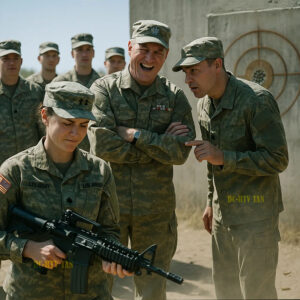
The laughter started the moment Private Nicole Harper’s first shot missed the paper target completely. And by her fifth miss, even the drill instructors were shaking their heads in disgust at Fort Ironwood’s most hopeless logistics trainee.
Colonel Thomas Bradley had orchestrated this public humiliation perfectly, forcing support personnel to demonstrate marksmanship skills they clearly didn’t possess, proving once and for all that warriors and desk jockeyies belonged in separate worlds. But when Range Master Sergeant Diane Foster walked down range to inspect the misses, her face went white as she stared at the concrete back stop, then whispered the words that would shatter everything they thought they knew about the quiet woman who cleaned their rifles. Check the back wall.
Five bullet holes grouped tighter than a quarter, revealed that Nicole Harper hadn’t missed at all. She had been hitting targets none of them could see. Quick pause before we continue. Tell us where in the world are you watching from. If you’re enjoying these stories, make sure to hit subscribe because tomorrow’s episode is absolutely mindblowing. Nicole Harper had perfected the art of being invisible.
At 28, she possessed the unremarkable features that allowed her to blend seamlessly into any crowd. shoulderlength brown hair usually pulled back in a regulation ponytail, hazel eyes that observed everything while revealing nothing, and a compact frame that filled out standard issue fatigues without drawing attention.
She had been assigned to Fort Ironwood’s logistics division 6 months ago, transferred from what her personnel file vaguely described as administrative duties at a classified location. The other soldiers barely knew her name. To them, she was simply another support specialist who kept their equipment clean, their ammunition counted, and their paperwork filed.
She arrived at 0630 each day, completed her assigned tasks with methodical precision, and disappeared into her quarters after evening cow. No complaints, no questions, no requests for additional responsibilities or recognition. Fort Ironwoods sprawled across 3,000 acres of Wyoming wilderness, 30 mi northwest of the small town of Hawks Landing. The facilities specialized in advanced tactical training for military personnel destined for special operations and high-risisk assignments. The base attracted the best and brightest young soldiers with steel in their spines and fire in their eyes,
eager to prove themselves worthy of elite units. Nicole worked in building 7, a nondescript concrete structure that housed the logistics operation center. While combat trainees practiced room clearing and repelling techniques, she maintained inventory spreadsheets and processed supply requisitions.
While they studied advanced tactics and weapon systems, she organized their gear and cleaned their equipment after training exercises. Her workspace occupied a corner of the main supply room surrounded by metal shelving units. stocked with everything from medical supplies to communications equipment, a single desk, a computer terminal, and a bulletin board covered with duty rosters and regulation updates.
The only personal touch was a small framed photograph of a golden retriever sitting in tall grass, though no one had ever seen her with a pet. Harper, you’ve got weapon maintenance duty on range 3 today, Staff Sergeant Marcus Webb announced during the weekly logistics briefing. Webb was a decent supervisor. Fair but distant, treating his personnel like the support assets they were trained to be.
Yes, Sergeant, Nicole replied without looking up from her clipboard. Combat training group finishes live fire exercises at 1,400 hours. Standard cleaning protocol on 30 M4 carbines and 6 M249 squad automatic weapons. Range Master Sergeant Foster will brief you on any special requirements. Nicole nodded and made a note on her duty roster.
Weapon maintenance was routine work that she actually preferred to administrative tasks. Firearms required attention to detail and respect for precision, qualities that came naturally to her, though she was careful not to demonstrate too much familiarity with the equipment. Thunder Ridge shooting range stretched across a natural valley between two hills with firing positions carved into the slope and targets positioned at distances ranging from 25 to 600 yd.
Concrete barriers and earthn BMS provided safety back stops while an elevated observation tower allowed range personnel to monitor multiple firing lines simultaneously. Range Master Sergeant Diane Foster ran the facility with quiet competence. A veteran of two combat deployments, she treated weapons with the reverence they deserved and expected the same attitude from everyone who set foot on her range.
Foster was one of the few senior non-commissioned officers who acknowledged Nicole’s existence beyond her function as a support specialist. Afternoon Harper Foster said as Nicole arrived at the range office, combat group had a good session today. Weapons are staged at position 7 for maintenance. Any special concerns, Sergeant? Nothing unusual.
Standard field stripping and cleaning. They’re pushing hard for qualification next week, so everything needs to be perfect. Nicole collected her cleaning supplies and made her way to the designated firing position. The weapons were laid out on tables in neat rows. Still warm from the day’s training.
She began her work methodically, disassembling each rifle and inspecting every component for wear, fouling, or damage. The afternoon sun cast long shadows across the range as she worked. The repetitive nature of the task allowed her mind to wander, though her hands continued moving with practiced efficiency. This was her life now.

Quiet, routine, unremarkable, safe. She was nearly finished when voices drifted across the range from the observation tower. Colonel Thomas Bradley’s distinctive baritone carried clearly in the still air, engaged in what sounded like a heated discussion with several of his staff officers.
The problem with this generation of soldiers, Bradley was saying, is that they don’t understand the fundamental differences between warriors and support personnel. They think everyone who puts on a uniform is automatically a soldier. Sir, the regulation changes require basic combat proficiency for all personnel, replied a younger voice that Nicole recognized as Lieutenant Colonel Beth Scott, the base psychiatrist.
Bradley’s laugh held no humor. regulations written by politicians who’ve never held a weapon in anger. You put a rifle in the hands of some logistics clerk and all you accomplish is wasting ammunition and embarrassing everyone involved.
With respect, Colonel, another voice interjected, Captain Brian Webb, whose personnel file indicated intelligence background. Combat effectiveness often depends on support personnel who understand weapons systems. Captain Web, I’ve been in uniform for 28 years. I’ve seen what happens when you ask pencil pushers to perform warrior tasks. It’s a disaster waiting to happen. Nicole’s hands never paused in their work, but her attention focused entirely on the conversation above.
She had heard variations of this debate throughout her military career, though never stated quite so bluntly. Perhaps a demonstration would clarify the issue, Bradley continued. Tomorrow’s training schedule includes marksmanship evaluation for Combat Group Charlie. I propose we include some of our logistics personnel in the exercise.
Sir, that might not be, Scott began. A learning experience for everyone involved, Bradley interrupted. The combat trainees will see firsthand why their success depends on staying in their lane. The support personnel will gain appreciation for skills they lack. Everyone benefits. Nicole finished cleaning the last rifle and began packing her supplies.
The conversation above had shifted to administrative details, but she had heard enough to understand what was coming. Colonel Bradley intended to use logistics personnel as object lessons, public demonstrations of the supposed gap between warriors and support staff. She had encountered officers like Bradley before, men who viewed military service through a rigid hierarchy that placed combat personnel at the top and everyone else in supporting roles.
In his worldview, soldiers were divided into two categories. Those who fought and those who enabled the fighting. The distinction was absolute, unreachable, and essential to maintaining proper military order. What Colonel Bradley didn’t know was that some distinctions were illusions carefully maintained for reasons that had nothing to do with capability and everything to do with survival. The next day arrived with the crisp clarity that characterized Wyoming autumns.
Nicole reported for normal duties, though she noticed increased activity around the training areas and a subtle tension among the logistic staff. Word had spread quickly through the unofficial communication networks that existed in every military installation. You hear about tomorrow? Asked specialist Mike Patterson during morning break.
Patterson worked in communication support, a quiet young man from Nebraska who treated everyone with polite respect. What about tomorrow? replied Corporal Andrea Mitchell, though her tone suggested she already knew. Bradley’s having support personnel participate in marksmanship evaluation, wants to show the combat guys what real training looks like.
Private First Class Khloe Bennett, barely 20 and still adjusting to military life, looked nervous. I’ve never fired anything bigger than a 22 rifle. What if I hurt someone? Range safety protocols will prevent accidents, Nicole said quietly from her position near the supply cabinets. Foster knows her business. Mitchell glanced at Nicole with curiosity. You don’t seem worried about it. Nicole shrugged.
It’s just shooting at paper targets. Not exactly life-threatening. What she didn’t say was that she had spent countless hours on firing ranges across three continents under conditions that ranged from controlled training environments to active combat zones.
What she didn’t mention was that her personnel file contained references to advanced marksmanship training that had been carefully edited to remove specific details. What she didn’t reveal was that some skills, once learned, became as natural as breathing and just as automatic. The logistics personnel received their briefing at 080 hours. Colonel Bradley himself presided over the session, flanked by his senior staff and wearing an expression of barely concealed disdain.
Ladies and gentlemen,” he began, “Today, you’ll have the opportunity to demonstrate basic marksmanship skills alongside our combat trainees. This exercise will serve multiple purposes. It will give you appreciation for the training our warriors undergo.
It will show our combat personnel the importance of staying focused on their primary mission, and it will provide everyone with realistic expectations about military capabilities.” The subtext was unmistakable. This was theater designed to reinforce existing hierarchies and assumptions. Nicole sat in the back row, maintaining the same neutral expression she wore during every official briefing.
You’ll be firing M4 carbines at standard targets positioned at 50 yards. Bradley continued, “Five rounds per person with safety oversight provided by range personnel. Combat group Charlie will observe and provide assistance as needed.” Private Bennett raised her hand tentatively.
Sir, what if we’ve never used these weapons before? Bradley’s smile was condescending. Specialist Patterson and Corporal Mitchell have completed basic marksmanship training. They’ll provide instruction for anyone who needs assistance. The dismissal was clear. This wasn’t about education or improvement. This was about proving a point that Bradley had already decided was true.
Two hours later, Nicole stood on the firing line at Thunder Ridge Range, holding an M4 carbine and listening to the barely suppressed laughter from Combat Group Charlie, positioned behind the safety barriers. 23 of Fort Ironwood’s finest combat trainees, along with their instructors and Colonel Bradley himself, had gathered to witness what everyone expected would be a demonstration of logistics personnel’s unsuitability for warrior tasks.
Remember, Rangemaster Sergeant Foster announced over the range’s public address system, five rounds, 50-yard target, standard firing position. Safety is our primary concern. Private Tyler Hughes, known to everyone as Tank for his aggressive training style and powerful build, leaned over to his squadmate.
20 bucks says the first one doesn’t even hit the dirt bm behind the targets. You’re on, replied another combat trainee. I’m betting she drops the rifle after the first shot. Nicole heard every word, though her expression remained unchanged. She had learned long ago that the most dangerous thing about underestimation was the temptation to correct it prematurely.
The target downrange was a standard military silhouette, black on white paper, measuring 18 in wide by 24 in tall. At 50 yards, it represented a relatively easy shot for anyone with basic marksmanship training. For logistics personnel who rarely handled weapons, it might as well have been a mile away.
Foster’s voice crackled over the speakers. Harper, you’re up first. Take your time, follow basic safety procedures, and remember that accuracy is more important than speed. Nicole stepped to the firing line and assumed a standard standing position. She performed her safety checks with mechanical precision, chamber clear, safety engaged, magazine properly seated.
Her movements were adequate but unremarkable, suggesting someone who had received basic training but lacked extensive experience. She raised the rifle and began the process of sight alignment. The front sight post centered in the rear sight aperture, both aligned on the target’s center mass. Her breathing was controlled but not noticeably practiced.
Her grip appeared functional but unremarkable. Behind the safety barriers, the comments continued, “Look at that stance. She’s holding it like a garden hose. Thinks she knows which eye to use for aiming. This is painful to watch. Colonel Bradley stood with arms crossed, wearing an expression of satisfied anticipation.
This was proceeding exactly as he had predicted. Nicole’s first shot rang out across the valley. Every pair of binoculars and spotting scope immediately focused on the target downrange. The paper remained untouched. No visible hole, no indication that a bullet had passed anywhere near the intended target.
The laughter started immediately. Jesus, she missed the entire target frame. Did she even open her eyes? I thought logistics personnel at least understood basic physics. Foster raised her hand for quiet, but the damage was done. The first shot had established the narrative that everyone expected to unfold.
Nicole’s expression never changed. She worked the bolt to chamber her second round and resumed her firing position. Again, the same adequate but unremarkable stance. Again, the same functional but unimpressive grip. The second shot produced the same result. No mark on the target. No indication of impact anywhere in the visible area.
The laughter grew louder and more creative. Maybe she’s aiming at the wrong range entirely. Someone should check if the rifle is actually loaded. I’ve seen recruits with better accuracy on their first day. By the third shot, even some of the other logistics personnel were showing signs of embarrassment. This was worse than anyone had anticipated.
Nicole was making their entire section look incompetent. The fourth and fifth shots followed the same pattern. Clean misses, no visible impact, no evidence that a trained soldier had just expended five rounds of ammunition at a target the size of a poster.
When Nicole set down the rifle and stepped back from the firing line, the range fell into the kind of silence that precedes either applause or disaster. She had just delivered the most comprehensive demonstration of marksmanship in competence in Fort Ironwood’s recent memory. Colonel Bradley stepped forward with theatrical satisfaction. Ladies and gentlemen, I believe we’ve just witnessed an important lesson about the difference between soldiers who train for combat and those who support them from safe positions. Tank Hughes was already reaching for his wallet, confident that he had won his bet. The
other combat trainees were sharing looks that mixed amusement with secondhand embarrassment. That’s when Range Master Sergeant Foster did something that surprised everyone present. Instead of dismissing the group and moving on to the next phase of training, she walked past the firing line and continued downrange toward the target area.
Sergeant Foster, Bradley called out, “Is there a problem with the range equipment?” Foster didn’t respond immediately. She was staring at something that had caught her attention behind the paper target beyond the wooden frame that held it in position. She continued walking until she reached the concrete barrier that served as the range’s final back stop 30 yard behind the target position.
there, embedded in the concrete at exactly chest height, she discovered something that made her 20 years of military experience suddenly feel inadequate for the situation at hand. Five bullet holes not scattered randomly across the surface, not grouped loosely in the general area of center mass.
Five holes that could have been covered by a silver dollar positioned with mathematical precision in the exact center of where a human torso would be located if someone had been standing behind the paper target. Foster traced the trajectory backward with her eyes from the concrete wall through the exact center of the target area through the microscopic gap between the paper silhouette and the wooden frame that supported it.
The gap was approximately 2 mm wide, barely visible to the naked eye. Certainly not something that could be aimed at deliberately, except that someone had just threaded five bullets through that gap with precision that bordered on the impossible. Foster looked back toward the firing line where Nicole Harper stood in the same unremarkable posture she had maintained throughout the exercise.
Their eyes met across the distance. And for just a moment, Nicole’s neutral mask slipped enough to reveal something that made the range master’s blood run cold. Recognition, acknowledgement, and a warning. Foster walked back to the group with deliberate steps, her mind racing through the implications of what she had just discovered.
When she reached Colonel Bradley, she spoke in a voice that carried across the range like a thunderclap. Sir, I need you to check the back wall. Telling and preparing this story took us a lot of time. So, if you’re enjoying it, subscribe to our channel. It means a lot to us. Now, back to the story. The silence that followed Fosters’s words stretched across Thunder Ridge Range like a held breath.
Colonel Bradley’s confident expression wavered as he processed the implications of the range master’s request. Behind the safety barriers, Combat Group Charlie exchanged uncertain glances. Their earlier amusement replaced by growing confusion. What exactly are you suggesting? Sergeant Foster. Bradley’s voice carried an edge of irritation mixed with curiosity. Foster gestured toward the concrete back stop. Five rounds were fired, Colonel.
They all found their mark. Tank Hughes lowered his binoculars, his cocky demeanor evaporating. That’s impossible. We all saw her miss every shot. Did we? Foster’s question hung in the air like a challenge.
Captain Brian Webb stepped forward from his position among the observers, his intelligence background evident in the way he studied both Foster and Nicole with analytical precision. Sergeant Foster, are you saying those rounds hit something other than the intended target? I’m saying everyone should examine the backs stop before drawing conclusions about what happened here. Bradley’s jaw tightened.
He had orchestrated this exercise to demonstrate a specific point about military hierarchy and competence. Foster’s cryptic statements threatened to undermine the entire demonstration. Very well. Everyone remains in position while we investigate this apparent discrepancy. The group moved down range in a loose formation with Bradley leading and Nicole bringing up the rear.
Her demeanor remained unchanged, neither defensive nor explanatory, simply present. But those who knew how to read body language might have noticed the slight shift in her posture. The way her eyes continuously scan the surrounding terrain, the subtle positioning that kept her back covered, and multiple exit routes in view.
When they reached the concrete barrier, Foster pointed to the five bullet holes clustered in the center of the wall. The precision was undeniable, each hole perfectly placed, the grouping so tight that a playing card could have covered all five impact points. “Holy shit,” whispered Private First Class Khloe Bennett, then immediately looked around in embarrassment at her language in front of senior officers.
Drill Sergeant Frank Coleman, a veteran of multiple combat deployments, approached the wall with the kind of reverence usually reserved for examining enemy positions. He traced the bullet holes with his finger, then stepped back to consider the trajectory. Sergeant Foster, help me understand the mathematics here.
Foster pulled out a small measuring tape and began calculating distances. Target position is 30 yards forward. Firing position is 50 yard beyond that. Total shot distance is 80 yard through a gap that measures approximately 2 mm. 2 mm. Corporal Andrea Mitchell’s voice cracks slightly. That’s smaller than a pencil lead.
Chief Warrant Officer Carl Barnes, whose expertise with weapons systems was legendary throughout Fort Ironwood, knelt down to examine the impact points more closely. The angle is perfect. Dead center of mass if someone had been standing behind that target. This isn’t accidental precision. Captain Webb found himself studying Nicole with renewed interest.
Harper, do you have any explanation for this extraordinary shooting? Nicole met his gaze without flinching. I fired five rounds at the designated target, sir. Were those rounds impacted is a matter of physics and ballistics. Her response was technically accurate while revealing nothing about intent or capability. It was the kind of answer that someone with extensive interrogation training might give.
truthful but strategically incomplete. Bradley’s face had progressed from confusion to something approaching anger. Are you suggesting that you deliberately shot through a gap the width of a pencil lead? I’m not suggesting anything, Colonel. I followed instructions and fired at the target you designated.
Master Sergeant Dave Riley, whose call sign ghost reflected his reputation for appearing and disappearing during training exercises, stepped closer to examine the concrete back stop. Riley had served in special operations for 15 years before accepting a training assignment at Fort Ironwood.
He possessed the kind of experience that made him sensitive to anomalies that others might miss. This grouping, he said quietly, represents a level of precision that requires specific training and considerable experience. The muscle memory alone would take years to develop. Muscle memory for what? Bradley demanded. Riley’s answer came slowly, as if he was reluctant to voice his suspicions.
precision shooting under unconventional conditions. The kind of skills taught in programs that most people never hear about. The implications of his statement settled over the group like a cold wind. Everyone understood that Fort Ironwood hosted various classified training programs, but the specific details remained compartmentalized according to security clearances and need to know protocols.
Lieutenant Colonel Beth Scott, whose psychological training made her particularly observant of human behavior, found herself reassessing everything she thought she knew about Nicole Harper. Harper, your personnel file indicates previous assignment at a classified facility. What was the nature of your duties there? Administrative support, ma’am.
Records management and inventory control. Again, the response was technically accurate while concealing more than it revealed. Scott recognized the pattern. Someone who had been trained to provide information without compromising operational security. Bradley’s frustration was becoming evident. Sergeant Foster, I want a complete investigation of this incident.
Equipment malfunction, ammunition defects, target placement errors. Something explains this apparent impossibility. Yes, sir. I’ll conduct a thorough examination of all equipment and procedures. But Foster’s tone suggested she already suspected that equipment malfunction wasn’t the answer.
She had spent enough time around firearms to recognize extraordinary marksmanship when she encountered it. As the group prepared to return to the firing line, Nicole remained near the concrete wall for a moment longer than necessary. She appeared to be studying the bullet holes, but her actual attention was focused on the terrain beyond the range, specifically the wooded hills that provided natural cover for observation posts. A glint of reflected light from the treeine caught her attention for just an instant.
Binoculars or a spotting scope positioned to observe the range activities. Someone else had been watching the demonstration, someone who wasn’t part of the official training group. She filed the information away without changing her expression or drawing attention to the discovery.
Years of survival in hostile environments had taught her that acknowledged threats were often less dangerous than hidden ones. The walk back to the firing line passed in relative silence with small groups of soldiers engaged in hushed conversations about what they had witnessed. The easy camaraderie and casual mockery that had characterized the beginning of the exercise had been replaced by uncertainty and speculation. Tank Hughes fell into step beside specialist Mike Patterson.
Dude, what the hell just happened back there? Patterson shook his head. I have no idea, but that wasn’t beginner’s luck or equipment malfunction. You think she’s been sandbagging this whole time, pretending to be some clueless logistics clerk when she’s actually what? Special forces Navy Seal? Women can’t be SEALs, Patterson pointed out. You know what I mean? Some kind of special operations background that she’s not advertising.
Their conversation reflected similar discussions occurring throughout the group. Nicole Harper had become a mystery that demanded explanation, and soldiers were naturally inclined to seek answers to tactical puzzles. When they reached the firing line, Bradley called for attention. Ladies and gentlemen, today’s exercise has provided us with unexpected learning opportunities.
We’ll suspend the demonstration pending investigation of equipment and ammunition. Combat Group Charlie will proceed with scheduled training activities. Logistics personnel will return to normal duties. The dismissal was abrupt, clearly designed to prevent further speculation and discussion, but the damage had already been done.
Nicole Harper was no longer invisible. As the groups dispersed, Captain Webb approached Nicole before she could disappear into the crowd. Harper, I’d like to speak with you privately. My office in building 1230 minutes. It wasn’t a request.
Webb’s tone carried the authority of someone accustomed to having his instructions followed without question. Nicole nodded acknowledgement. Yes, sir. Web was intelligence, which meant he had access to personnel files, classification databases, and information networks that most officers couldn’t reach. If anyone at Fort Ironwood was positioned to uncover her true background, it would be him. She had always known this moment would come eventually.
The carefully constructed facade of mediocrity couldn’t be maintained indefinitely, especially not in an environment filled with people trained to notice tactical anomalies. The only question was how much Webb already knew and what he intended to do with that knowledge. Building 12 housed the intelligence and security offices for Fort Ironwood.
Unlike the utilitarian structures that dominated most of the base, this building featured enhanced physical security, restricted access controls, and the kind of electromagnetic shielding that prevented electronic surveillance. Nicole arrived at Web’s office precisely 30 minutes after their conversation at the range.
Punctuality was expected in military environments, but her timing also demonstrated the kind of discipline that came from specialized training. Web’s office reflected his background. Sparse furnishings, multiple secure communication devices, and walls lined with certificates and photographs from assignments that couldn’t be discussed in normal conversation.
He gestured for her to take a seat across from his desk. Harper, I’m going to ask you some questions. Your responses will determine whether this conversation remains between us or becomes part of an official investigation. Nicole settled into the chair with relaxed alertness, the kind of posture that suggested readiness without betraying anxiety. I understand, sir.
Your personnel file contains several interesting gaps. Previous assignment listed as classified facility administrative duties, but no specific location or unit designation. Security clearance level redacted. medical records sealed above my access level. Webb paused, studying her face for reactions.
Nicole’s expression remained neutral, interested, but not defensive. Most logistics personnel don’t have medical records classified above a captain’s clearance level, he continued. Most administrative clerks don’t demonstrate marksmanship skills that violate the laws of physics. The laws of physics weren’t violated, sir. Listics is a mathematical discipline. Given the right conditions, any trajectory is theoretically possible.
Theoretically possible and practically achievable are different things. What you did today requires training that isn’t available through normal military channels. Nicole remained silent, recognizing that Webb was fishing for information rather than stating facts he could prove.
I have made some preliminary inquiries, Webb continued. Your social security number traces back to records that were sealed 7 years ago. Your fingerprints are flagged in a database that requires clearances I don’t possess. Your photograph triggers automated alerts and systems I can’t access. Now Nicole understood the scope of the problem. Web hadn’t just noticed her unusual shooting.
He had attempted to investigate her background and encountered the kind of security walls that surrounded classified personnel. Captain Web, I think you’re overcomplicating a simple training exercise. I fired five rounds at a target and happened to achieve an unusual result.
Equipment variations, atmospheric conditions, and pure chance can produce seemingly impossible outcomes. Webb leaned back in his chair. Harper, I’ve been in intelligence for 12 years. I know the difference between coincidence and operational security. What I witnessed today wasn’t luck. What do you think you witnessed, sir? A demonstration of skills that don’t exist in your official background.
Skills that someone has gone to considerable trouble to conceal. The conversation had reached a decision point. Nicole could continue deflecting and denying, hoping that Webb lacked the resources to penetrate her cover story, or she could acknowledge enough truth to satisfy his curiosity without compromising her operational security.
Captain, some military occupational specialties require security considerations that extend beyond normal personnel management. If my file contains unusual characteristics, perhaps there are reasons that don’t concern standard training operations. It was a carefully crafted response that acknowledged Web’s observations without confirming his suspicions.
She was neither admitting nor denying the existence of classified background, simply suggesting that such things might exist for legitimate reasons. Web studied her for a long moment. Harper, I don’t know who you really are or what brought you to Fort Ironwood, but I know enough to recognize that today’s demonstration was a message.
Someone wanted to communicate something to someone else, and they used a training exercise to do it. A message, sir. Five impossible shots that announce capabilities while maintaining plausible deniability. It’s exactly the kind of trade craft that intelligence professionals use when they need to signal without communicating directly.
Nicole felt a chill of recognition. Webb was more perceptive than she had anticipated, and his analysis was uncomfortably accurate. She had used the training exercise to send a message not to anyone at Fort Ironwood, but to whoever had been watching from the treeine.
Captain, I’m not sure I understand the implications of what you’re suggesting. The implications are that you’re not who you pretend to be, and someone else knows it. The question is whether that represents a threat to base security or simply an administrative complication. Webb opened a desk drawer and removed a manila folder that he placed on the desk between them.
Harper, I’m going to give you a choice. You can tell me enough truth to satisfy my security concerns, or I can request a full background investigation through channels that will attract attention you probably want to avoid. The folder remained closed, but its presence represented a threat that Nicole couldn’t ignore.
Full background investigations could uncover connections and timelines that would compromise not just her current identity, but the entire network of people who had helped establish it. What kind of truth are you looking for, Captain? Start with why someone with your apparent skill set is working logistic support at a training facility in Wyoming.
Nicole studied the Manila folder on Web’s desk, calculating probabilities and potential consequences. Seven years of careful identity construction could unravel in minutes if the wrong people began asking the right questions. But Webb’s perceptive analysis suggested he already suspected more than he was revealing. Captain, there are aspects of military service that exist outside normal career progression.
She said finally, “Sometimes personnel are assigned to positions that don’t reflect their complete background or training.” Web’s eyes sharpened. Go on. Sometimes those assignments serve purposes that aren’t documented in standard personnel files. Sometimes maintaining operational security requires accepting positions that appear inconsistent with actual qualifications.
It was another carefully calibrated response, acknowledging the possibility of classified assignments without confirming specific details. Nicole was walking a tight rope between satisfying Web’s curiosity and protecting information that could endanger multiple lives. You’re suggesting that your current assignment serves a purpose beyond logistics support.
I’m suggesting that military personnel often serve where they’re needed, regardless of how that service might appear to outside observers. Webb leaned forward. Harper, I appreciate diplomatic language, but I need concrete information. Are you currently conducting an operation that affects Fort Ironwood? The question struck closer to the truth than Nicole had expected.
She wasn’t conducting an active operation, but her presence at Fort Ironwood wasn’t entirely coincidental. Sometimes the safest hiding place was inside the system that was hunting you. No sir, I’m not conducting any operation that affects base security or personnel. Technically accurate, though it didn’t address whether her presence might be related to avoiding other operations or individuals, but you do have operational experience that exceeds your apparent qualifications. Nicole made a decision that balanced disclosure with security.
Captain, my previous assignment involved specialized training that isn’t reflected in standard documentation. That training included marksmanship instruction that exceeded normal military standards. How far did it exceed normal standards? Far enough to account for what you observe today. Web processed this admission specialized training for what purpose? Classified, sir.
By whose authority? Above both our clearance levels. This exchange represented a delicate dance between truth and operational security. Nicole was confirming that she possessed classified background while avoiding specific details that could be verified or investigated.
Web opened the Manila folder and removed several documents. Harper, I’ve been authorized to conduct preliminary security assessments when anomalies arise. Your demonstration today definitely qualifies as an anomaly. He placed a single sheet of paper on the desk. It contained a form requesting expanded background investigation partially completed with Nicole’s personal information.
I can submit this request through official channels which will trigger a comprehensive review of your history, associations, and current status. Or you can provide enough information to satisfy my immediate security concerns. Nicole recognized the leverage Web was applying.
The form represented a significant threat because comprehensive investigations could uncover connections between her current identity and her previous life. Connections that certain people had spent considerable resources trying to eliminate. What specific information would satisfy your security concerns? Are you currently under threat from hostile personnel or organizations? The question demonstrated web’s understanding of operational realities.
Personnel with classified backgrounds often carried threats that persisted long after their official service ended. Not to my knowledge, sir. Another technically accurate response. Nicole wasn’t aware of any current active threats, though she understood that her previous life contained people who would prefer her permanently eliminated.
Are you using Fort Ironwood as cover for unauthorized activities? No, sir. Do you pose any security risk to base personnel or operations? No sir, my presence here represents no threat to Fort Ironwood or its mission. Webb studied her answers, recognizing the careful language while appreciating her directness on security related questions. Harper, I’m going to make a professional judgment call.
Your background clearly involves classified elements that I’m not authorized to investigate. Your current behavior suggests no immediate security concerns. He collected the documents and returned them to the folder. However, today’s demonstration has attracted attention that extends beyond my office.
Other people will want explanations, and they may not be satisfied with diplomatic responses. What kind of attention, Captain? Colonel Bradley is demanding a full investigation. He’s convinced that either equipment malfunction or deliberate deception occurred during the exercise. He wants to prove that logistics personnel can’t perform at levels that threaten his worldview. Nicole understood the problem.
Bradley’s ego had been challenged by her demonstration, and he possessed the authority to demand investigations that could expose her background. Additionally, Webb continued, “Master Sergeant Riley has been asking questions about specialized training programs.
His special operations background makes him sensitive to unusual skill demonstrations.” Riley represented a different kind of threat. Special operations personnel developed networks and contacts that could verify or contradict cover stories. If Riley became sufficiently curious, he might reach out to people who knew too much about Nicole’s previous identity.
Captain, what would you recommend? Short-term, maintain your current profile and avoid any actions that might reinforce suspicions. Long-term, consider whether Fort Ironwood remains the appropriate assignment for someone with your background. It was reasonable advice, though Nicole suspected that leaving Fort Ironwood might create more problems than staying.
Moving triggered new background checks, fresh scrutiny, and the kind of attention that her survival depended on avoiding. I’ll take your recommendations under consideration. Sir Harper, there’s one more thing. This afternoon’s events may have been observed by individuals who weren’t part of the official training group.
Nicole felt a chill of confirmation. Webb had noticed the same reflected light from the treeine that she had observed. Observed by whom, sir? Unknown. But surveillance suggests interest from outside parties. That could mean many things. None of them particularly comforting.
The conversation had revealed more than Nicole had intended while confirming her worst fears. Her carefully maintained invisibility had been compromised not just by her own actions but by outside surveillance that suggested someone had been tracking her location. Captain, I appreciate your discretion in handling this matter. Harper, discretion serves everyone’s interests, but understand that today’s demonstration has changed the operational environment.
People are asking questions and some of those people have resources that exceed local authority. Web stood indicating the meeting’s conclusion. Maintain your current assignment and profile. Report any unusual contact or surveillance. And Harper, be very careful who you trust with additional information. Nicole left building 12 with the uncomfortable awareness that her situation had become significantly more complicated.
Web’s intelligence background had allowed him to piece together enough information to understand that she represented something beyond normal logistics personnel. While his discretion suggested he had no immediate intention of exposing her, but Bradley’s wounded pride and Riley’s curiosity represented ongoing threats, and the surveillance from the treeine indicated that other parties were taking interest in her activities.
She walked across the base toward building 7, maintaining the same unremarkable pace and demeanor that had served her well for 6 months. But her operational awareness had shifted to active mode, constantly scanning for surveillance, unusual activity, or changes in routine that might indicate developing threats.
The logistics office was nearly empty when she arrived, with most personnel having departed for evening cow. Nicole sat at her desk and began the process of updating inventory records. Routine administrative work that provided cover for more serious thinking about her current situation. The demonstration at Thunder Ridge Range had been a calculated risk designed to send a specific message to anyone who might be watching. The message was simple.
Nicole Harper was not the helpless logistics clerk she appeared to be, and anyone who underestimated her capabilities did so at their own peril. But messages once sent couldn’t be recalled. Her demonstration had attracted attention from multiple directions, some of which posed serious threats to her continued safety and freedom. A soft knock on the office door interrupted her thoughts.
Specialist Mike Patterson stood in the doorway looking uncertain and slightly nervous. Harper, sorry to bother you, but could I ask you something? Nicole gestured for him to enter. Patterson was harmless, a young communication specialist from Nebraska, whose biggest ambition was completing his enlistment without incident and returning to civilian life.
What’s on your mind, Patterson? He closed the door behind him and took a seat across from her desk. This afternoon at the range, what really happened out there? Nicole maintained her neutral expression. I fired five rounds at a target. The bullets impacted somewhere downrange. Come on, Harper.
I saw those holes in the concrete. That wasn’t random chance or equipment malfunction. Patterson’s directness was both refreshing and dangerous. Unlike Web’s calculated probing, this was simple curiosity from someone who had witnessed something that challenged his understanding of reality.
Patterson, sometimes unusual results occur during training exercises. Environmental factors, equipment variations, and statistical probability can produce seemingly impossible outcomes. Statistical probability doesn’t group five bullets in a space smaller than a quarter at 80 yards through a gap you can barely see.
Patterson had done the mathematics, which meant he understood the implications of what he had witnessed. His technical background in communications had given him the analytical skills to recognize that Nicole’s shooting represented something far beyond normal capabilities.
What are you really asking, Patterson? I’m asking if you’re someone I should know more about. I’m asking if there’s something going on here that affects the rest of us. His concern was understandable. Military personnel and isolated assignments developed close working relationships. And anomalies that affected one person could have implications for everyone else.
Patterson, my background doesn’t affect anyone else in this unit. My presence here represents no threat or complication for normal operations. But it’s not a normal background, is it? Nicole studied his face, recognizing genuine concern rather than idle curiosity.
Patterson had served honorably for three years, maintained excellent performance ratings, and demonstrated loyalty to his fellow soldiers. He deserved better than diplomatic evasions. Mike, some people serve in capacities that aren’t reflected in their official records. Some assignments require security considerations that extend beyond normal documentation. That doesn’t make them threats, it just makes them complicated.
Using his first name was a calculated signal of trust and respect, acknowledging his legitimate concerns while encouraging discretion. Are you in some kind of trouble, Harper? The question reflected the kind of loyalty that existed among soldiers who had served together.
Patterson was worried that she might be facing problems that could affect her safety or career. I don’t think so, but today’s demonstration has attracted attention that complicates my situation. From who? People who have reasons to be interested in personnel with certain types of background and training. Patterson nodded slowly. People who might not have your best interests in mind.
Something like that. Is there anything I can do to help? His offer was genuine, reflecting the kind of solidarity that developed among military personnel facing uncertainty together. But accepting help would mean involving him in potential dangers that he didn’t deserve. Mike, the best thing you can do is maintain normal routines and avoid drawing additional attention to what happened today.
If people start asking questions about me, the honest answer is that you don’t know anything beyond what’s obvious. That’s the truth. Until today, none of us knew you could shoot like that. And hopefully, most people will assume today was an anomaly that doesn’t require further investigation. Patterson stood to leave.
Harper, I don’t know what your real background is, and I’m not asking for details, but if you need someone to watch your back, you’ve got it. I appreciate that, Mike, more than you know. After Patterson left, Nicole sat alone in the logistics office, contemplating the complex web of relationships and threats that now surrounded her position at Fort Ironwood.
Web represented official scrutiny that could expose her background. Bradley’s investigation could attract unwanted attention from higher authorities. Riley’s curiosity could activate networks that might recognize her true identity. And somewhere beyond the base perimeter, unknown observers were tracking her activities with purposes that remained unclear.
The comfortable anonymity that had protected her for 6 months was dissolving rapidly, replaced by the kind of operational environment that demanded constant vigilance and careful decision-making. Nicole Harper had spent 7 years becoming invisible. Now she faced the possibility that visibility might be the only way to survive what was coming.
The next morning brought an unexpected development that changed everything Nicole thought she understood about her situation at Fort Ironwood. She discovered it when she arrived at building 7 for normal duty hours and found Master Sergeant Dave Riley waiting in the logistics office, studying her workstation with the kind of attention that suggested professional interest rather than casual curiosity.
Morning, Harper,” Riley said without looking up from her desk. “Interesting reading material.” Nicole approached cautiously, noting that Riley had positioned himself between her and the office’s primary exit. His body language suggested alertness rather than hostility, but years of survival experience had taught her that the most dangerous threats often appeared deceptively casual. “Good morning, Sergeant Riley.
Is there something I can help you with?” Riley gestured toward her computer monitor, which displayed the inventory management system she had been using the previous day. You’ve been tracking some unusual equipment requests through the supply chain, medical supplies, communications gear, specialized tools that don’t match normal training requirements. Nicole felt a chill of recognition.
She had indeed been monitoring certain supply requests, but not for official logistics purposes. Someone at Fort Ironwood had been ordering equipment that could serve multiple functions, and she had been trying to determine whether those orders represented normal operational requirements or something more concerning. Inventory tracking.
As part of my assigned duty, sergeant, I monitor all equipment requests for compliance with regulations and availability. Riley finally looked at her directly, and Nicole saw something in his eyes that made her reassess everything she thought she knew about the master sergeant. Harper, some of these requests match patterns that I’ve seen before.
Patterns that usually indicate preparation for operations that don’t appear on official schedules. What kind of operations? The kind that require medical trauma supplies, encrypted communications equipment, and tools designed for bypassing security systems. Nicole understood that Riley was sharing information that extended far beyond normal training facility operations.
His special operations background had exposed him to operational planning methods that helped him recognize suspicious patterns. Sergeant, are you suggesting that someone at Fort Ironwood is planning unauthorized activities? I’m suggesting that someone has been very carefully acquiring resources that could support activities extending beyond normal training missions. And your inventory tracking suggests you’ve noticed the same patterns. Riley was correct.
Nicole had been monitoring the supply requests because they reminded her of preparation phases for operations that officially didn’t exist. The kind of missions where success depended on having the right equipment available without creating traceable connections to official sources.
What makes you think I’ve been tracking these patterns for reasons beyond normal logistics duties? Riley smiled and for the first time since she had known him, Nicole saw genuine amusement in his expression. Harper, your computer access logs show queries into databases that most logistics specialists don’t know exist. Your search parameters include cross references to equipment specifications that aren’t documented in standard cataloges.
Either you’re the most thorough inventory clerk in military history, or you’re conducting analysis that requires knowledge most people don’t possess. The revelation that Riley had been monitoring her computer activity was both alarming and illuminating.
It meant he had been suspicious of her background for longer than she had realized, and he possessed the technical resources to conduct sophisticated surveillance without her awareness. Sergeant Riley, I’m not sure what conclusions you’re drawing from routine administrative work. The conclusions I’m drawing are that you’re not conducting routine administrative work, and we have a problem that extends beyond your unusual shooting demonstration yesterday. Riley moved away from her workstation and gestured for her to sit down.
Harper, I’m going to share some information with you, and then you’re going to decide whether to trust me with information in return. Nicole settled into her chair, recognizing that Riley was offering some form of alliance or partnership. Her operational instincts suggested caution, but her situation was deteriorating rapidly enough that additional allies might be worth the risk.
3 weeks ago, Riley began, “I was contacted by someone claiming to represent a government agency that doesn’t appear in standard organizational charts. They asked questions about base personnel, specifically whether anyone had demonstrated capabilities that exceeded their apparent qualifications.
What kind of capabilities, advanced tactical skills, specialized technical knowledge, or behavior patterns that suggested training beyond normal military channels? They were particularly interested in anyone who might be using Fort Ironwood as cover for activities that weren’t reflected in official records. Nicole felt the familiar sensation of walls closing in around her.
The surveillance she had detected from the treeine, Web’s investigation, and now Riley’s revelation about outside inquiries suggested that multiple parties were focusing attention on her presence at Fort Ironwood. Did you provide them with any information? I told them I hadn’t observed anything unusual, but that was before yesterday’s demonstration. Riley paused, studying her reaction.
Harper, whoever contacted me, possessed detailed knowledge about classified programs and personnel assignments that shouldn’t be available to normal government agencies. They knew things about Fort Ironwood’s operations that exceed the clearance levels of most federal personnel.
What does that suggest to you? It suggests that someone with serious resources has been tracking personnel who might be connected to programs that officially don’t exist. and they’re specifically interested in people who might be hiding in plain sight. The implications were worse than Nicole had feared.
If Riley was correct, then her carefully constructed anonymity had been penetrated not just by local curiosity, but by organized investigation from parties with extensive resources and questionable authorization. Sergeant, why are you sharing this information with me? Because yesterday’s shooting demonstration answered questions I didn’t know I was asking. and because the people who contacted me didn’t strike me as individuals who had your best interests in mind.
Riley’s answer suggested that he had made a decision to side with her against unknown threats, though Nicole wasn’t certain what had motivated that choice. What questions did yesterday answer? Questions about why someone with your apparent skill set would accept assignment to a training facility in Wyoming? Questions about why your personnel file contains gaps that don’t match normal career progression? questions about why my contacts were so interested in finding people with backgrounds they couldn’t officially acknowledge. Riley walked to the office window and looked out across the base toward the mountains
beyond. Harper, I’ve served in units where operational security meant the difference between mission success and catastrophic failure. I recognize the patterns that people use when they’re trying to disappear into normal military service. And you think that’s what I’m doing? I think you’re running from something that wants to find you.
And I think yesterday’s demonstration was a message to whoever might be watching that you’re not as helpless as you appear to be. Riley’s analysis was uncomfortably accurate. Nicole had used the shooting demonstration to communicate capabilities without directly threatening anyone, hoping to deter potential threats through ambiguity rather than confrontation.
Sergeant, assuming your analysis is correct, what would you recommend? Riley turned back from the window. Short-term, we need to identify who’s been placing those unusual supply orders and why. If someone at Fort Ironwood is planning operations that require specialized equipment, we need to understand whether those plans represent threats to base security or to you personally.
And long-term long-term you need to decide whether continued hiding serves your interests or makes you more vulnerable to people who have resources to conduct extended investigations. It was the same conclusion that Nicole had been reaching independently. Her anonymity strategy was failing because it depended on avoiding attention and yesterday’s demonstration had made continued invisibility impossible.
Riley, what makes you think I should trust you with information that could compromise both of our positions? Because we’re already compromised. The people asking questions about you have resources that exceed anything available to individual soldiers. If we’re going to navigate this situation successfully, we need to coordinate our efforts. Riley’s logic was sound, though accepting his offer of alliance would represent a fundamental change in Nicole’s operational approach.
For 7 years, she had survived by trusting no one and depending only on her own resources and judgment. What kind of coordination are you proposing? information sharing about threats, resource pooling for protective measures, and mutual support if the situation deteriorates beyond what either of us can handle individually.
Before Nicole could respond, the office door opened and private first class Khloe Bennett entered, looking nervous and slightly out of breath. Sorry to interrupt, but Sergeant Foster needs to see both of you at the range immediately. She says it’s urgent. Riley and Nicole exchanged glances, recognizing that urgent summons often indicated developing crises rather than routine administrative matters.
Did she say what kind of urgency? Riley asked. Bennett shook her head. Just that you needed to get there as soon as possible and to be prepared for questions about yesterday’s training exercise. The walk to Thunder Ridge Range took 15 minutes, during which Riley and Nicole maintained careful separation and casual conversation that wouldn’t attract attention from potential observers, but both understood that Foster’s urgent summons probably meant that new developments had emerged regarding the previous day’s shooting demonstration.
When they arrived at the range office, they found Foster waiting with Captain Webb and Colonel Bradley along with two individuals that Nicole didn’t recognize, but who possessed the kind of understated authority that suggested federal law enforcement or intelligence backgrounds.
Harper Riley Bradley said without preamble, “These gentlemen have some questions about yesterday’s training activities.” The older of the two strangers stepped forward. I’m agent Marcus Stone, Federal Bureau of Investigation. This is Agent Lisa Kaine. We’re conducting an investigation into potential security violations that may have occurred at this facility.
Nicole felt her operational awareness shift into maximum alertness. FBI involvement suggested that someone had escalated concerns about her background to federal law enforcement, which represented a significant threat to her continued freedom and safety. What kind of security violations? Riley asked.
Agent Cain consulted a tablet computer before responding. possible unauthorized disclosure of classified capabilities, potential infiltration of military facilities by personnel with false identities, and suspected coordination with hostile intelligence services. The accusations were serious enough to result in federal prosecution and imprisonment, though Nicole noted that they were stated as possibilities rather than confirmed facts.
The FBI was fishing for information rather than presenting evidence of specific violations. Agent Stone Webb interjected. I’ve conducted preliminary interviews with the personnel involved in yesterday’s exercise. I found no evidence of security violations or unauthorized disclosure.
Stone’s expression suggested that Web’s assessment didn’t align with information the FBI had received from other sources. Captain Web, we appreciate your cooperation, but this investigation extends beyond local authority. We have reason to believe that individuals with connections to classified programs may be operating at Fort Ironwood without proper authorization or oversight.
Bradley stepped forward with obvious satisfaction. Agents, I’ve been concerned about irregular activities at this facility for some time. Yesterday’s demonstration confirmed my suspicions that unauthorized personnel may be conducting operations that violate established protocols.
Nicole realized that Bradley had contacted federal authorities to support his wounded pride and determination to prove that logistics personnel couldn’t possess capabilities that threatened his worldview. His ego had escalated a local training incident into a federal investigation.
Miss Harper, Agent Cain said, “We’d like to speak with you privately about your background and current assignment. We have some questions about discrepancies in your personnel records.” The request wasn’t optional, despite being phrased politely. Nicole understood that declining to cooperate would only intensify federal scrutiny and potentially result in detention for questioning.
Of course, Agent Cain, I’m happy to provide any information that might help with your investigation. But as she spoke, Nicole was calculating escape routes, assessing potential allies, and considering options that extended far beyond cooperative answers to FBI questions.
Her carefully constructed new life was collapsing rapidly, and survival might require returning to skills and methods that she had hoped never to use again. The game had changed completely. Now, the question wasn’t whether she could maintain her cover, but whether she could survive long enough to discover who had betrayed her location and why federal agents were asking questions that suggested they knew far more about her background than should have been possible.
The FBI interrogation took place in a secure conference room within building 12, the same facility where Captain Webb had questioned Nicole the previous day, but the atmosphere now carried the weight of federal authority and potential criminal prosecution rather than military administrative inquiry.
Agent Stone arranged recording equipment while Agent Cain reviewed documents from a thick manila folder that contained far more information than should have existed about Nicole’s carefully constructed identity. The site of that folder confirmed Nicole’s worst fears. Someone had provided the FBI with intelligence that penetrated her operational security. Ms. Harper Stone began activating the recording device.
For the record, please state your full name, current assignment and security clearance level. Nicole Marie Harper, logistics specialist, Fort Ironwood training facility, secret clearance. Cain looked up from her documents. Is that your legal name, Miss Harper? The question was a trap.
If Nicole confirmed that Harper was her legal name, the FBI could prove deception by revealing her previous identity. If she acknowledged using an assumed name, she would be admitting to potential fraud and identity violations. That’s the name reflected in my current military records. Agent Cain, current military records can be amended or falsified.
I’m asking about your actual legal identity. Nicole recognized the interrogation technique, progressive pressure designed to force admissions that could be used to justify expanded investigation. Agent Cain, I’ve served under the name Nicole Harper for my entire military career.
If you have concerns about my identity documentation, perhaps you could share the specific nature of those concerns. Stone leaned forward. Miss Harper, we have information suggesting that you’ve used multiple identities during the past seven years and that your current assignment may be part of a pattern of infiltration targeting military facilities. Infiltration by whom? Agent Stone? Intelligence services hostile to United States interests. The accusation was both absurd and dangerous.
Foreign intelligence infiltration was a federal crime that could result in decades of imprisonment or worse. And Nicole understood that the FBI was either testing her reactions or had received seriously inaccurate information about her background and motivations. Agent Stone, I’m a United States citizen who has served honorably in the military for my entire adult career.
I’ve never had contact with foreign intelligence services and I’ve never engaged in any activity that could be construed as hostile to American interests. Cain consulted her documents again. Ms. Harper, can you account for your activities and whereabouts during the period from March 2018 through September 2018? Nicole felt a chill of recognition.
That 6-month period represented the transition between her previous identity and her current cover when she had been establishing the documentation and background necessary to become Nicole Harper. It was also the period when she had been most vulnerable to surveillance and investigation. I was transitioning between assignments during that period.
Medical leave, administrative processing in preparation for new duties. Medical leave for what condition? Classified medical issues related to previous service. Stone’s expression suggested skepticism, Ms. Harper. Medical classifications don’t prevent disclosure to federal law enforcement conducting authorized investigations.
What was the nature of your medical condition? Nicole was walking deeper into dangerous territory with each response. medical records could be verified and claiming classified status would only encourage more aggressive investigation. Agent Stone, I was treated for psychological trauma resulting from combat exposure.
The specific details were classified to protect operational security related to the circumstances that caused the trauma. It was a calculated response that acknowledged psychological treatment while suggesting that the underlying events were classified rather than the treatment itself.
Many military personnel received psychological care for combat related trauma, making it a plausible explanation that would be difficult to investigate without proper security clearances. Cain made notes on her tablet. Miss Harper, where did this combat exposure occur? Classified Agent Cain. By whose authority? Above both our clearance levels. The exchange represented Nicole’s attempt to use security classifications as a shield against FBI investigation, though she understood that federal agents possessed resources to penetrate most classification barriers if they were sufficiently motivated. Stone leaned back in his chair. Miss Harper, we’ve been told that you
demonstrated marksmanship capabilities yesterday that exceed normal military training standards. Can you explain how you acquired those skills? Advanced marksmanship training was part of my specialized military education. The specific nature of that training is classified.
Specialized military education in what field? Classified agent stone. The repetitive classification claims were becoming less credible with each exchange, and Nicole could see that both agents were growing frustrated with her evasive responses. Cain opened the manila folder and removed a photograph that she placed on the table facing Nicole.
Miss Harper, do you recognize the woman in this photograph? Nicole looked down at a professional military portrait of herself from 7 years ago, wearing different insignia and a different name tag, but unmistakably the same person. The photograph had been taken during her service with a unit that officially didn’t exist, conducting operations that were never documented.
That photograph appears to show a military service member, Agent Cain. Does it show you, Ms. Harper? Nicole understood that denying obvious visual evidence would only damage her credibility and suggest deception about other matters, but acknowledging the photograph would confirm that she had served under a different identity.
Opening the door to questions about why that identity had been abandoned. The photograph shows someone who resembles me, but I can’t confirm specific details about military personnel from photographs alone. Stone produced additional documents from the folder. Ms. Harper.
We have service records, medical files, and personnel evaluations for Staff Sergeant Sarah Elizabeth Phoenix, who served in classified special operations units until she was reported killed in action during March 2018. The name hit Nicole like a physical blow.
Sarah Phoenix had been her identity for 8 years of service in the most dangerous and classified military operations. Hearing that name spoken aloud in an FBI interrogation room meant that her most carefully protected secrets had been completely compromised. Agent Stone, I’m not familiar with the individual you mentioned. Staff Sergeant Phoenix was reported killed in Syria during a classified operation that resulted in the elimination of her entire unit.
No remains were recovered and no survivors were documented. Cain leaned forward. Ms. Harper, forensic analysis indicates that you and Staff Sergeant Phoenix are the same person. Facial recognition, bone structure analysis, and biometric comparisons confirm identity matches that exceed statistical probability. Nicole realized that the FBI possessed evidence that would be impossible to refute through continued denial.
Someone had provided them with enough information to conduct sophisticated forensic analysis that conclusively linked her current and previous identities. Agents, if you’ve already reached conclusions about my identity, why are you asking questions that you apparently believe you can answer independently? Stone’s expression hardened.
Because we need to understand how someone who was officially killed in action 7 years ago managed to acquire a new identity and infiltrate a military training facility. and we need to know who helped you accomplish that infiltration. The questions reveal the FBI’s actual concerns. They weren’t simply investigating identity fraud.
They were trying to uncover a network of individuals who had helped Nicole transition from Sarah Phoenix to Nicole Harper. And they were treating that assistance as potential conspiracy against federal authority. Agent Stone, I think this conversation has reached a point where I should request legal representation.
Miss Harper, you have the right to legal counsel, but understand that requesting a lawyer at this stage will limit our ability to resolve this matter through cooperation rather than formal prosecution. It was a threat disguised as advice. Stone was suggesting that cooperation might lead to lenient treatment, while legal representation would result in aggressive prosecution.
Before Nicole could respond, the conference room door opened and Captain Webb entered without invitation or announcement. agents, I need to interrupt this interview. Cain looked annoyed. Captain Web, we’re conducting a federal investigation. Your interruption is inappropriate. Web ignored her objection and addressed Nicole directly.
Harper, there’s been an incident at the range that requires your immediate attention. Someone has tampered with evidence from yesterday’s demonstration. Stone stood up abruptly. Captain, this interview takes precedence over any local administrative matters. Agent Stone, the evidence tampering may be related to your investigation.
Someone removed the bullets from the concrete back stop and attempted to alter the impact patterns. The revelation changed everything. If someone had tampered with the physical evidence that supported Nicole’s extraordinary shooting demonstration, it suggested that other parties were actively interfering with the investigation for reasons that weren’t clear.
Nicole understood that evidence tampering created new complications for everyone involved. The FBI would need to investigate who had access to the range and why they might want to eliminate proof of her capabilities. But evidence tampering also suggested that someone else was operating at Fort Ironwood with purposes that extended beyond normal training activities.
Cain consulted her tablet. Captain Web, who discovered this tampering, Range Master Sergeant Foster. During routine maintenance activities, she found tool marks around the bullet holes and metal fragments that suggest someone used specialized equipment to extract the bullets.
Stone and Kane exchanged glances that suggested the evidence tampering represented a development they hadn’t anticipated. Captain, we’ll need to examine the scene and interview Sergeant Foster immediately. Webb nodded. She’s waiting at the range with the affected area secured.
As the group prepared to leave the conference room, Nicole realized that the evidence tampering might represent either an opportunity or a trap. Someone had eliminated physical proof of her shooting capabilities, which could support her claims that the demonstration had been misunderstood or exaggerated. But evidence tampering also indicated that unknown parties were operating at Fort Ironwood with sophisticated resources and unclear motivations.
The same people who had provided the FBI with information about her background might be eliminating evidence that could support or contradict their accusations. The walk to Thunder Ridge Range took place in tense silence with Nicole flanked by federal agents and accompanied by Web, who had positioned himself in a way that suggested protective rather than supervisory intent.
She found herself grateful for his intervention, though uncertain whether his motives aligned with her interests or represented some other agenda. When they reached to the range, they found Foster standing near the concrete back stop with Master Sergeant Riley and several other personnel who had been excluded from the original investigation.
The scene looked different from the previous day. The bullet holes had been enlarged and altered in ways that obscured their original precision. Sergeant Foster, Agent Kain, called out, “When did you discover this tampering?” Foster walked over to meet the group. approximately 030 hours this morning.
I was conducting routine safety inspections when I noticed fresh concrete dust and metal fragments around the impact areas. Stone examined the altered bullet holes. Who had access to the range during the overnight period? According to access logs, no one was authorized to be in this area between 1,800 hours yesterday and 060 hours today. Cain made notes on her tablet.
Sergeant Foster, in your professional opinion, what kind of equipment would be required to extract bullets from concrete without damaging surrounding material? Specialized tools designed for precision excavation, diamond tipped bits, variable speed drilling equipment, and extraction tools that aren’t part of standard base inventory. Riley stepped forward.
Agents, the equipment Sergeant Foster described matches items that have been ordered through base supply channels during the past month. orders that didn’t match normal training requirements. Nicole felt pieces of a larger puzzle beginning to connect. The suspicious equipment orders that Riley had discovered, the overnight evidence tampering, and the FBI investigation were all related to activities that extended beyond her personal situation.
Someone at Fort Ironwood had been planning operations that required both specialized equipment and the elimination of evidence that might interfere with those plans. Her shooting demonstration had apparently disrupted whatever timeline those operations were following, forcing premature action to control information and evidence. Stone looked around the group.
Ladies and gentlemen, it appears we’re dealing with a more complex situation than originally anticipated. This investigation will continue under expanded federal authority, but Nicole was no longer focused on the FBI’s investigation. She was calculating the implications of evidence tampering conducted by parties with access to base facilities, specialized equipment, and detailed knowledge of the previous day’s events.
Someone at Fort Ironwood was playing a game that involved more than investigating her background or capabilities. Someone had resources, planning, and motivations that represented threats extending far beyond her personal security. The question was whether that someone was working with or against the parties who had provided the FBI with information about her previous identity as Sarah Phoenix.
The investigation at Thunder Ridge Range was interrupted by the arrival of General Linda Murphy, whose unscheduled appearance at Fort Ironwood created immediate complications for everyone involved. Murphy stepped out of a black sedan accompanied by two individuals in civilian clothing who carried themselves with the unmistakable bearing of federal security personnel.
Agent Stone, Agent Kaine Murphy said without preamble, “I’m here to assume oversight of this investigation under executive authority that supersedes your current mandate.” Stone’s expression shifted from confidence to confusion, General Murphy. This is an FBI investigation into potential security violations.
We haven’t received notification of any jurisdictional changes. Murphy produced a document from her briefcase and handed it to Stone. You’re receiving notification now. This matter has been reclassified under national security provisions that require military oversight.
Cain read over Stone’s shoulder, her face revealing growing concern as she processed the implications of Murphy’s intervention. General, this document suggests that the subjects of our investigation are protected under classifications that weren’t disclosed during our initial briefing. Agent Cain, initial briefings often contain incomplete information.
This investigation now falls under protocols that require specialized handling and restricted access. Nicole watched the jurisdictional dispute with growing unease, recognizing that Murphy’s arrival represented either salvation or a trap. Military oversight might protect her from FBI prosecution, but it could also mean transfer to facilities and authorities that operated beyond normal legal protections.
Riley positioned himself near Nicole in a way that suggested protective intent, though his expression indicated he was as uncertain about Murphy’s motivations as everyone else present. General Murphy Webb interjected, “What specific authority are you invoking to assume control of this investigation?” Murphy gestured to one of her civilian companions who produced additional documentation.
Captain Web, this investigation involves personnel and operations connected to programs that fall under the Department of Defense’s special access programs. Such programs require compartmentalized handling that exceeds FBI jurisdiction. The mention of special access programs sent a chill through Nicole’s operational awareness.
SAPs represented the most classified military operations with security protocols that could make people disappear permanently if their existence threatened operational security. Stone handed the documents back to Murphy with obvious reluctance. General, if you’re assuming jurisdiction, we’ll need official confirmation through our chain of command.
Agent Stone, your chain of command has already been notified. You’ll receive confirmation within the hour. Murphy’s response carried the authority of someone who had coordinated her intervention with higher powers before arriving at Fort Ironwood. This wasn’t an impulsive action. It was a planned operation designed to control the investigation’s direction.
Cain closed her tablet and looked around the group. General, what happens to the subjects of our investigation? The subjects will be handled according to protocols appropriate for their security classifications and operational status. It was a diplomatic non-answer that revealed nothing about Nicole’s immediate future, while suggesting that her fate would be determined by authorities beyond those present.
Colonel Bradley stepped forward with obvious frustration. General Murphy, I requested federal investigation because I believe security violations had occurred at my facility. Are you suggesting that my concerns were unfounded? Murphy’s gaze could have cut steel.
Colonel Bradley, your concerns triggered a review that revealed classified operations requiring oversight beyond your clearance level. Your facility will continue normal training operations while specialized personnel handle matters that don’t concern standard command authority. Bradley’s face flushed red at the implicit dismissal of his authority over Fort Ironwood’s operations. General, with respect, this is my command.
I have the right to understand activities that affect base security. Colonel, you have the right to command training operations within your assigned scope. You don’t have the right to interfere with classified programs that utilize your facility for purposes beyond your need to know.
The exchange revealed that Fort Ironwood served multiple functions, some of which were hidden from Bradley’s awareness despite his command position. Nicole found herself wondering what other classified activities were taking place at the facility without official acknowledgement. Foster approached the group with additional evidence bags containing metal fragments recovered from the tampered bullet holes.
General Murphy, we’ve collected physical evidence from the tampering incident. Analysis might reveal information about the individuals responsible. Murphy accepted the evidence bags and handed them to one of her civilian companions.
Sergeant Foster, analysis will be conducted by specialized laboratories with appropriate security clearances. Regular forensic facilities lack the resources to handle materials connected to classified programs. The systematic removal of evidence from normal investigative channels reinforced Nicole’s suspicion that Murphy’s intervention was designed to control information rather than reveal truth.
Everything connected to her situation was being channeled into classified systems where normal oversight wouldn’t apply. General Riley said carefully what happens to base personnel who witnessed events related to this investigation. Murphy studied Riley with the kind of attention that suggested she knew more about his background than his current assignment would indicate.
Master Sergeant Riley base personnel will continue their assigned duties while understanding that certain information is classified beyond their clearance levels. And if base personnel have concerns about security issues that extend beyond normal channels, those concerns should be directed through appropriate classification protocols to personnel authorized to evaluate them.
Riley’s questions were probing for information about his own safety and freedom of action. Recognizing that his involvement in the investigation could make him a liability that needed to be controlled or eliminated, Nicole realized that Murphy’s intervention might be protecting her from FBI prosecution while simultaneously isolating her from any potential allies or normal legal protections.
Special access programs operated in legal gray areas where traditional rights and procedures didn’t necessarily apply. Stone and Cain packed their equipment with obvious reluctance. Their investigation terminated before reaching any conclusions about Nicole’s identity or activities.
General Murphy will report the jurisdictional change through our chain of command, but we reserve the right to resume investigation if circumstances change. Murphy nodded acknowledgement. Agents, your cooperation is noted and appreciated. If circumstances change in ways that require FBI involvement, appropriate notifications will be provided.
After the FBI agents departed, Murphy addressed the remaining group with authority that brooked no discussion. Ladies and gentlemen, this incident has been classified under national security provisions. Discussion of today’s events with unauthorized personnel is prohibited. Violation of these restrictions will result in federal prosecution.
Webb raised his hand. General, what specific restrictions apply to base personnel who were involved in the original training exercise? Captain Web restrictions apply to all information connected to the subjects under investigation, their capabilities, their backgrounds, and the circumstances that led to federal scrutiny.
Standard military classification protocols are in effect. The sweeping nature of the restrictions meant that everyone present was now bound by security oaths that could result in criminal prosecution if violated. Nicole understood that Murphy was creating a wall of silence around the entire incident.
General Murphy Foster said, “How should we handle routine questions from base personnel who witnessed unusual events?” Sergeant Foster, “Routine questions should be answered with standard responses, indicating that administrative matters are being handled through appropriate channels. No specific details should be discussed.
” Murphy’s civilian companions had been conducting electronic sweeps of the area during the conversation, using equipment that suggested they were checking for surveillance devices or recording equipment. Their thoroughess indicated that Murphy’s operation had been planned to eliminate any evidence that unauthorized parties might have collected. “Miss Harper,” Murphy said, finally addressing Nicole directly. “You’ll come with me for debriefing and administrative processing.
Your personal effects will be collected and transferred according to security protocols.” Nicole understood that she had no choice but to comply, though debriefing and administrative processing could mean anything from protective relocation to permanent detention. Murphy’s authority was absolute within the current circumstances.
Riley stepped forward. General, will Harper be returning to normal duties. Murphy’s expression revealed nothing about Nicole’s future status. Master Sergeant, personnel assignments are determined by operational requirements and security considerations. Those determinations are made by appropriate authorities.
It was another non-answer that suggested Nicole’s immediate future would be decided by people and criteria beyond normal military personnel management. As Murphy’s group prepared to depart, Nicole caught Web’s eye and saw something that might have been sympathy or concern.
He had intervened earlier to interrupt the FBI interrogation, suggesting that he understood the threats she was facing and had some interest in her welfare. Captain Web, she said quietly. Thank you for your assistance during this situation. Webb nodded. Harper, take care of yourself. And remember that not everyone in uniform serves the same interests.
His cryptic warning suggested that Murphy’s intervention might represent different threats rather than protection from the problems Nicole had been facing. Foster approached with a small package wrapped in brown paper. Harper, you left this in the office yesterday. Thought you might want it back.
Nicole accepted the package, recognizing it as the framed photograph of the golden retriever that had been the only personal item at her workstation. Foster’s gesture was both practical and symbolic, returning something personal while acknowledging that Nicole’s time at Fort Ironwood was ending. Thank you, Sergeant Foster, for everything. Fosters’s expression suggested she understood that Nicole’s departure was permanent and involuntary.
Good luck, Harper, wherever you end up. Murphy gestured toward the sedan with authority that ended all further conversation. Miss Harper, we have a schedule to maintain. Nicole walked toward the vehicle, accompanied by Murphy’s civilian security personnel, who positioned themselves to prevent any possibility of escape or resistance.
As they reached the car, she took a final look back at Fort Ironwood, wondering if she would ever see the place where she had found 6 months of relative peace and safety. Hey, the sedan’s interior was equipped with communications equipment and security features that indicated Murphy’s operation involved resources extending far beyond normal military transportation.
As they drove away from the base, Nicole realized that her carefully constructed anonymity had not just been compromised. It had been completely dismantled by parties with capabilities she had underestimated. Miss Harper Murphy said as they reached the main gate, or should I say Staff Sergeant Phoenix, “We have a great deal to discuss about your activities during the past 7 years.
” The use of her previous identity confirmed that Murphy knew everything about Nicole’s background, including details that should have been destroyed when Sarah Phoenix was officially declared dead in Syria. Someone had preserved information that was supposed to have been eliminated, and that information had now fallen into the hands of people whose motivations remained unclear.
Nicole settled back in the sedan’s leather seat and prepared for whatever interrogation or detention awaited her at their destination. Seven years of hiding and running had ended, replaced by circumstances that would require different survival strategies and skills she had hoped never to use again.
The road ahead stretched toward mountains that looked exactly like the terrain where Sarah Phoenix had first learned to disappear. But this time, disappearing might not be an option, and survival might depend on remembering why she had become someone worth hunting in the first place. The sedan traveled for 2 hours through increasingly remote Wyoming wilderness before turning off the main highway onto a private road marked only by a small sign reading, “Restricted access authorized personnel only.
” Nicole observed the route carefully, noting landmarks and terrain features that might be relevant if escape became necessary. Though the presence of Murphy’s security personnel made immediate flight impractical, the facility they approached looked nothing like a traditional military installation.
Instead of gates and guard towers, the compound resembled a corporate retreat center with modern buildings nestled among pine trees and natural rock formations. Only the subtle presence of security cameras and the complete absence of civilian traffic suggested this was something other than a legitimate business operation.
Impressive, isn’t it? Murphy commented as they passed through an electronically controlled entry point. Most people assume the classified facilities look like something from a movie. In reality, the most sensitive operations are conducted in places that don’t attract attention. Nicole remained silent, recognizing that Murphy was attempting to establish conversational rapport while gathering information about her reactions and knowledge.
After 7 years of maintaining operational security, she wasn’t inclined to provide voluntary intelligence to anyone, regardless of their apparent authority. They parked in front of a building that could have housed any technology company’s executive offices. Murphy’s security personnel flanked Nicole as they walked toward the entrance. Their positioning professional, but unmistakably restrictive.
Inside, the facility maintained its corporate appearance with modern furnishings, artwork that suggested expensive interior design and the kind of ambient lighting that created psychological comfort. But Nicole’s trained eye noticed details that revealed the building’s true nature.
Reinforced walls, sophisticated security systems, and ventilation that suggested capability for containment rather than mere climate control. Murphy led them to a conference room with floor to ceiling windows overlooking a courtyard where other individuals in civilian clothing moved with the purposeful efficiency of military or intelligence personnel.
The view was pleasant and designed to suggest openness, though Nicole suspected the windows were equipped with surveillance and recording capabilities. “Please have a seat,” Murphy said, gesturing toward a comfortable chair positioned to face both the windows and the room’s main entrance. Would you like coffee, water, or something else? Coffee would be appreciated, General Murphy.
One of Murphy’s companions left to fulfill the request, while the other positioned himself near the door in a way that appeared casual, but effectively blocked the room’s primary exit. Murphy settled into a chair across from the Cole and opened a tablet computer that displayed what appeared to be extensive files and documentation.
Ms. Harper, or do you prefer Phoenix? I imagine you have questions about why you’re here and what happens next. I have questions, General. Whether you’re prepared to answer them honestly is another matter. Murphy smiled with what might have been genuine amusement. Direct communication.
I appreciate that quality, especially from someone with your background and experience. The coffee arrived in an expensive ceramic mug that suggested attention to psychological comfort designed to encourage cooperation. Nicole accepted it gratefully while maintaining awareness that any consumable could be modified with substances designed to affect judgment or memory.
General Murphy, what specific authority gives you jurisdiction over my situation? The same authority that originally authorized your training and deployment as Sarah Phoenix. The same authority that supervised the operation where you were supposedly killed. The same authority that has been monitoring your activities for the past 7 years.
Nicole felt a chill of recognition. Murphy wasn’t representing external agencies investigating her background. She was representing the same organizational structure that had originally created and deployed Sarah Phoenix. Are you saying that my current situation is connected to my previous service? I’m saying that your previous service never actually ended.
Sarah Phoenix was declared dead for operational reasons, but the program that created her continued functioning with different personnel and objectives. Murphy consulted her tablet. Nicole Harper was established as a deep cover identity designed to provide Sarah Phoenix with extended operational capabilities while maintaining plausible deniability for activities that required absolute discretion.
The revelation that her carefully constructed new identity had been orchestrated by the same people she thought she was hiding from fundamentally changed Nicole’s understanding of the past 7 years. General, are you telling me that everything I’ve done since leaving Syria was planned and supervised by the program I thought I’d escaped? Not everything.
You demonstrated considerable initiative in avoiding contact and maintaining your cover, but the resources and documentation necessary to create Nicole Harper required capabilities that exceed individual access. Murphy turned her tablet to display a timeline that showed Nicole’s activities during the past seven years, including details that should have been known only to her.
Fort Ironwood was selected as your assignment because it provided security, stability, and opportunities to monitor personnel who might pose threats to ongoing operations. Nicole realized that her transfer to Fort Ironwood hadn’t been random administrative assignment. It had been orchestrated to serve purposes beyond her awareness or consent.
What ongoing operations, General? The same operations that Sarah Phoenix was originally trained to support. Elimination of threats to national security that operate beyond the reach of normal law enforcement or military action. Murphy’s explanation suggested that the program had continued functioning with different operatives while maintaining Nicole as a reserve asset who could be activated when circumstances required her specific skills.
Why was I not informed that my cover identity was program controlled rather than independently established? Because effective deep cover requires genuine emotional investment in the assumed identity. Sarah Phoenix needed to believe that Nicole Harper represented genuine escape and freedom in order to maintain psychological authenticity.
The clinical description of psychological manipulation disturbed Nicole more than threats or coercion would have. Murphy was explaining that her entire emotional relationship with her new identity had been engineered to serve operational requirements.
General Murphy, what changed that required activating my awareness? Now Murphy’s expression became more serious. Threats emerged that require capabilities available only from operatives with your specific training and experience. The demonstration at Fort Ironwood confirmed that those capabilities remain intact despite 7 years of inactive status. What kind of threats? Personnel connected to your original program have been eliminated systematically over the past 18 months.
Someone is targeting people who possess knowledge about operations that were supposedly closed when Sarah Phoenix died. Nicole understood that she was being informed about threats to her own survival rather than recruited for new missions.
Who’s conducting these eliminations? unknown parties with access to classified personnel information and resources that suggest either insider knowledge or penetration of secure systems. Murphy displayed photographs on her tablet showing crime scenes and incident reports that documented the deaths of people Nicole recognized from her previous service.
14 operatives have been killed during the past year and a half. All deaths were staged to appear accidental or routine criminal activity. The photographs confirmed Nicole’s worst fears about remaining visible in any official capacity. Whoever was hunting program personnel possess the patience and resources to conduct extended operations against highly trained targets.
General, why wasn’t I warned about these threats earlier? Because active notification would have required breaking your deep cover and exposing your location to monitoring systems that might be compromised. The decision was made to maintain your security through continued anonymity until yesterday’s demonstration made anonymity impossible. Exactly.
Your shooting display attracted attention that made continued cover maintenance counterproductive. The FBI investigation was triggered by reports from individuals who recognized the implications of your capabilities. Nicole realized that her careful message to unknown observers had succeeded too well, attracting not just the attention she had intended, but also scrutiny from parties she hadn’t anticipated.
General Murphy, what reports who recognized the implications? Murphy hesitated before responding, suggesting that her answer would reveal information she preferred not to disclose. Personnel at Fort Ironwood with backgrounds in special operations recognized that your demonstration represented skills consistent with classified training programs.
Personnel like Master Sergeant Riley, among others. But more concerning, your demonstration was observed by parties who weren’t part of the official training exercise. Murphy displayed surveillance photographs taken from positions in the wooded hills surrounding Thunder Ridge Range.
The images showed figures with optical equipment positioned to observe the firing range activities. Unknown individuals had established observation posts prior to your shooting exercise. They recorded your demonstration and transmitted data to recipients we haven’t been able to identify. The revelation that her message had been intercepted by unknown parties created complications that Nicole hadn’t anticipated.
Her attempt to deter threats through capability demonstration had instead provided intelligence to people whose motivations remained unclear. General, do you believe these observers are connected to the elimination of program personnel? We believe they’re connected to intelligence gathering that precedes the elimination operations. Your demonstration may have confirmed information they were seeking about your identity and capabilities.
Murphy closed her tablet and leaned back in her chair. Sarah, we need your help to identify and eliminate the threats that are systematically destroying people connected to your original program. The use of her original name was a calculated appeal to loyalties and relationships that Murphy hoped still influenced Nicole’s decision-making process.
General Murphy, I’ve been Nicole Harper for 7 years. Sarah Phoenix died in Syria, and I have no interest in resurrecting her for any purpose. Sarah Phoenix may have died in Syria, but the people who trained her, equipped her, and supported her missions are dying now. And Nicole Harper won’t survive long if those eliminations continue.
Murphy stood and walked to the windows overlooking the courtyard. The individual’s hunting program personnel know about Nicole Harper. They know about Fort Ironwood. They know enough about your current circumstances to locate and eliminate you whenever they choose.
Then why haven’t they made that attempt? because they need information that only you possess about the original Syrian operation. Information about what really happened when your unit was supposedly eliminated. Nicole felt pieces of a 7-year-old puzzle beginning to connect in ways that threatened everything she had built since escaping Syria.
The operation where Sarah Phoenix had died hadn’t been a simple mission failure. It had been something that people were still willing to kill for. General, what information do you think I possess about Syria? Murphy returned to her seat and fixed Nicole with a stare that carried the weight of command authority. Information about who betrayed your unit to hostile forces.
Information about why you were the only survivor of an operation that was compromised before it began. Information about evidence you collected that could expose corruption reaching to the highest levels of government and military authority. Nicole’s coffee had grown cold during the conversation, but she hadn’t noticed until now.
The comfortable conference room suddenly felt like an interrogation chamber where her survival might depend on providing information that she had spent seven years trying to forget. Sarah Murphy continued, “It’s time to remember why Phoenix had to die and why Nicole Harper was never safe.
Because the people who betrayed your original unit aren’t finished with the cover up, and they won’t stop until everyone who might threaten their secrets is eliminated.” The choice Murphy was presenting wasn’t between cooperation and freedom. It was between act of resistance and eventual elimination by enemies who had been hunting her since Syria.
Nicole Harper’s peaceful existence at Fort Ironwood had been an illusion maintained only as long as it served the purposes of people whose loyalty remained questionable. Sarah Phoenix was going to have to come back from the dead one more time. Nicole sat down her coffee cup and studied Murphy’s face, searching for tells that might reveal the general’s true motivations.
7 years of survival had taught her that people offering help often had agendas that served their interests rather than her safety. General Murphy, before I consider any cooperation, I need to understand who you really represent. The program that created Sarah Phoenix involved multiple agencies with conflicting objectives. Murphy nodded acknowledgement. Fair question.
I represent the oversight division that was established after your Syrian operation to investigate what went wrong and prevent similar compromises. Oversight created by whom? Joint chiefs, CIA counter intelligence, and a Senate subcommittee that handles classified program failures.
My authorization comes from people who weren’t involved in the original operation. It was a plausible explanation that suggested Murphy might be trustworthy. Though Nicole understood that plausibility was often engineered by people with sophisticated deception capabilities. General, if you represent oversight investigating the Syrian compromise, what conclusions have you reached about who betrayed my unit? Murphy activated her tablet and displayed organizational charts that showed the command structure for Nicole’s original program. We’ve identified three individuals who possessed sufficient access and
authority to compromise your mission. Two of them have been eliminated during the past year. The charts brought back memories that Nicole had spent seven years suppressing faces of people who had planned operations, provided intelligence, and made decisions that determined life and death for field operatives.
Seeing those names and photographs again triggered emotional responses she hadn’t anticipated. Who were the two that were eliminated? Colonel Marcus Fitzgerald who supervised mission planning, Major Patricia Cross, who handled intelligence briefings and target identification. Nicole remembered both individuals clearly.
Fitzgerald had been a career officer with extensive special operations experience who took professional pride in detailed preparation. Cross had been younger but exceptionally competent in intelligence analysis and threat assessment. How were they killed? Murphy displayed crime scene photographs that showed what appeared to be random violence.
Fitzgerald shot during an apparent robbery. Cross- killed in a vehicular accident that investigation revealed to be sabotage. Both deaths were staged to appear coincidental, but forensic analysis revealed professional execution methods designed to eliminate specific individuals while maintaining plausible deniability. Nicole studied the photographs with the analytical detachment that she had developed during her operational service. These eliminations required detailed surveillance, careful planning, and resources that suggest
organizational backing rather than individual revenge. Exactly. Someone is conducting systematic operations to eliminate people who might possess information about the Syrian compromise. Operations that require the kind of infrastructure and support available only to intelligence organizations. Which brings us to the third individual with sufficient access to betray my unit.
Murphy hesitated before displaying the final photograph. General Robert Carile, who had overall command authority for your program and final approval for all mission parameters. The name hit Nicole like a physical blow. Carile had been more than a commanding officer. He had been a mentor who had guided her development from conventional military service into the specialized capabilities that defined Sarah Phoenix.
The possibility that he had betrayed her unit challenged fundamental assumptions about loyalty and trust. General Murphy, do you have evidence that Carile was responsible for the compromise? We have evidence that someone with his access level provided information that enabled hostile forces to anticipate your unit’s actions.
Whether that person was Carile or someone using his authorization is still under investigation. Nicole realized that Murphy was presenting her with information designed to influence her decision rather than complete intelligence about the investigation’s findings. Where is Carile now? Officially, he’s retired and living quietly in Montana.
Unofficially, he’s been under protective surveillance since the elimination pattern became clear. Protective surveillance by whom? personnel under my authority who have orders to prevent his elimination until the investigation determines his actual role in the Syrian compromise. Murphy’s explanation suggested that Carile was either a potential target requiring protection or a suspected traitor requiring monitoring. The distinction was crucial for determining whether he represented ally or enemy.
General, what specific information do you believe I possess about the Syrian operation? Murphy closed the organizational charts and activated a different file that contained maps and operational timelines. Your unit was tasked with eliminating a weapons trafficking network that was supplying advanced technology to hostile forces.
Standard counterpoliferation mission with established procedures and protocols. The maps showed the Syrian border region where Nicole’s unit had conducted their final operation. Seeing the terrain features brought back sensory memories. the smell of desert air, the weight of equipment, the constant awareness that survival depended on vigilance and split-second decision-making, but intelligence indicated that the trafficking network was more extensive than originally assessed. Murphy continued, “Your unit discovered connections to American defense
contractors who were deliberately supplying technology to create markets for countermeasures and enhanced security systems.” Nicole remembered discovering documentation that suggested the weapons trafficking wasn’t random criminal activity, but part of a systematic program designed to create conflicts that would justify increased defense spending and military contracts.
General Murphy, that information was classified at levels that exceeded my clearance. How do you know what my unit discovered? Because you transmitted preliminary reports before the operation was compromised. reports that were received and processed by people who understood their implications for defense industry corruption.
The revelation that her unit’s intelligence had reached oversight authorities explained why systematic elimination of program personnel had become necessary. Someone was eliminating witnesses to defense industry corruption that could result in criminal prosecutions and massive financial losses. Who received those preliminary reports? personnel in my oversight division who were investigating suspicious patterns in defense contracting and technology transfer.
Your intelligence provided confirmation of corruption that we had suspected but couldn’t prove. Murphy displayed documents showing defense contracts worth hundreds of millions of dollars, many of which had been awarded to companies that were simultaneously supplying technology to the same hostile forces that American military personnel were tasked with fighting.
Sarah, the Syrian operation wasn’t just counterp proliferation. It was an investigation into systematic corruption that reaches to the highest levels of defense industry and government authority. That’s why your unit was eliminated, not to prevent mission success, but to prevent exposure of criminal conspiracy.
Nicole understood that Murphy was revealing the true scope of the threat she faced. This wasn’t about protecting classified information or preventing enemy intelligence operations. This was about protecting financial interests worth billions of dollars in political careers that could be destroyed by exposure.
General, if your oversight division possesses this information, why hasn’t action been taken against the individuals responsible? Because the individuals responsible include people with sufficient authority to terminate investigations, transfer personnel, and eliminate evidence. Prosecuting defense industry corruption requires evidence that can survive legal challenges from defendants with unlimited resources. Murphy activated another file that showed current defense contracts and personnel assignments.
The same companies that were supplying weapons to hostile forces in Syria are now primary contractors for homeland security technology, military communications systems, and classified research programs. The financial stakes have increased dramatically and the same people who authorized the Syrian operation are now in positions where they can prevent investigation of defense industry corruption. Exactly.
Which is why systematic elimination of witnesses has become necessary from their perspective. Dead operatives can’t testify about what they discovered during classified missions. Nicole realized that her survival required more than avoiding detection by hunting parties.
It required actively confronting corruption that possessed the resources and authority to eliminate threats indefinitely. General Murphy, what specific action are you proposing? Murphy leaned forward with the intensity of someone presenting a critical decision.
We need you to help us identify and locate the remaining personnel responsible for the Syrian compromise. We need you to provide testimony that can survive legal challenge. And we need you to help eliminate the threats that are systematically destroying evidence and witnesses. Eliminate the threats how? Using the same methods they’re using against program personnel, professional operations designed to neutralize specific targets while maintaining plausible deniability.
Murphy was asking Nicole to return to the work that Sarah Phoenix had been trained to perform, assassination missions against targets that operated beyond the reach of normal law enforcement. But this time the targets would be Americans who had betrayed their own personnel for financial and political gain. General, are you asking me to conduct domestic operations against United States citizens? I’m asking you to eliminate traders who are systematically murdering American military personnel to protect defense industry corruption. The legal distinction is significant. Nicole stood
and walked to the windows, looking out at the courtyard where other personnel moved with the efficiency of people conducting operations that would never be officially acknowledged. Murphy’s offer represented everything that Sarah Phoenix had been created to accomplish. Elimination of threats that normal systems couldn’t address.
But accepting Murphy’s proposal would mean abandoning any hope of returning to the peaceful existence that Nicole Harper had represented. It would mean acknowledging that 7 years of hiding had been temporary rather than permanent solution.
General Murphy, what guarantees do I have that your oversight authority is legitimate? What prevents this entire operation from being another layer of deception designed to eliminate the last witness to Syrian operation? Murphy smiled with what appeared to be genuine respect for Nicole’s caution. Sarah, you don’t have any guarantees except your operational judgment about who represents actual threats to your survival.
But consider the alternative, remaining passive while systematic elimination continues until you’re the final target. The choice Murphy presented was between active resistance and eventual death. Though both options carried risks that could result in elimination by different parties for different reasons.
If I agree to cooperation, what resources and support would be available? full operational support, including equipment, intelligence, transportation, and backup personnel. Legal authority for actions taken against verified targets, and most importantly, protection for any cover identity you choose to maintain after threats are eliminated. Murphy’s offer was comprehensive enough to suggest that her authority was genuine, though Nicole understood that comprehensive deception was possible for organizations with sufficient resources. General, I need time to consider this
proposal and evaluate the risks involved. Time is a luxury that may not be available. The personnel hunting, you know that Nicole Harper has been compromised. They’re probably planning elimination operations right now. Murphy stood and activated her tablet one final time, displaying real-time intelligence that showed suspicious activity near Fort Ironwood and increased surveillance of locations associated with Nicole’s recent activities.
Sarah, you can spend time evaluating options, but your enemies aren’t waiting for you to reach comfortable decisions. They’re moving against you now. And passive response guarantees elimination. Nicole studied the surveillance reports, recognizing patterns that suggested coordinated operations by people with sophisticated resources and detailed intelligence about her situation. Hull.
Murphy was probably correct that immediate action was necessary for survival. The question was whether accepting her proposal represented salvation or walking deeper into a trap designed by enemies with seven years to plan her elimination. Sarah Phoenix was going to have to make the same kind of life or death decision that had defined her original career.
But this time the stakes included not just her own survival, but justice for the people who had died because they trusted the wrong authorities with their lives. Nicole turned away from the windows and faced Murphy with the kind of resolve that had once defined Sarah Phoenix’s approach to impossible missions.
General, I’ll need operational details before making final commitment, targets, timeline, resources, and extraction protocols. Murphy opened a secure briefcase and removed a thick folder containing photographs, maps, and intelligence reports.
Primary target is Jonathan Blackwood, current CEO of Meridian Defense Systems, the company that supplied advanced targeting technology to Syrian networks while simultaneously contracting with DoD for counterpoliferation systems. The photograph showed a distinguished man in his 50s wearing an expensive suit and the confident expression of someone accustomed to wielding significant power.
Nicole studied his features, noting details that would be relevant for operational planning. Blackwood coordinated the Syrian operation from the corporate side, Murphy continued. He provided intelligence about your unit’s capabilities and timeline to ensure that hostile forces could prepare appropriate counter measures.
What evidence connects him specifically to the betrayal? Murphy displayed communications intercepts showing encrypted messages between Blackwood and offshore accounts that had funded the Syrian weapons network. Financial intelligence indicates payments totaling $12 million in exchange for operational information.
Nicole examined the intercepted communications recognizing patterns that suggested systematic intelligence sharing rather than isolated transactions. These payments continued after my unit was eliminated. Why? Because the corruption network remained active. Syrian operation was just one component of a larger program designed to create artificial demand for defense technology by supplying weapons to hostile forces.
The scope of the conspiracy was larger than Nicole had anticipated, involving ongoing operations that continue generating profits from conflicts that American military personnel were dying to resolve. General Murphy, what’s the secondary target? Senator Harrison Webb, chairman of the Senate Defense Appropriations Subcommittee, who authorized funding for programs that channeled technology to Syrian networks through deliberate security failures.
Nicole recognized the name from her earlier conversation with Captain Webb at Fort Ironwood. Web, any relation to Captain Brian Webb. Murphy’s expression darkened. Senator Webb is Captain Webb’s uncle. The captain has been investigating his uncle’s financial connections independently, which is why he showed interest in protecting you from FBI scrutiny.
The family connection explained Web’s intervention during her interrogation and his warning about people in uniform who serve different interests. He had been trying to protect her from his own uncle’s criminal activities. Does Captain Web know about his uncle’s involvement in defense corruption? He suspects financial impropriy but doesn’t know the full scope of the conspiracy or its connection to Syrian operation.
His investigation has been limited to public records and standard financial disclosure information. Nicole understood that Captain Webb’s efforts to help her had been motivated by genuine concern rather than operational knowledge, making his assistance more valuable and more dangerous for his career and safety.
General, what operational timeline are you proposing? Murphy consulted her tablet. Blackwood is attending a defense industry conference in Denver next week. Public venue, predictable security arrangements, multiple approach and extraction options. And Senator Webb Webb maintains a residence in Montana approximately 60 mi from General Carile’s location.
Eliminating both targets during the same operational window would prevent coordination of defensive measures. Nicole realized that Murphy was proposing simultaneous operations against geographically separated targets, which would require careful coordination and backup planning for multiple contingencies.
General Murphy, what resources would be available for these operations? Murphy removed additional documents from her briefcase. Full mission support including transportation, communications, weapons, equipment and intelligence updates. Backup personnel for surveillance and security. Legal documentation for post operation protection.
What about operational authority? Who authorizes target elimination and takes responsibility if complications arise. Authorization comes from the same oversight committee that created this investigation. Responsibility is shared among people who have invested years in exposing this corruption.
Nicole studied the mission parameters, recognizing elements of professional operational planning mixed with political considerations that could complicate execution or aftermath. General, I need to speak with General Carile before accepting these assignments. If he’s innocent of betrayal, he deserves protection. If he’s guilty, he represents a threat that needs addressing. Murphy hesitated before responding.
Carile is under protective surveillance, but communication with him could expose your location to hostile monitoring. General Carile trained me for 8 years. He knows my capabilities, my methods, and my decision-making patterns better than anyone alive. If he’s planning elimination operations against me, avoiding contact won’t prevent his success. Murphy activated her communication equipment. Very well.
We can arrange secure contact with Carile, but understand that any compromise of security could result in immediate threat to all parties involved. The communication took 30 minutes to establish, involving encryption protocols and relay systems designed to prevent location tracking. When Carile’s voice finally emerged from the speakers, Nicole felt an emotional response that she hadn’t anticipated.
Sarah, Jesus, I thought you were dead. I’ve been grieving your loss for 7 years. The pain in Carile’s voice sounded genuine. Though Nicole understood that emotional authenticity could be performed by people with sufficient motivation and training.
General Carile, I survived Syrian operation, but my entire unit was eliminated because someone provided intelligence to hostile forces. I need to understand whether you were involved in that betrayal. Sarah, I would have died before betraying you or anyone else in the program. The Syrian compromise destroyed everything I spent my career building.
Carile’s response carried the conviction of someone speaking absolute truth, but Nicole needed more than emotional appeals to evaluate his trustworthiness. General, who else possessed sufficient access to compromise our mission? Initially, I believed the compromise came from intelligence leaks or communications intercepts, but financial investigation revealed payments to people with operational authority who deliberately provided targeting information.
What people general defense contractor personnel who were coordinating with offshore accounts connected to the weapons trafficking network. People who were generating profits from both sides of the conflict. Carile’s explanation aligned with Murphy’s intelligence about defense industry corruption, suggesting that either both sources were truthful or both were part of coordinated deception.
General Carile, are you currently under threat from the same parties who eliminated other program personnel? I’ve been under protective surveillance for 6 months. Three attempts have been made to stage accidents that would result in my elimination. Murphy leaned toward the communications equipment.
General Carile, this is General Murphy, oversight authority. Can you provide specific information about parties attempting your elimination? General Murphy, the attempts involved professional surveillance, sophisticated planning, and resources that suggest organizational backing rather than individual action, corporate security teams, or intelligence contractors working for defense industry interests. Nicole understood that Carile’s situation paralleled her own.
targeted for elimination by parties with extensive resources and connections to the defense industry corruption that their operations had exposed. General Carile, what would you recommend regarding the current operational proposal? Sarah, active resistance is preferable to passive elimination, but understand that success requires eliminating not just individual targets, but the entire network that supports them. Murphy activated her tablet again.
General Carlile intelligence indicates that the corruption network includes approximately eight primary individuals and dozens of supporting personnel. Comprehensive elimination would require extended operations, which is why immediate action against primary targets is essential, Carile replied.
Eliminating Blackwood and Web removes leadership and funding while disrupting coordination capabilities. Nicole realized that both generals were advocating for the same operational approach from different perspectives, which suggested that their analysis was probably accurate.
General Murphy, what happens after primary targets are eliminated? Does the corruption network collapse or adapt with different leadership? Intelligence suggests that removing Blackwood and Web eliminates 60% of the network’s operational capabilities. Remaining personnel lack the authority and resources to maintain systematic elimination operations. And what happens to me after target elimination is complete.
Murphy closed her briefcase. Sarah, successful completion of this operation eliminates the threats that have been hunting you for 7 years. Nicole Harper can resume normal life with genuine security rather than temporary hiding. The promise of genuine security was appealing.
Though Nicole understood that no operation guaranteed permanent safety from parties with sufficient motivation and resources. General Murphy, I accept the operational assignment with the understanding that mission parameters may require adaptation based on developing circumstances. Understood. Operational briefing will commence tomorrow morning at 080 hours.
Transportation to Denver departs at 1,400 hours. Murphy stood and extended her hand. Sarah, welcome back to operational status. The people who died in Syria deserve justice, and you’re the only person who can provide it. Nicole accepted the handshake while processing the implications of her decision. 7 years of Nicole Harper’s peaceful existence were ending, replaced by Sarah Phoenix’s return to the work that had originally defined her identity and purpose. But this time, the missions would be conducted on American soil against American citizens who had
betrayed their own personnel for financial gain. The technical challenges would be familiar. But the political and moral complexities would be unprecedented. As Murphy’s personnel escorted her to quarters within the facility, Nicole found herself thinking about the people at Fort Ironwood who had shown her kindness and respect during her months of service there.
Captain Webb, Range Master Sergeant Foster, Specialist Patterson, and even Master Sergeant Riley had treated her with dignity when they believed she was simply a logistics clerk doing unremarkable work. They deserved better than having their trust associated with someone who was about to become an assassin targeting corruption at the highest levels of government and defense industry.
But their safety and the safety of countless other military personnel depended on eliminating threats that normal legal systems couldn’t address. Sarah Phoenix was returning to operational status not just for revenge or survival, but for justice that could only be achieved through methods that officially didn’t exist.
The people who had betrayed her unit in Syria were about to discover that some deaths create consequences that persist far longer than they had anticipated. The quiet woman who had cleaned rifles at Fort Ironwood was about to remind powerful people why legends are sometimes more dangerous than the truth. 3 weeks later, Nicole Harper sat in the logistics office at Fort Ironwood, updating inventory records with the same methodical precision that had characterized her work for the past 6 months.
To everyone around her, nothing had changed. She arrived at the same time, completed the same tasks, and maintained the same unremarkable demeanor that had served her cover so well. But everything was different now. The Denver operation had succeeded beyond Murphy’s projections. Jonathan Blackwood’s elimination during the Defense Industry conference had been attributed to a heart attack brought on by stress from congressional investigations into defense contractor irregularities. Senator Harrison Webb’s death at his Montana residence appeared to be a
hunting accident involving equipment malfunction and unfortunate timing. Both eliminations had been conducted with precision that left no forensic evidence connecting them to professional assassination. Sarah Phoenix had returned to operational effectiveness without compromising the security that protected Nicole Harper’s continued existence.
The corruption network had collapsed exactly as Murphy had predicted. Without Blackwood’s corporate resources and Web’s political protection, the remaining conspirators had been exposed through congressional investigation and Justice Department prosecutions that were currently proceeding through normal legal channels.
More importantly, the systematic elimination of program personnel had ceased entirely. The people responsible for hunting former operatives were either dead, imprisoned, or too concerned with their own legal problems to continue offensive operations. Nicole had achieved something that few people in her situation ever accomplished.
She had eliminated the threats that had been hunting her while returning to the peaceful existence that those threats had made impossible. Specialist Mike Patterson knocked on the office door, interrupting her thoughts about recent operations that officially had never occurred.
Harper, “Sorry to bother you, but Captain Webb wants to see you in his office, says it’s important, but not urgent.” Nicole felt a brief moment of concern before remembering that Captain Webb had been conducting his own investigation into his uncle’s financial irregularities. Senator Webb’s accidental death would probably raise questions that the captain might want to discuss with someone who had demonstrated unusual capabilities. Thanks, Patterson.
Did he say what it was about? Something about receiving information that might interest you. He seemed pleased rather than concerned. Nicole saved her work and walked across the base toward building 12, noting that Fort Ironwood had returned to normal training operations without any lasting effects from the federal investigation or her temporary absence.
Military installations were designed to maintain routine regardless of external complications. Web’s office looked unchanged since her previous visit, though the captain himself appeared more relaxed than she had seen him during the past month. He gestured for her to take a seat and activated a secure communication device.
Harper, I wanted to thank you for your patience during the federal investigation. I know the FBI interrogation was stressful and I appreciate your cooperation with unusual circumstances. Thank you, Captain Web. I understand you were trying to protect base personnel from unnecessary complications. Webb smiled. Actually, I was trying to protect you specifically from complications that might have been dangerous.
My investigation into certain financial irregularities suggested that some people might have reasons to harm personnel connected to classified programs. Nicole maintained her neutral expression while processing the implications of web statement. What kind of financial irregularities, sir? Defense contracting fraud involving my uncle’s subcommittee and several major corporations.
the kind of corruption that generates billions in profits and requires elimination of witnesses who might testify about criminal activities. Web activated his computer and displayed news reports about congressional investigations into defense industry corruption. Recent developments have exposed the full scope of the conspiracy, including connections to operations conducted 7 years ago in Syria.
The news reports contained details about Blackwood’s corporate activities and Web’s legislative corruption that aligned with intelligence Nicole had received during her operational briefing. Someone had provided journalists with information that supported prosecutions while maintaining operational security about how that information had been obtained.
Captain, what specific information did you think might interest me? Webb leaned back in his chair. information indicating that personnel connected to Syrian operations have been systematically eliminated over the past two years and information suggesting that those eliminations have now ceased entirely. Nicole understood that Webb possessed enough knowledge to recognize that recent developments represented more than coincidental timing.
Captain Webb, are you suggesting some connection between Syrian operations and current events? I am suggesting that justice sometimes operates through channels that don’t appear in official records. and I’m suggesting that certain people who have been in hiding might now be able to return to normal lives.
Webb’s carefully diplomatic language suggested that he understood more about her situation than he was stating directly, while his reassuring tone indicated that his knowledge posed no threat to her security. Captain, I’m not sure I understand the implications of what you’re suggesting. Harper, I’m suggesting that threats to personnel with specialized backgrounds have been eliminated through methods that ensure permanent resolution.
I’m also suggesting that those methods were applied by people who understand the difference between justice and revenge. Web stood and walked to the window overlooking the base. My uncle’s death was ruled accidental, but the timing eliminated a threat to national security while exposing corruption that normal legal systems couldn’t address.
professional work conducted by people who care about protecting American military personnel. Nicole realized that Webb was expressing gratitude for operations he couldn’t officially acknowledge. While confirming that her involvement wouldn’t create problems for her continued service at Fort Ironwood, Captain Webb, what happens now regarding the investigation into defense industry corruption? Congressional hearings continue, Justice Department prosecutions proceed, and reforms are implemented to prevent similar corruption in the future. The system works when threats to its integrity are removed. Web returned to his desk and
removed a manila folder that he handed to Nicole Harper. This contains official notification of your permanent assignment to Fort Ironwood along with promotion to staff sergeant and assignment to advanced training coordination. Nicole accepted the folder with surprise. Promotion and expanded responsibility suggested that her cover as logistics support was being enhanced rather than maintained or eliminated.
Captain, what does advanced training coordination involve? Working with specialized personnel who require discretion and expertise that exceeds normal training facility capabilities, people with backgrounds that need careful handling and operational security.
Web’s explanation suggested that Fort Ironwood served multiple functions beyond conventional training, including support for personnel with classified backgrounds who needed secure assignments. You’ll be working with Master Sergeant Riley to develop training protocols for people transitioning from classified programs to conventional military service.
Important work that helps valuable personnel maintain productive careers. Nicole understood that her new assignment would provide cover for helping other people in situations similar to what she had experienced. Former operatives who needed legitimate careers while maintaining operational security about their backgrounds.
Captain Web, thank you for this opportunity. I appreciate your confidence in my capabilities. Webb smiled with genuine warmth. Harper, your capabilities have never been in question. Your discretion and judgment are what make you valuable for this assignment. As Nicole prepared to leave, Webb opened his desk drawer and removed a small package wrapped in brown paper.
One more thing, this arrived through official channels addressed to Nicole Harper, but with return address information that doesn’t correspond to any official records. Nicole accepted the package, recognizing the weight and dimensions that suggested specialized equipment rather than correspondence. Thank you, Captain Harper.
Everyone deserves the opportunity to start fresh when past complications have been resolved. Your new assignment provides that opportunity while utilizing skills that would be wasted in conventional logistics support. Nicole left building 12 with the understanding that her situation at Fort Ironwood had fundamentally changed.
Instead of hiding among logistics personnel, she would be working openly with people who possessed similar backgrounds and security requirements. Back in her quarters, she opened the package and found a small electronic device along with a handwritten note from General Murphy.
Sarah, monitoring equipment shows no active threats to your security. Nicole Harper can continue normal life indefinitely. Thank you for completing necessary work. Your service continues to matter. Nicole activated the device, which displayed a secure communication interface connecting her to networks that would remain available if circumstances ever required return to operational status.
Murphy was providing ongoing support while confirming that immediate threats had been permanently eliminated. She placed the device in her personal belongings and returned to updating inventory records. But now the work carried different meaning.
Fort Ironwood would continue serving his home base for people who had served in capacities that officially didn’t exist, providing security and purpose for operatives who deserved better than permanent hiding. The next morning brought a new routine that reflected her expanded responsibilities. Instead of managing supply inventories, she was coordinating training schedules for personnel whose backgrounds required special consideration.
Instead of cleaning weapons after exercises, she was developing protocols for people whose skills exceeded conventional military standards. Range Master Sergeant Foster approached her desk with a training roster that included names Nicole didn’t recognize, but file indicators that suggested familiar operational backgrounds. Staff Sergeant Harper Foster said with a slight smile, “Your new trainees arrive next week.
” three former special operations personnel who need conventional assignments that accommodate their specialized experience. Nicole reviewed the roster, recognizing the careful language that described people transitioning from classified programs to normal military service. Thank you, Sergeant Foster. I’ll ensure they receive appropriate orientation and support.
Harper, these people have been through situations that most soldiers never experience. Your understanding of their background will be valuable for their successful transition. Fosters’s acknowledgement that Nicole possessed relevant experience represented the kind of open recognition that would have been impossible during her months of enforced invisibility.
That afternoon, Specialist Patterson stopped by her desk with equipment requisitions that reflected the expanded scope of her new responsibilities. Staff Sergeant Harper, congratulations on your promotion. The advanced training program sounds like important work. Thank you, Patterson. The work involves helping people who have served in specialized capacities find productive roles in conventional military service.
Patterson nodded understanding. People who have done things they can’t talk about but deserve recognition for their sacrifice and service. Nicole realized that Patterson’s comment reflected broader understanding among Fort Ironwood personnel that their facility served multiple functions, some of which involved people with extraordinary backgrounds and unusual requirements.
As evening approached, Nicole walked to Thunder Ridge Range where she found Master Sergeant Riley conducting equipment inventory that included weapons systems exceeding normal training facility requirements. Staff Sergeant Harper Riley said as she approached, “Ready to start working with people who understand what you’ve been through. Ready, Sergeant Riley. And thank you for recognizing that some people need different kinds of support than conventional military personnel.
” Riley gestured toward the concrete back stop where five bullet holes had once demonstrated capabilities that changed everything. Harper, some people possess skills that should be used to protect others rather than hidden out of fear. Your new assignment provides that opportunity.
Nicole looked at the repaired concrete wall where her demonstration had ended 7 years of hiding and begun the process of eliminating threats that had made normal life impossible. The bullet holes were gone, but their impact would continue affecting people’s lives in positive ways.
Sergeant Riley, thank you for understanding that some demonstrations serve purposes beyond what they appear to accomplish. Riley smiled. Harper, the best demonstrations teach important lessons about underestimating people based on appearances. Lessons that everyone needs to learn. As Nicole walked back toward her quarters, she reflected on the journey that had brought her from Sarah Phoenix through seven years of Nicole Harper’s invisibility to her current status.
As someone who could openly use her experience to help others facing similar challenges, Colonel Bradley had been transferred to administrative duties at a facility that didn’t involve personnel with specialized backgrounds. His departure had eliminated the kind of prejudice that made life difficult for people whose contributions couldn’t be properly acknowledged.
Fort Ironwood had become what it was always meant to be, a place where people with extraordinary service records could find productive roles that honored their sacrifice while providing security for their future. Nicole Harper’s story had begun with five impossible shots that announced capabilities no one suspected she possessed.
It would continue with work that helped other people transition from legends they could never discuss to normal lives they finally deserve to live. Sometimes the most important shots are the ones that teach rather than kill. Sometimes the greatest impact comes not from eliminating targets, but from changing the way people think about who deserves respect, recognition, and the opportunity to serve with dignity.
The quiet woman who had cleaned rifles at Fort Ironwood would continue her work. But now with the understanding that her greatest weapon had always been her ability to see past appearances and recognize the worth in people that others underestimated, Sarah Phoenix could rest peacefully.
Knowing that Nicole Harper would carry forward the mission of protecting people who had protected others, the legend could remain officially dead while the woman lived openly, using her experience to ensure that no one else would have to choose between hiding their capabilities and surviving the consequences of demonstrating them. Check the back wall.
Indeed, sometimes what appears to be a miss reveals precision that no one expected to find. The end. Up next, two more incredible stories are waiting for you right on your screen. If you enjoy this one, you won’t want to miss this. Just click to watch and don’t forget to subscribe. It would mean a lot.