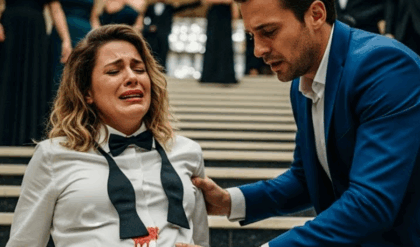
Newly hired maid plays piano with blind little girl, unaware her CEO father is watching from behind the door. The estate was quiet, almost too quiet. Set just beyond the city lights of New York’s bustling skyline, the King residence sat like a piece of modern sculpture, glass, steel, and stone.
Impressive in architecture, but cold in atmosphere. Elena Morgan stood at the front entrance with her small suitcase, looking up at the tall windows that reflected only gray clouds. 25 years old, her light blonde hair was half pulled back in a soft knot, the rest falling in gentle waves across her shoulders. She took a breath. her first day.
The agency had told her little about the family, just that it was a high-profile household, that the position required someone gentle, discreet, and dependable. The door opened with a quiet click. You are the new housekeeper, a voice asked. It belonged to an older woman with a tight bun and professional air. Mrs. Whitmore, the house manager. Yes, Elena Morgan. Follow me.
You will be in charge of light cleaning, meal assistance, and attending to Miss Ariel when needed. Mr. King prefers silence in the house. As they walked through the halls, Elena noticed everything was pristine but untouched, too clean, no photos on the walls, no laughter behind doors. Then she saw her.
At the end of the hallway sat a little girl in a soft pink dress, legs crossed beneath her, fingers trailing slowly across the fabric of the chair. Her eyes didn’t move to greet Elena. Ariel, Mrs. Whitmore said gently. “This is Elena. She will be staying with us for a while.” The girl tilted her head. “Hello,” she said softly. Elena knelt beside her. “Hi, Ariel. I love your dress.
” The girl gave a small, polite nod, but said nothing more. “She is blind, Mrs. Whitmore” explained once they moved away. “Since birth, she speaks little. Her father believes routine is best.” “And the mother,” Elena asked before realizing she should not. “Mrs. Whitmore’s expression didn’t change.” “Pasted 3 years ago.” That night, after dinner was prepared and the dishes cleared, Elena was assigned the upstairs wing to tidy. Most of the doors were closed.
She moved quietly, dusting, folding, rearranging books that had not been touched in months. Then she noticed one door was slightly a jar. She peeked inside. The room was dim, but filled with something almost sacred. A grand piano sat beneath a sheer draped window. Dust covered the lid.
A metronome sat frozen on a shelf beside framed sheet music. Her hand reached for the piano bench before she could think. She sat down carefully. She opened the lid. The keys were cold beneath her fingers. She pressed one, then another, and then softly she began to play. A melody came to her slowly, something she remembered from her childhood.
A lullabi perhaps, then something more playful, like a fairy tale waltz. She let her fingers dance, her heart guiding each note. Unbeknownst to her, small footsteps approached. Ariel had heard the sound from across the house. Drawn by the music, she followed it like a threat of light. For the first time since her mother’s passing, she walked toward the piano room without assistance, one hand brushing the wall until she reached the source. She pushed the door open.
Elena startled, she looked up and gasped softly. Ariel stood at the threshold. Her hands were out, palms turned slightly. I I heard light, Ariel whispered. Elena blinked. You heard light? The little girl nodded. the music. It felt warm, like sunlight. Elena smiled gently. “Would you like me to play more?” Ariel hesitated, then stepped forward, guided only by the sound. She reached the bench and carefully climbed up beside Elena.
“Can I touch the keys?” Elena placed her small hands at top the piano. “Of course.” As Elena played the fairy tale melody again, Ariel pressed one key, then another. Her face lit up, something unseen in her eyes coming to life. Just outside the door, slightly a jar, stood a tall figure.
Julian King, 36, in his dark tailored suit, had come searching for Ariel. He froze at the sound of the piano, something he had not heard in this house in years. his daughter, his late wife’s piano, a stranger playing music that made his child smile. He said nothing, just stood there motionless.
Something inside him, long buried, stirred, and for the first time in years, the house was no longer silent. The days passed quietly in the king household. But something had changed. Each evening after dinner, Elena would go to the music room. She never called Ariel. She didn’t need to. The moment her fingers touched the keys, the soft sound of footsteps would shuffle down the hall. Ariel never missed a night.
They sat side by side at the bench. Elena on the left, Ariel to her right. What started as a routine lullabi before bed slowly became a ritual, a shared space, a language without words, where neither had to explain why silence had once been safer than sound. Elena didn’t speak about her past, but her music did.
Her fingers, though steady, carried the ache of something unresolved. She avoided grand familiar pieces, instead returning to quiet tunes from her childhood, ones she hadn’t touched in years. Ariel noticed. “Your music sounds like it’s remembering something,” she said softly. One night, Elena paused, surprised. “Maybe it is. Do you miss someone?” Ariel asked.
The question stopped. Elena. She looked down at the keys, her hands still. “Yes,” she whispered. “My little sister, her name was Hazel. The silence that followed was full, not empty. She taught me to play. We used to dream of performing on big stages. Then she got sick. It happened fast. I was 17. After she died, I couldn’t bring myself to touch the piano again. Ariel didn’t say she was sorry.
She simply reached out and placed her small hand on top of Elena’s. That was enough. From that night on, their music changed. It wasn’t just notes. It was connection, healing. Elena began teaching Ariel as she wished she had been taught. Gently, patiently, without pressure. She guided the girl’s hands across the keys, helping her count the spaces between notes. Feel the length of an octave.
Then one evening, she tried something new. Elena placed Ariel’s hand over her own wrist. “Feel the rhythm,” she said, “Like dancing, but with your hands.” Ariel giggled. “It tickles.” But she focused. She learned. By the end of that week, Ariel could play the opening of a lullabi.
Her timing was uneven, her fingers hesitant, but the music was hers. What neither of them knew was that they were not alone. Julian watched from his office, the camera feed from the music room open on his monitor. At first, it was routine. Check the house, ensure safety. But now, each evening, he lingered. He watched Ariel lean into Elena’s shoulder. Watched her laugh.
Watched Elena smile, not like hired help, but like someone who belonged. Julian knew Elena’s resume. He had read every reference. But he hadn’t known about the music, about her grief, about the quiet strength she carried. She had entered his house with almost no sound. But now her presence echoed everywhere.
He never interrupted, never walked in while they played. He just listened. Sometimes when alone, he opened the drawer of his desk where an old family photo lay face down beneath paperwork. A photo of his wife seated at that very piano holding baby Ariel in her lap. The same piano that now sang again. He hadn’t heard it played in 3 years.
Now every night the music returned, fragile, honest, and full of something he thought he’d buried with his wife. Hope. There was a shift in the air. Subtle, but real. Ariel, once so quiet, had begun to hum softly at first, only when she thought no one was listening. in the mornings while brushing her hair.
At night before sleep, just little melodies drifting from her room like fireflies. Then came the piano. Elena noticed it one afternoon. Returning from the laundry room, she paused outside the music room, hearing something faint, hesitant. Through the half-open door, she saw Ariel seated alone at the bench, her hands searching for keys. The sight struck her in the chest.
She didn’t interrupt, just listened as the child pressed one note, then another, slowly forming a pattern from the night before. When Ariel noticed her, she looked up and smiled. “I was trying to find the part that felt like sunshine,” she said. Elena’s throat tightened. Later that week, Julian heard something unexpected. Passing Ariel’s bedroom, he heard her laugh, bright and unguarded. He paused.
She sat cross-legged talking to her stuffed rabbit, telling a madeup story. Then she stopped and asked, “Dad, did mommy ever play piano like Elena?” Julian’s breath caught. It was the first time in a year she’d mentioned her mother without tears. He stepped in and sat beside her. “She used to play all the time,” he said. “She taught music.
That’s how we met.” Ariel leaned into him. What was her favorite song? Julian hesitated. A piece she wrote herself. It didn’t have a name. She just called it our lullabi. She played it for you as a baby. Do you remember it? He looked down. I haven’t heard it in a long time.
That weekend, in the golden light of afternoon, Elena sat alone at the piano. Ariel had described a melody to her earlier, said she dreamed it. A tune soft like wind, warm like soup. It lingered all day, tugging at Elena. Now she followed it. She played slowly, a simple lullabi, minor chords wrapped inside major ones, soft, honest notes. Then the door creaked.
Julian stood in the doorway, his eyes fixed on her hands. He stepped forward, stunned. Why are you playing that? Elena turned. I didn’t know it was anything. Ariel hummed it in pieces. I just listened. Julian’s face pald. That melody, he whispered. That’s the one my wife composed. She never wrote it down, never taught it. Elena’s breath caught. I only followed what felt right, she said. But Julian turned and walked away.
Elena stood, unsure if she’d crossed a line. A few minutes later, he returned. In his hands, a small wooden music box, dusty with time. “I kept this since the day she died,” he said. “I never opened it.” He placed it gently on the bench, turned the key. A melody began to play. The same one, but it wasn’t mechanical.
It was a real piano recorded years ago. The voice of a mother saved for a daughter who could no longer see her. She made this,” Julianne said, his voice low so Ariel could hear her when she missed her. Elena covered her mouth overwhelmed. Just then, footsteps padded in.
Ariel stood in the doorway, head tilted, glowing. “That’s mommy,” she said softly. “She’s here, isn’t she?” She walked over, touched the box, and smiled. I knew I wasn’t dreaming. Elena blinked back tears. She looked to Julian. He stepped closer, resting a hand on her shoulder. You didn’t just follow your heart, he said. You’ve touched ours.
From that moment on, no one called Elena the maid again. The letter arrived one afternoon, tucked inside an envelope bearing the golden seal of the Harmonia Foundation, an organization known for supporting young musicians with disabilities. It was addressed to Julian King. He opened it casually, scanning the first few lines. Dear Mr.
King, we are honored to invite your daughter, Miss Ariel King, to perform at this year’s Harmonia Children’s Concert for Visually Impaired Youth. Julian frowned, read the rest, then folded the letter with a sigh. That evening, he stood at the doorway of the music room, watching as Ariel played piano with Elena beside her.
The girl’s fingers moved gently across the keys, a soft smile on her face. Elena whispered something, and they both laughed. Julian cleared his throat. “I received a letter today,” he said. “Someone invited Ariel to a concert.” Elena looked up. “That’s wonderful.” I declined, Julian said. Ariel’s fingers froze. Why? She asked. Julian hesitated.
It’s too much, too public, too risky. You might get hurt. I won’t, Ariel whispered. I just want to try. Julian’s voice softened, but stayed firm. You’re not ready. Then he turned and left. What he didn’t know was that Ariel had overheard more earlier. Outside his office, she’d heard him telling his lawyer he wouldn’t let his daughter be put on display or set up for failure.
That night, Ariel sat on her bed, pink dress wrapped around her knees, hugging her toy rabbit. “I guess I really am just a burden,” she whispered. Elena found her like that and sat beside her. “He thinks I’ll fail,” Ariel said. No, Elena replied gently. He’s just afraid. Sometimes fear sounds like doubt.
But you don’t think I’ll fail, do you? Elena looked at her, then smiled softly. No, I think you’re already amazing. Later, after Ariel fell asleep, Elena found a short video on her phone. Ariel playing during an early session. Her hands trembled at first, then steadied, producing a soft, lovely tune. Elena uploaded the clip and sent it to the Harmonia Foundation with a note.
She doesn’t know how brilliant she is. Maybe you can help her see it. A week later, a reply came. Ariel had been accepted. When Julian found out, he was furious. You went behind my back. She deserves this, Elena said. And deep down you know that she’s a child. She’s your daughter and she’s stronger than you think.
Julian’s voice dropped. If she gets hurt, she’ll be hurt worse if you keep dimming her light. The room fell silent. The night before the concert, the house was too quiet. Elena knocked gently on Ariel’s door. No answer. She opened it. The bed was empty. the window, a jar.
Julian’s face turned pale when she told him. They searched everywhere, the yard, the gates, the sidewalk. Then Elena stopped. I think I know where she is. 20 minutes later, they found her in the park near the lake, sitting alone on a bench with a small toy piano in her lap. Her fingers rested on the keys. Elena walked up slowly. Ariel.
The girl didn’t turn. I just wanted to play one song for mom. I thought maybe if she’s listening, she’d hear me. Julian stepped forward, voice unsteady. She hears you. Ariel turned toward him. I’m sorry I ran away, she said. I didn’t want to embarrass you. Julian knelt beside her, took her hand. You could never embarrass me.
I’m the one who’s sorry for being afraid of your courage. He nodded toward the piano. Will you play for both of us? Ariel gave a small nod. Then slowly she began to play soft notes, tender and familiar, a song her mother used to love. Julian wrapped his arms around her as the melody rose. And for the first time in years, it felt like they were more than father and daughter. They felt like a family.
The morning after the park, something shifted in the air. Julian sat quietly in his office staring at the photo on his desk. It was an old picture of his wife seated at the piano holding a much younger Ariel in her lap. Her smile in the photograph seemed to radiate warmth he had long tried to forget.
Later that day, Julian found Elena in the music room wiping down the keys with her usual care. She paused when she saw him at the door, uncertain if he had come to criticize again. He stepped inside slowly, his voice softer than usual. “I owe you an apology,” he said. Elena blinked in surprise.
“I tried to control everything,” Julian continued. “Out of fear. I thought if I kept the world small, I could keep Ariel safe, but I only ended up keeping her from feeling alive.” Elena gave a small nod, her voice gentle. You were trying to protect her. That is what parents do. Julian sat down on the edge of the piano bench. Her mother wanted to teach her piano.
She said it would help Ariel see in a different way, but I I said no. I was terrified. I imagined her getting frustrated, feeling different, getting hurt. I thought I was saving her from pain, but I was only stealing joy. Elena watched him carefully, sensing the weight of every word. Julian exhaled, then looked toward the hallway.
Is she awake? She is reading with her fingers in the library. Elena said, “I think she is calmer today.” Julian nodded and stood. Do you think she would let me play with her? Elena smiled. I think she would love that. Later that afternoon, Ariel sat beside the piano, her hands hovering above the keys, waiting. She had heard her father’s voice, but hadn’t expected what came next.
Julian entered the room with slow, measured steps. “Hi, sweetheart,” he said. She tilted her head, surprised. “Hi.” He walked to the piano and sat down beside her. “Would you let me play something with you?” he asked. Ariel hesitated, then she nodded. Julian looked to Elena, who was already placing the sheet music in front of them, but then he pushed it aside.
Let’s play the piece mom used to hum, he said. The one you played in the park. Ariel’s face lit up. I remember it. She placed her fingers on the keys. Julian waited until she reached the final stanza. Then, just as the melody began to slow, he lifted his hands and gently added a second layer.
His chords were deep, steady, soft. They wrapped around her notes like a warm embrace. Ariel stopped suddenly. Her fingers froze midnote. She tilted her head and listened carefully. “You know it?” she asked, stunned. Julian did not answer immediately. He kept playing, letting the last line fall into place.
When the piece ended, the room was silent. Ariel turned to him. That was you, she said. That was your sound. You finished it. Her hands reached out and touched his. How did you know? Julian’s voice was quiet. Because I remember her playing it for me once. The night before you were born.
Ariel leaned forward, resting her head against his shoulder. I thought I was the only one who remembered. You are never alone in remembering her, Julian said. She is in every note we play. Tears welled in Ariel’s eyes as she wrapped her arms around him. I missed this. I missed you. Julian held her tightly, his own eyes glassy with emotion.
“I am here now,” he whispered. “And I am not going anywhere.” Elena stepped quietly out of the room, leaving them in peace. That night, the sound of piano drifted softly through the house, not just from one player, but from two. And as the final notes echoed against the high ceilings, they carried more than music. They carried healing.
The concert hall was grand, filled with polished wood, velvet curtains, and rows of waiting seats that shimmerred under soft stage lighting. It was a special night, the annual children’s music showcase for youth with disabilities. Families filled the audience. Programs in hand, names circled in pride.
Backstage, Elena stood near the curtain, her hands trembling slightly as she straightened the bow on Ariel’s soft pink princess dress. The little girl beamed, her hair curled neatly, her posture tall and poised. She could not see the faces that would soon watch her, but she could feel the energy in the air. “You look beautiful,” Elena whispered, kneeling down to adjust the hem.
“Hiellell reached out, touching Elena’s cheek with delicate fingers. You are shaking,” she said. Elena smiled nervously. “It has been a long time since I stood near a stage. You do not have to play if you are scared.” But I want to,” Elena replied. “Because you are brave enough to.
” Just then, Julian appeared from the side hallway dressed in a tailored charcoal suit. He held a small bouquet of daisies, Ariel’s favorite. “Are you ready, sunshine?” he asked. Ariel nodded. Julian bent to hand her the flowers. She felt them with her hands, then handed them to Elena for safekeeping. I will take care of them until you are finished, Elena promised.
When Ariel’s name was announced, the room fell into an almost sacred silence. Julian led her gently onto the stage. As they reached the piano, he placed her hands on the bench and gave her a quiet squeeze on the shoulder. Then he stepped aside, returning to his seat in the front row, his heart pounding harder than he expected.
Ariel sat in stillness for a moment. The lights above cast a soft glow across her pink dress and pale hair. The Steinway before her gleamed under the stage lights. She reached out slowly, finding the middle sea with practiced ease. Her fingers paused, hovering. Then she began to play. The melody was soft, delicate, like a whisper. Lullabi for two sons, a piece born from two hearts across time.
The core theme came from her mother, once hummed as a bedtime tune, and now brought to life through Elena’s careful composition. Each note shimmerred with warmth as if Ariel were painting with sound. People in the audience leaned forward. Some closed their eyes. Some already held tissues in their hands. There was no showmanship, no drama, only the pure, honest music of a child who could not see but felt everything.
Julian sat motionless as the melody swelled into the bridge, his hands clenched together. He recognized the phrasing, a rhythm his wife used to hum while cooking, a small motif she had written in her notebook, unfinished. Now it was complete. Ariel’s fingers moved with care. Her left hand wavered slightly near the final passage. Then, as if sensing it in the air, she pressed the last cord, soft, sustained, glowing with feeling. The hall remained still for a heartbeat. Then Julian stood.
He began clapping, strong and steady. Others followed. The entire room rose in ovation. Some wept, some smiled. Elena stood behind the curtain, both hands over her mouth, tears shining in her eyes. Ariel turned her head slightly toward the sound of the applause. She tilted her chin and gave a small, almost shy smile.
She rose from the bench and walked to the edge of the stage, guided by the voice of the host who joined her. The microphone was lowered gently to her height. “I would like to dedicate that song,” she said softly. “To my mom, who used to sing it in pieces, and to the one who taught me how to feel light even though I cannot see it.
” Elena wiped her eyes, her breath caught in her throat. Julian looked up at his daughter and for the first time in years, let the tears fall freely down his cheeks. The music had ended, but something far more powerful had just begun. The concert was over, but its echo still lingered in every heart that had heard Ariel play.
Back at the estate, the once quiet halls now carried a soft warmth. Laughter had returned. So had music. But in her room, Elena stood quietly, folding the last of her clothes into a small, worn suitcase. Her fingers paused over the piano-shaped keychain Ariel had given her. It was time.
Her contract had always been temporary. From the beginning, she planned to leave after the performance to let the King family continue their journey. Without her, she had helped them heal. That was enough. Maybe it was better this way. She zipped up the suitcase, took one last look around the room that had become more than a space.
It had been shelter, a return to self, a place where music found her again. As she stepped out, Julian was already waiting. “You’re leaving,” he said softly. Elena nodded. “I should. The concert is done. Ariel is stronger. So are you.” Julian studied her, then gestured for her to follow. She hesitated, then walked beside him.
They moved through the house in silence until they reached a hallway she hadn’t noticed before. At the end was a freshly painted room. Sunlight poured in through wide windows. Shelves lined the walls, some filled with braille books. A warm, polished wooden floor reflected soft light. It was a music studio, bright, peaceful, designed for visually impaired children.
On one wall, painted in soft cursive, were the words, “Light in sound.” Elena turned to him, stunned. “This wasn’t here before.” “No,” Julian said. “It was built in the last few weeks. I waited until it was ready.” He handed her a folder. She opened it slowly. Inside was a contract. director of musical enrichment light and sound program. I want you to stay, Julian said.
Not just for Ariel, for every child who’s never been told they can create beauty. Elena shook her head overwhelmed. I’m not qualified. I don’t even have a degree. I left all of this behind. But you came back, he said gently. And you brought something only you could bring. He reached into his coat and pulled out a small velvet box. Inside was a silver hair clip shaped like a treble cliff.
Along its edge was an inscription. To the girl who helped my daughter see again. Elena’s eyes filled with tears. She doesn’t see with her eyes, Julian said, but she hears joy now. She hears memory. She hears her mother. You gave that back to her. Elena touched the clip, her hands trembling. I don’t know what to say. Say you’ll stay.
Say you believe music still belongs to you. She looked down, catching her faint reflection in the polished piano nearby. I thought when my sister died, I didn’t deserve joy anymore. That I wasn’t allowed to play. Julian stepped closer. But joy doesn’t erase grief. It honors it by keeping beauty alive.
Elena looked up and met his eyes. Do you really think I can do this? I do, he said softly. And so does Ariel. At that moment, a small voice echoed down the hallway. Ariel singing the melody they once played together. Elena smiled through her tears. She took the clip from the box and gently fastened it in her hair.
Then she looked at the contract once more and nodded. Yes. Yes, she would stay. Yes, she would believe again. Yes, she would play. A year had passed since the night Ariel first played on stage. The once silent mansion had changed, but more than that, so had the people inside it. NY’s table was no longer just a name. It had become a sanctuary.
A music studio filled each week with soft laughter, small hands-on keys, and melodies shaped by little fingers. Dozens of visually impaired children came through its doors, and Elena was at the center of it all. She was no longer the quiet housemaid with guarded eyes. Now she wore a flowing blue dress, her blonde hair loose over her shoulders.
Confidence followed her as she guided hesitant hands to middle sea or offered gentle encouragement with a smile. Julian came often, more often than he had reason to. He always said it was to support the studio financially, but everyone could see the warmth in his gaze when he looked at Elena. He helped set up chairs, brought tea, carried snacks, and he always stayed a little longer than needed. Ariel, once so withdrawn, now thrived.
Dressed in her favorite pink dress, she became the studio’s little assistant, patiently helping other children count steps to the bench, feel the keys, and settle in. One afternoon, as Julian handed Elena a cup of tea, their fingers touched, a pause, a glance, a smile, brief, but meaningful.
Later that week, Elena found a drawing tucked beneath her notebook made with raised paint and textured paper. three figures, a girl in a pink dress, a woman with long yellow hair, and a man in a colored shirt. Above them, written in braille, were the words, “Our family.” Tears filled her eyes. Julian stepped beside her, hand resting gently on her shoulder. “She draws from her heart,” he said.
“No one told her what a family looks like. She just knows.” That evening, after the students left, Julian asked Elena to stay and help clean up. When she returned to the studio, she stopped in her tracks. The lights had dimmed to a soft glow. A small bouquet of wild flowers sat in the corner. The grand piano stood covered with a white cloth. On it rested a single sheet of handwritten music.
For Elena, the light I didn’t know I needed. Julian sat at the piano. He looked up and smiled, then began to play. The melody was simple, familiar, echoes of lullabi for two sons, but with something new, a fullness, a quiet joy. When the last note faded, Julian rose and walked to her. He reached into his pocket and pulled out a small velvet box.
Then he knelt. “Elena,” he said, voice steady but tender. You brought light back into my life, into hers. Not by saving us, but by believing in us in love, in music. Will you marry me? Not to fix what’s broken, but to write something new together. Tears spilled freely as Elena nodded, unable to speak. Yes. Yes.
To love, to family, to a life she once thought was out of reach. Julian rose and embraced her just as Ariel came bounding into the room. She wrapped her little arms around both of them, laughing. In that moment, there were no ghosts left, only music, only love. By the studio entrance now hangs a framed photo.
Elena, Julian, Ariel, smiling together. Beneath it, carved into wood. Family is not who sees you, it’s who believes in your light. Thank you for joining us on this deeply moving journey. If Elena’s quiet resilience, Julian’s transformation, and little Ariel’s radiant strength touched your heart, then you understand what we believe here at Soul Stirring Stories that love, healing, and family can be born in the most unexpected ways.
Stories like this are why we do what we do. And if this one left a light in your heart, we would be so grateful if you’d subscribe to our channel and hit the hype button to support us. Your support helps us keep telling the stories that matter.
The ones that remind us that kindness still exists and that even in silence, music, and love, we’ll always find a way. Until next time, stay compassionate, stay inspired, and remember, every soul has a story. We’re here to tell the ones that stir yours. This is soul stirring stories.