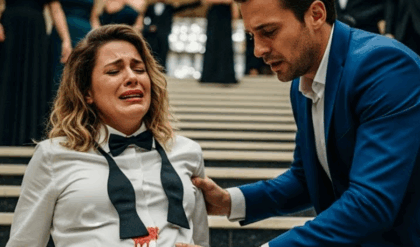
The crystal chandeliers cast warm light across the elegant ballroom of the Grand Metropolitan Hotel, where Chicago’s most influential business leaders had gathered for the annual Children’s Foundation charity gala. The evening represented months of planning with auction items worth millions and donation pledges that would fund educational programs throughout the city.
Standing near the auction display tables, Margaret Thornton adjusted her black evening dress and surveyed the room with the practiced eye of someone accustomed to hosting successful events. At 45, Margaret had built Thornon Industries into one of the most respected technology companies in the Midwest. But tonight, her focus was entirely on her 16-year-old daughter.
Isabella Thornton stood beside her mother, wearing an elegant navy blue dress that complimented her light brown hair, which was styled in a sophisticated updo for the formal occasion. To anyone observing from a distance, Isabella appeared to be the picture of a poised teenager from a privileged background, comfortable in the world of luxury and social expectations.
But those who looked more closely might notice that Isabella’s eyes held a certain weariness, and that she positioned herself where she could see the entire room while keeping her back to a wall. What they couldn’t know was that Isabella had been profoundly deaf since birth. And despite her obvious intelligence and her mother’s wealth, she often felt completely isolated in social situations like this one.
Margaret had tried everything money could buy to help Isabella feel included in their social circle. Private tutors, speech therapy, the finest hearing aids available, and enrollment in exclusive schools that claimed to serve students with diverse learning needs. But what Margaret hadn’t fully understood was that inclusion required more than expensive accommodations.
It required people who could communicate with Isabella in the language she actually used. As the evening progressed, Isabella found herself surrounded by well-meaning adults who spoke to her mother about her rather than to her directly. When people did address Isabella, they often spoke slowly and exaggerated their lip movements, assuming this would help her understand.
Few realized that Isabella communicated primarily through American Sign Language, and fewer still made any effort to learn even basic signs. The fundraising portion of the evening was in full swing when Isabella excused herself from a particularly awkward conversation with a board member who kept asking Margaret if Isabella could hear anything at all.
She walked toward the service corridor. Looking for a quiet space away from the overwhelming social dynamics she couldn’t fully participate in. That’s where she encountered Miguel Santos, who was refilling the water glasses at the auction tables. At 38, Miguel had worked as part of the hotel’s maintenance and catering staff for 5 years.
His blue work shirt and practical demeanor marked him as someone from a completely different world than the wealthy attendees. But when he looked up and saw Isabella’s frustrated expression, his response was immediate and unexpected. “Are you all right?” Miguel asked, but instead of speaking the words aloud, his hands moved in the fluid, expressive gestures of American sign language.
Isabella’s eyes widened with surprise and relief. For the first time all evening, someone was communicating with her in her native language rather than expecting her to navigate theirs. You know, sign language. Isabella signed back, her movements quick with excitement at finding someone who could truly understand her.
Miguel smiled and continued signing. My younger brother is deaf. I learned ASL when he was little, and I’ve been signing for 20 years now. I noticed you looked frustrated, and I wondered if anyone here was actually talking with you instead of about you. Isabella felt tears of gratitude forming in her eyes.
This janitor, who everyone else in the room probably considered invisible, had seen her in a way that none of the distinguished guests had managed. “Most people here don’t sign,” Isabella explained with her hands. “They’re all very nice to my mother, but they treat me like I’m not really here or like I’m some kind of inspiration just for existing.
” Miguel nodded with understanding. People often don’t know how to act around disability, so they either ignore it completely or make it the only thing they see about you. Neither approach actually helps anyone communicate. As they continued their conversation, Isabella found herself relaxing for the first time all evening.
Miguel asked her about her interests, her school experiences, and her thoughts about the charity event, treating her as a complete person rather than a problem to be solved or an inspiration to be admired. What do you want to do after high school? Miguel asked genuinely curious about her plans. I want to study engineering like my mom, Isabella signed enthusiastically.
Specifically, I want to design better communication technology for deaf and heart of hearing people. There are so many innovations that could make the world more accessible, but most hearing engineers don’t understand what we actually need. Miguel’s respect for her intelligence and ambition showed clearly in his expression.
That sounds like incredibly important work. The world needs more engineers who understand accessibility from personal experience. Their conversation was interrupted when Margaret appeared in the service corridor, having noticed Isabella’s absence from the main ballroom. Isabella. There you are, Margaret said, then paused as she noticed Miguel.
I’m sorry. Is everything all right here? Miguel stepped back respectfully, understanding his place in the social hierarchy of the event. But Isabella quickly moved to bridge the gap between her two worlds. “Mom, this is Miguel.” Isabella signed, then spoke aloud for her mother’s benefit. “He’s been having an actual conversation with me in ASL.
It’s the first real talk I’ve had all evening.” Margaret looked at Miguel with new interest. Realizing that this hotel employee had accomplished something that none of her wealthy, educated friends had managed. “You know sign language?” Margaret asked clearly impressed. “Yes, ma’am,” Miguel replied respectfully.
“My brother is deaf, so our whole family learned ASL when he was young. I was just telling Isabella how impressive her career goals sound.” Margaret felt a mixture of gratitude and shame as she realized how little effort her own social circle had made to include Isabella meaningfully in their conversations.
Miguel, I have to ask you something, Margaret said thoughtfully. Isabella has been struggling to connect with her peers and feel included in social situations. Would you consider tutoring her in confidence building and perhaps helping some of her friends learn basic sign language? Miguel looked surprised by the offer. Mrs.
Thornton, I’m honored that you’d trust me with something so important, but I’m not a professional tutor. I just happen to know ASL because of my family situation. Isabella jumped into the conversation, signing rapidly to Miguel while speaking aloud for her mother. Miguel, you’ve made me feel more understood in 20 minutes than most people do in 20 days.
You don’t need a teaching degree to help other people learn how to communicate respectfully with deaf people. Margaret watched this exchange with growing realization about what her daughter truly needed. Not more expensive accommodations or specialized programs, but simply people who were willing to meet her where she was and communicate in her language.
Miguel, what if we approached this differently? Margaret suggested Thornton Industries has been looking for ways to improve our accessibility initiatives. What if I hired you as a consultant to help us understand how to make our workplace and our social events more inclusive for deaf and heart of hearing employees and guests? Miguel was stunned by the unexpected offer. Mrs.
Thornton, I don’t have any business experience or formal credentials in accessibility consulting. But you have something more valuable, Margaret replied. You have lived experience, cultural competency, and the ability to help hearing people understand how to interact respectfully with deaf people. That’s exactly what we need,” Isabella beamed with excitement as she watched her mother finally understand what inclusion actually looked like. “Miguel,” Isabella signed.
“This could be amazing. you could help create programs that actually work for deaf people instead of programs that make hearing people feel good about helping. 6 months later, Miguel had become Thornton Industries director of accessibility and inclusion, developing training programs that were being adopted by companies throughout the region.
His first initiative had been establishing ASL classes for employees and hosting social events that were designed to be fully accessible rather than simply accommodating. More importantly, Isabella had found her voice as an advocate for accessibility in technology. Working with Miguel, she had developed a peer mentoring program that connected deaf teenagers with adults who could provide both practical support and career guidance, the partnership between the wealthy CEO’s daughter and the hotel janitor had created Ripple, effects that extended
far beyond their initial meeting. Miguel’s brother had been hired as a junior developer at Thornton Industries, and several other deaf employees had been recruited specifically for their unique perspectives on accessible design. At the next year’s charity gala, the event featured live ASL interpretation, visual announcements, and communication cards that allowed hearing attendees to practice basic sign language with deaf guests.
Isabella served as the evening’s youth speaker, addressing the audience about the importance of inclusion that goes beyond accommodation. Standing at the podium with Miguel providing interpretation, Isabella spoke about how true accessibility requires listening to the communities being served rather than making assumptions about what they need.
Last year, I felt invisible at this event despite being surrounded by people,” Isabella said, her words flowing confidently as Miguel’s hands provided simultaneous translation. The difference wasn’t in the expensive accommodations, but in finding one person who took the time to communicate with me in my language. She looked out at the audience, which now included several deaf guests and interpreters.
Real inclusion happens when we stop trying to fix people and start building bridges between communities. It happens when a janitor teaches a CEO about accessibility and when a teenager’s frustration becomes the foundation for systemic change. Margaret watched from the audience. Amazed at how much her understanding of her daughter’s needs had evolved.
The millions she had spent on specialized programs pald in comparison to the impact of one authentic connection between Isabella and someone who truly understood her experience in the service corridor where they had first met. Miguel and Isabella now maintained a small display about deaf culture and ASL visible to hotel staff and guests alike.
It served as a reminder that the most important conversations often happen in unexpected places between people who might never meet if not for chance and the willingness to see each other as complete human beings. The billionaire’s daughter had learned that being truly heard had nothing to do with sound and everything to do with finding people who were willing to listen in whatever language she chose to speak.
And the janitor had discovered that his life experiences, which he had never considered particularly valuable, could become the foundation for transforming how entire communities thought about inclusion and accessibility. Thank you for listening to this story about the power of authentic communication and true inclusion.
If this tale inspired you to think about how you might better include people with disabilities in your community, please like this video. Share it with someone who believes in the importance of accessibility and subscribe for more stories celebrating the bridges we can build between different communities. We’d love to hear in the comments about times when someone took the effort to communicate with you in your preferred way or when you learned something important from someone whose experiences were different from your own. Remember, inclusion isn’t
about fixing or inspiring people. It’s about creating spaces where everyone can participate fully and authentically.